Introduction
In our previous lesson, we examined peak-load pricing, a strategy for managing fluctuating demand with fixed capacity. We will now turn to another crucial area of strategic pricing, one that focuses on deterring or eliminating competition. This lesson addresses the important distinction between preventing rivals from entering a market and actively driving existing ones out.
Today's learning outcome is to calculate the limit price to deter market entry and identify predatory pricing by comparing price to cost. We will first develop a formal model to calculate the exact price an incumbent firm can set to make entry unprofitable for a potential rival—a strategy known as limit pricing. Then, we will define predatory pricing and establish the cost-based rules used to identify it. Your quantitative background will be valuable as we work through the algebra of these strategic models.
Part 1: Limit Pricing - Keeping Competitors Out
Limit pricing is a strategy where a dominant incumbent firm sets its price low enough to discourage potential competitors from entering the market. The core idea is for the incumbent to forgo maximizing its short-run monopoly profit in favor of securing longer-term profits by maintaining its monopoly status.
This strategy relies on a key assumption, often framed in a Stackelberg model context: the potential entrant believes the incumbent will not change its output level after entry. The incumbent, anticipating this, chooses a specific output level, (the limit quantity), which results in a market price, (the limit price), that is just low enough to make entry unprofitable for the newcomer.
The graph below, known as Bain's Limit Pricing Model, illustrates this concept.
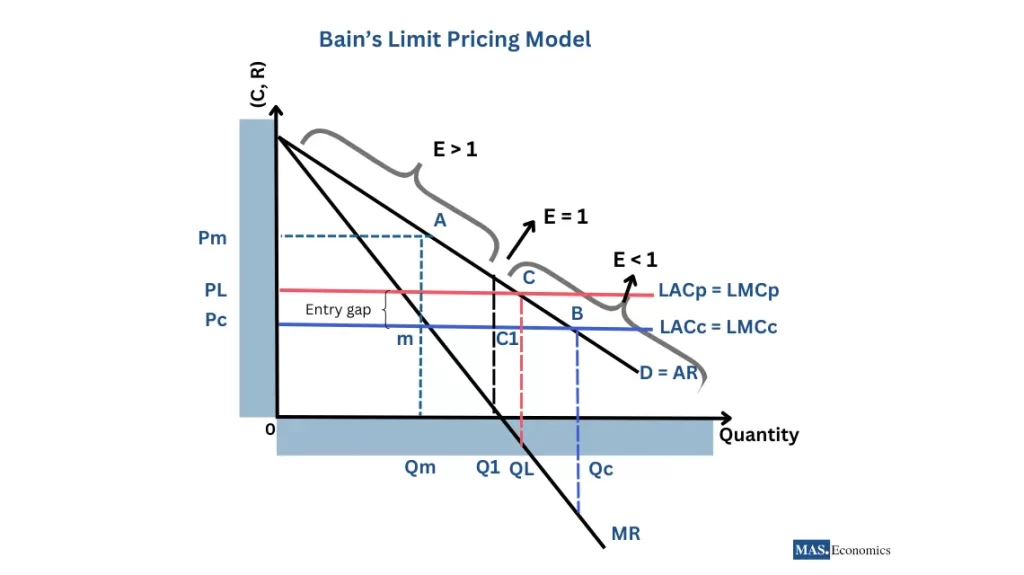
In the model depicted, the potential entrant has a higher long-run average cost curve () than the incumbent (), perhaps due to economies of scale, brand loyalty, or other advantages enjoyed by the established firm. The incumbent can produce a quantity , leading to the limit price . At this price, the entrant cannot cover its average costs, and thus, will not enter the market. The "Entry gap" represents the range of prices where the incumbent makes a profit, but entry is still deterred.
Part 2: Calculating the Limit Price
To calculate the limit price, we need to model the entrant's decision-making process. The key is to find the output level for the incumbent that drives the entrant's potential profit to zero. Let's build a model with linear demand and costs, which is a common setup for these problems.
A potential entrant will only enter a market if it expects to earn a non-negative economic profit. The entrant's profit () depends on the price it receives, its production costs, and any sunk costs of entry (). Sunk costs are unrecoverable expenses like specialized equipment or initial marketing campaigns, and they are critical to the limit pricing model.
To deter entry, the incumbent must set its output high enough so that the resulting market price leaves no profitable opportunity for the entrant. The following reading provides a formal derivation of the limit quantity and price.
[PDF] Econ 640 Dominant Firm Analysis and Limit Pricing
This document provides a rigorous mathematical derivation of the limit price. It is well-suited to your preference for formal analysis.
Please read the section titled "General Example". This section sets up a model with a linear market demand curve (P = a - bQ), an incumbent, and a potential entrant with a sunk entry cost e. Follow the derivation to see how the entrant's profit function is formulated. Then, focus on the logic used to find the incumbent's output level (Q) that makes the entrant's profit (\pi_f) equal to zero.
As you saw in the reading, the entrant's maximum possible profit, given the incumbent's output , is:
where and are parameters of the inverse demand curve, is the entrant's marginal cost, and is the sunk entry cost.
To deter entry, the incumbent must choose a limit quantity, , such that . Setting the equation above to zero and solving for gives us the limit quantity:
The limit price, , is the price that results from this quantity being placed on the market:
Notice how the limit price depends on the entrant's marginal cost () and the sunk cost of entry (). A higher sunk cost makes it easier for the incumbent to deter entry (i.e., it can set a higher limit price).
A Numerical Application
Let's apply these formulas. The following reading provides a concise, step-by-step numerical example that solidifies the calculation process.
[PDF] Chapter 12: Limit Pricing and Entry Deterrence
This resource from a course instructor's manual walks through a typical exam-style problem on calculating the limit output.
Read through "Problem 1" on pages 76-77. This problem takes a slightly different but equivalent approach by first deriving the entrant's reaction function and then finding the incumbent's output that makes the entrant's optimal quantity zero. This reinforces the strategic nature of the interaction.
Part 3: Predatory Pricing - Driving Competitors Out
While limit pricing is about preventing entry, predatory pricing is an aggressive and often illegal strategy aimed at driving existing competitors out of the market. After the rivals have exited, the predator firm can raise prices back to monopoly levels and recoup its losses.
The key challenge for regulators and courts is to distinguish legitimate price competition from illegal predatory pricing. The generally accepted standard revolves around comparing the firm's price to its costs.
-
Pricing below Average Variable Cost (AVC): This is almost always considered predatory. There is no economically rational reason for a firm to sell a product for less than the variable cost of making it, unless the goal is to eliminate competition. A firm pricing below its AVC is not only failing to cover any of its fixed costs but is also losing money on every single unit it sells.
-
Pricing between AVC and Average Total Cost (ATC): This is a grey area. A firm might price below its ATC in the short run if it needs to cover its variable costs and contribute at least something toward its fixed costs (as we saw with the shut-down rule in perfect competition). However, if this pricing strategy is part of a deliberate plan to eliminate rivals and there's a high likelihood the firm will later raise prices to recoup losses, it can be deemed predatory.
The graph below provides a clear visual of a firm engaging in predatory pricing.
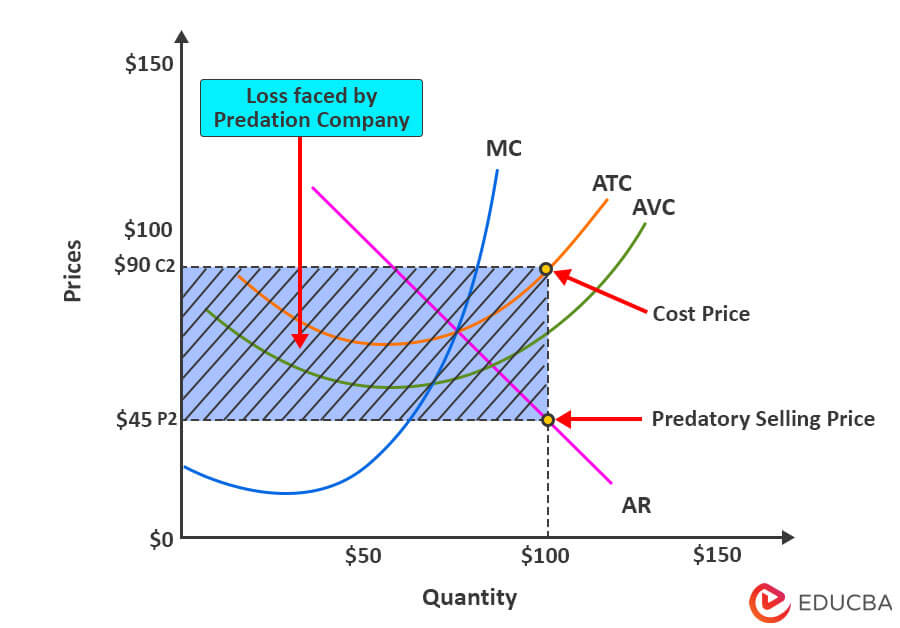
In this example, the firm is selling at a price of $45. At the production level of 100 units, its average total cost is $90. By pricing below its ATC, the firm is intentionally incurring a loss. If this price is also below the costs of its competitors, it could drive them out of business. To determine if this is definitively predatory, we would need to know the firm's Average Variable Cost. If $45 is below AVC, it's a clear case of predation. If it's between AVC and ATC, as depicted, further analysis of the firm's intent and market structure would be required.
Conclusion
In this lesson, we have dissected two powerful strategic pricing tools related to competition. We moved from the preventative strategy of limit pricing to the aggressive strategy of predatory pricing. You are now equipped to model and calculate the prices central to these strategies.
Key Takeaways:
- Limit Pricing is a strategy to deter entry by setting a price low enough to make the market unprofitable for potential rivals.
- The limit price is calculated by finding the price that drives an entrant's potential economic profit to zero, and it is heavily influenced by the entrant's costs, especially sunk costs.
- Predatory Pricing is a strategy to eliminate existing rivals by setting prices at a level that forces them to exit the market.
- A key test for identifying predatory pricing is comparing price to cost. Pricing below Average Variable Cost (AVC) is a strong indicator of predation, while pricing between AVC and Average Total Cost (ATC) requires more evidence of anti-competitive intent.
In our next lesson, we will explore another sophisticated pricing method: the two-part tariff. This strategy, used by everything from golf clubs to printer manufacturers, involves charging customers both a fixed access fee and a per-unit price.