Introduction
Welcome to our next lesson on advanced pricing strategies. In our last session, we focused on how firms price strategically to manage competition, exploring limit pricing to deter entry and predatory pricing to eliminate rivals. Today, we shift our focus from pricing against competitors to pricing schemes designed to extract the maximum possible value from consumers.
This lesson's learning outcome is to calculate the optimal two-part tariff structure, consisting of a fixed fee and a per-unit price. A two-part tariff is a common strategy you've likely encountered, used by businesses from gyms and golf clubs (membership fee + per-use fee) to video game consoles (console price + price per game). We will begin by analyzing the simplest case with a single type of consumer and then, drawing on your quantitative skills, we will develop and solve the more complex model for a market with different consumer types.
Part 1: The Basic Two-Part Tariff with a Single Consumer Type
A two-part tariff consists of two separate charges to the consumer:
- An access fee (T): A fixed charge for the right to purchase the product. This could be a membership fee, a cover charge, or the price of the hardware required to use software.
- A usage price (P): A price paid for each unit of the product consumed.
The firm's goal is to set and to maximize its profit. When all consumers are identical, the strategy is straightforward and powerful. The firm can capture the entire consumer surplus. The method is as follows:
- Set the per-unit price (P) equal to the marginal cost (MC). Why? This price encourages the consumer to purchase the maximum efficient quantity of the good—the same amount they would consume in a perfectly competitive market. This maximizes the total surplus (consumer + producer) generated by the transaction.
- Set the access fee (T) equal to the consumer's entire consumer surplus (CS) at that price. Since the consumer still breaks even (the value they get is exactly equal to what they pay in total), they will accept the deal.
This allows the firm to convert all potential consumer surplus into profit.

Let's illustrate with the example from the graph. The demand is and marginal cost is constant at .
- The firm sets the usage price .
- At this price, the consumer demands a quantity found by plugging into the demand equation: , which gives .
- The consumer surplus is the area of the triangle: .
- The firm sets the access fee .
The firm's total profit from this consumer is the sum of the profit from the access fee and the profit from per-unit sales:
The firm has successfully extracted all the surplus.
[PDF] RECITATION NOTES #6 - Price Discrimination and Two Part Tariff
These notes from MIT provide a formal definition of the two-part tariff and a clear explanation of the profit-maximization process for the single-consumer case.
First, read the definitions in section 5.1 and the necessary conditions in 5.2. Then, focus your attention on section "5.3.1 A single kind of consumer". This section formalizes the two-step process we just discussed.
Part 2: Two-Part Tariff with Different Consumer Types
The real challenge and analytical substance of two-part tariffs arise when a firm serves consumers with different demands but cannot charge them different fees. This is a form of second-degree price discrimination, where the firm designs a pricing scheme that causes consumers to self-select.
Imagine a firm facing two types of consumers, one with high demand and one with low demand.
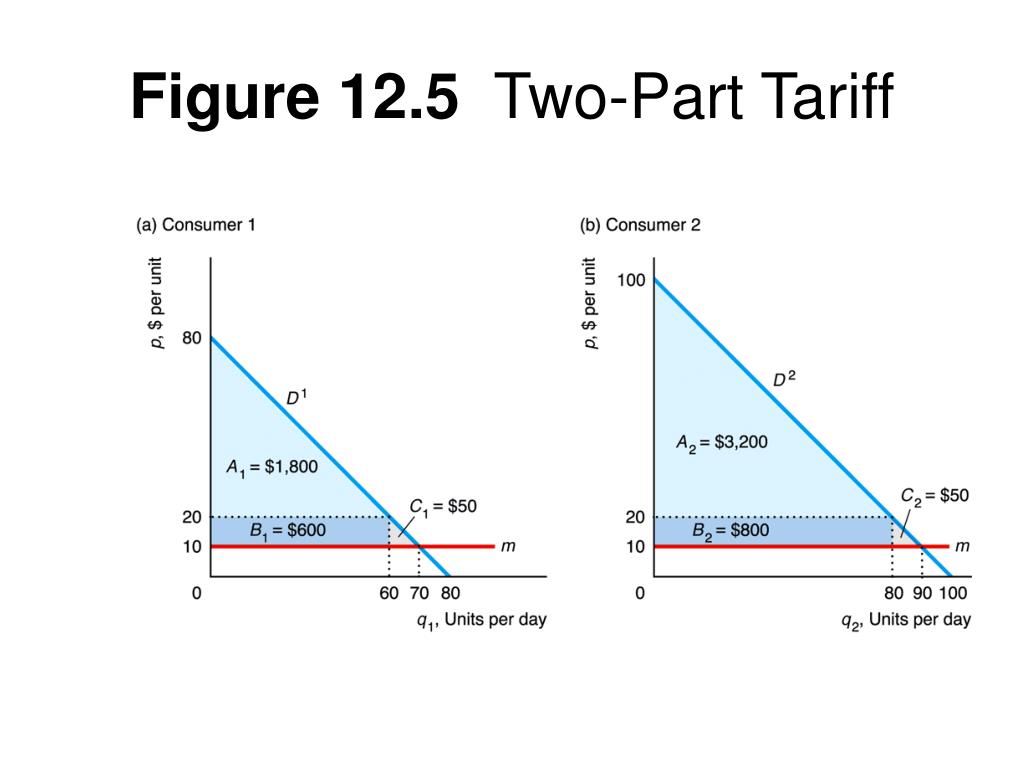
The firm must set a single access fee, , and a single per-unit price, . The core trade-off is this:
- If the firm sets the fee to capture the high-demand consumer's surplus, the low-demand consumer will refuse to pay, as the fee exceeds the surplus they would receive. The firm would only serve the high-demand market.
- To serve both markets, the firm must set the fee no higher than the surplus of the low-demand consumer. This ensures both types find it worthwhile to pay the fee. But in doing so, the firm leaves the high-demand consumer with a significant amount of surplus (an "information rent").
The optimal strategy involves a delicate balance. The firm will:
- Set the access fee equal to the consumer surplus of the low-demand consumer.
- Set a per-unit price that is greater than marginal cost (MC).
You might wonder, why set ? The simple strategy from Part 1 maximized the total surplus to be extracted. Here, however, by raising the price above marginal cost, the firm generates profit on every unit sold to both types of consumers. This comes at the cost of reducing the total consumer surplus available, which in turn shrinks the access fee the firm can charge. The optimal price is the one that perfectly balances these two effects—the gain from per-unit profit versus the loss in fee revenue—to maximize total profit.
Calculating the Optimal Tariff
Finding this optimal price requires calculus. The process is as follows:
- Define the demand curves for the low-demand group () and the high-demand group ().
- Write an expression for the consumer surplus of the low-demand group as a function of price, . This will be the access fee, so .
- Construct the firm's total profit function, . Assuming there are low-demand consumers and high-demand consumers, the function is:
- Substitute the expressions for , , and into the profit function so that is solely a function of .
- Take the derivative of the profit function with respect to price, , and set it to zero.
- Solve the resulting equation for the optimal price, .
- With , you can find the optimal fee and calculate the maximum total profit.
The following video provides a clear, step-by-step demonstration of this entire process with a numerical example.
Two Part-Tariff with Different Consumers
The video "Two Part-Tariff with Different Consumers" by Economics in Many Lessons walks through the setup and solution for this exact problem. The presenter first considers suboptimal strategies before deriving the profit-maximizing price and fee using calculus.
Please watch the final segment of the video, from the optimal calculation. Pay close attention to how the profit function is constructed and how the derivative is used to find the optimal price.
The Theory Behind the Method: Constraints and Information Rents
Your background in formal reasoning invites a deeper look at the theory underpinning this calculation. The problem can be framed using participation constraints (PC) and incentive compatibility constraints (IC).
- PC: Each consumer's net utility (surplus minus fee) must be non-negative for them to participate.
- IC: The firm might offer different "deals" (quantity-fee bundles), and each consumer must prefer the one designed for them. In our simpler case with one tariff, this means both must prefer buying over not buying.
To maximize profit, the firm will raise the fee as high as possible. The limit is the low-demand consumer's surplus; any higher and they drop out. Thus, the low-demand consumer's participation constraint is binding: . This leaves them with zero net surplus.
The high-demand consumer, however, gets to keep any surplus they have in excess of the fee: . This positive surplus is their information rent. It is a reward for having a high demand that the firm cannot perfectly identify and exploit. The firm's strategy of setting is, in part, an attempt to reduce this information rent by lowering the quantities purchased, even though it also lowers the fee it can charge everyone.
The handout below formalizes this using a more general utility framework, which should resonate with your interest in rigorous models.
[PDF] Adverse Selection Handout on Two-part tariffs (Second-degree price ...
This document provides a graduate-level treatment of the problem. While more abstract than needed for the exam, it rigorously proves why certain constraints bind and others do not.
I suggest skimming the section "Several (or menu) two-part tariffs" on pages 6-7. You don't need to absorb all the math, but notice the formal setup with PC and IC constraints. The discussion shows precisely why the low-demand customer's participation constraint (PCL) and the high-demand customer's incentive compatibility constraint (ICH) are the ones that end up being binding, which is the theoretical foundation for the method we've used.
Conclusion
In this lesson, we have added the two-part tariff to your toolkit of advanced pricing strategies. You are now equipped to calculate the optimal structure for this common pricing model in different scenarios.
Key Takeaways:
- A two-part tariff comprises a fixed access fee () and a per-unit price ().
- When all consumers are identical, the optimal strategy is to set and charge a fee equal to the entire consumer surplus.
- When consumers have different demands and must be charged a uniform tariff, the optimal strategy typically involves setting and an access fee equal to the surplus of the low-demand consumer group.
- Finding the optimal price in the multi-consumer case requires setting up a profit function that incorporates both fee revenue and per-unit profit, and then maximizing it with respect to price using calculus.
Our exploration of sophisticated pricing continues in the next lesson, where we will examine bundling. This strategy, which involves selling multiple products together as a package, provides another powerful way for firms to capture consumer surplus.