Introduction
In our previous lesson, we explored the two-part tariff, a clever pricing mechanism for extracting consumer surplus. We saw how firms can maximize profit by setting a combination of a fixed access fee and a per-unit price, and how the optimal strategy changes when dealing with different types of consumers. Today, we continue our investigation into advanced pricing strategies by examining another powerful tool: bundling.
This lesson focuses on calculating profit-maximizing bundle prices and comparing the profitability of selling products as a package versus selling them separately. You've encountered bundling in many forms, from software suites like Microsoft Office and cable TV packages to set menus at restaurants. We will unpack the economic logic behind this strategy and, in line with your preference for quantitative analysis, work through the precise calculations needed to determine when and how to bundle effectively.
Part 1: The Logic of Bundling
At its core, bundling is a form of price discrimination. It allows a seller to capture more consumer surplus by packaging goods together, particularly when different consumers have different valuations for the individual items. The ideal condition for bundling to be more profitable than selling goods separately is when consumer preferences are negatively correlated. This means that a consumer group with a high willingness to pay for good A has a low willingness to pay for good B, while another consumer group has the reverse preference.
By bundling the goods, the seller can effectively "average out" these preferences. The combined value of the bundle tends to be more uniform across different consumer types than the values for the individual products. This homogeneity allows the firm to set a single bundle price that captures a large portion of the market without leaving too much surplus on the table for any single group.
Let's begin by watching a video that introduces this concept and sets up the analytical framework.
Intermediate Microeconomics: Bundling
This video, "Intermediate Microeconomics: Bundling" by Ben Zamzow, provides an excellent introduction to the topic. The instructor clearly explains the conditions under which bundling is likely to be a useful strategy.
Please watch the beginning of the video, from the introduction. Pay close attention to the discussion of negatively correlated preferences and why this creates a good opportunity for bundling.
The fundamental insight, first articulated by George Stigler using the example of movie distribution, is that bundling can increase revenue by leveraging these differences in consumer valuation.
[PDF] Commodity Bundling and Tie-In Sales
This chapter from a standard industrial organization textbook formalizes the concepts we're discussing. It begins with Stigler's classic story and then moves to the more formal Adams and Yellen model that underpins modern analysis of bundling.
First, read the introduction, starting from the initial example. This will solidify the intuition. Then, read the next section, which introduces the formal definitions and graphical representations of separate pricing, pure bundling, and mixed bundling (formal definitions). While our focus is on comparing separate pricing and pure bundling, understanding mixed bundling provides important context.
Part 2: Profit Calculation and Comparison
Now we turn to the central task: calculating the profit-maximizing prices under separate sales and pure bundling, and comparing the results to determine the optimal strategy. This is a systematic process of evaluating all viable price points for each strategy.
Strategy 1: Separate Pricing
When selling goods separately, the firm treats each product as an independent monopoly pricing problem. The process is as follows:
- For each good, identify the possible prices you could charge. These are typically the reservation prices of the different consumer types.
- For each potential price, determine how many units will be sold (i.e., how many consumer types have a reservation price at or above this level).
- Calculate the total profit (Total Revenue - Total Cost) for each price point.
- Select the price for each good that yields the highest profit for that good.
- The total maximum profit under separate pricing is the sum of the maximum profits from each good sold independently.
Strategy 2: Pure Bundling
When using a pure bundling strategy, the goods are only available as a package.
- For each consumer type, calculate their reservation price for the bundle. Assuming the goods are not complements, this is simply the sum of their reservation prices for the individual goods ().
- Identify the possible bundle prices you could charge. These are the bundled reservation prices you just calculated.
- For each potential bundle price, determine how many bundles will be sold.
- Calculate the total profit for each bundle price. Remember that the cost per bundle is the sum of the marginal costs of the individual goods ().
- Select the bundle price that yields the highest profit.
The Comparison
Finally, you compare the maximum profit achievable with separate pricing against the maximum profit from pure bundling to decide which strategy is superior.
The following video segments walk through this exact calculation process using a clear numerical example.
Intermediate Microeconomics: Bundling
We will continue with the "Intermediate Microeconomics: Bundling" video. The instructor now works through the numbers to find the optimal strategy.
First, watch the calculation for separate pricing profits. Notice how he considers both pricing high (selling to one consumer) and pricing low (selling to both). Then, watch the segment on pure bundling profits. This demonstrates the complete method for comparing the two strategies.
Part 3: A Worked Example
Let's solidify your understanding by working through a typical exam-style problem. Consider the following scenario for "Ginnie's Gym Refreshment Bar," which sells to two types of customers: those who work out "Early" and those who work out "Late."
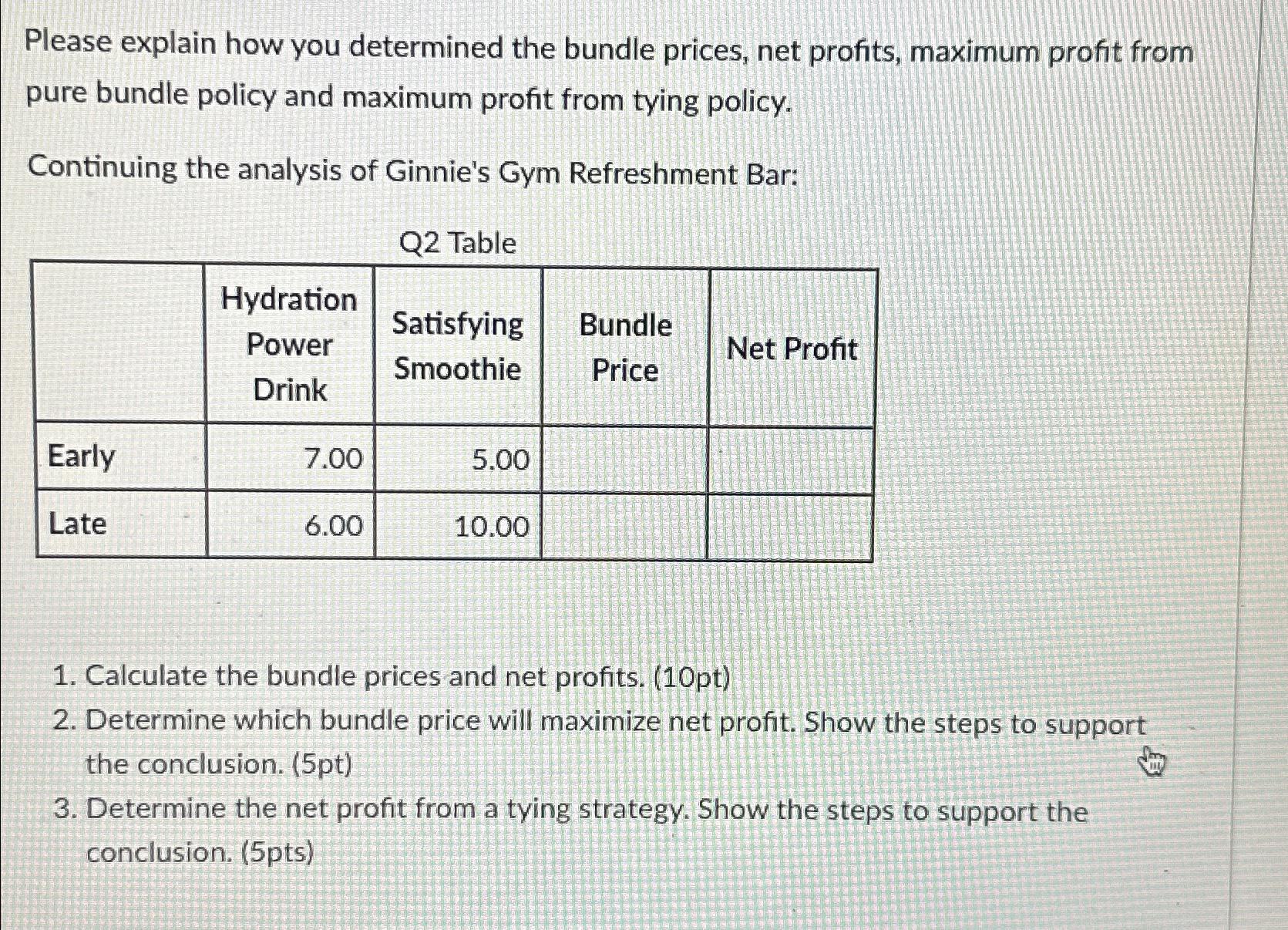
Let's assume, for simplicity, that the marginal cost of producing each item is zero. Our goal is to find the profit-maximizing strategy.
1. Analyze Separate Pricing
-
Hydration Power Drink:
- If we price at $7.00, only the Early customer buys. Profit = $7.00.
- If we price at $6.00, both customers buy. Profit = 2 × $6.00 = $12.00.
- Optimal Price for Drink: $6.00, yielding a profit of $12.00.
-
Satisfying Smoothie:
- If we price at $10.00, only the Late customer buys. Profit = $10.00.
- If we price at $5.00, both customers buy. Profit = 2 × $5.00 = $10.00.
- Optimal Price for Smoothie: Either $5.00 or $10.00, yielding a profit of $10.00.
-
Total Profit from Separate Pricing:
- The maximum total profit is $12.00 (from the drink) + $10.00 (from the smoothie) = $22.00.
2. Analyze Pure Bundling
-
Calculate Bundle Valuations:
- Early Customer's bundle value = $7.00 (drink) + $5.00 (smoothie) = $12.00.
- Late Customer's bundle value = $6.00 (drink) + $10.00 (smoothie) = $16.00.
Notice the negative correlation: the Early customer values the drink more and the smoothie less, while the Late customer has the opposite preference. This is a classic setup where bundling might be profitable.
-
Determine Optimal Bundle Price:
- If we set the bundle price at $16.00, only the Late customer buys. Profit = $16.00.
- If we set the bundle price at $12.00, both customers buy. Profit = 2 × $12.00 = $24.00.
- Optimal Bundle Price: $12.00, yielding a profit of $24.00.
3. Compare Strategies
The profit from pure bundling ($24.00) is greater than the profit from selling the items separately ($22.00). Therefore, the firm should adopt a pure bundling strategy.
For a more detailed walkthrough with four customers, which demonstrates the same principles on a slightly larger scale, you can study the numerical example in the textbook chapter you reviewed earlier.
[PDF] Commodity Bundling and Tie-In Sales
This section provides another complete numerical example that compares simple monopoly pricing (separate pricing), pure bundling, and mixed bundling.
Focus on the tables and calculations for "separate pricing" and "pure bundling". Work through the logic to see how the profits of $750 and $1,000 are derived, confirming that pure bundling is superior in that case.
Conclusion
In this lesson, we have demystified the strategy of bundling. We've seen that its power lies in its ability to smooth out heterogeneous consumer valuations, particularly when those valuations are negatively correlated. You are now equipped with the analytical method to calculate and compare the profitability of separate pricing versus pure bundling.
Key Takeaways:
- Bundling is a pricing strategy where two or more products are sold together as a package.
- It is most effective when consumer demands for the individual products are negatively correlated.
- To find the optimal strategy, you must systematically calculate the maximum possible profit under both separate pricing and pure bundling.
- For separate pricing, you optimize the price for each product individually. For pure bundling, you optimize a single price for the entire package.
- The final step is to compare the total profits from each strategy and choose the higher one.
This lesson concludes our module on Advanced Pricing Strategies. We have covered a range of powerful techniques firms use to move beyond simple monopoly pricing. In our next module, we will broaden our scope to analyze situations where markets themselves fail to produce efficient outcomes, a topic known as Market Failures, which will introduce new quantitative challenges related to externalities, public goods, and information asymmetry.