Introduction
In our last lesson, we established the long-run relationship between the money supply and the price level using the Quantity Theory of Money. We saw that controlling the growth of money is fundamental to managing inflation. This leads us to a critical practical question: how does a central bank actually manage the money supply?
Today, we will answer that question by examining the primary tools of monetary policy. Your learning outcome is to calculate the impact of various monetary policy tools (open market operations, reserve requirements, and the policy rate) on the money supply and the equilibrium interest rate. We will move from the theoretical "what if" to the operational "how-to," exploring the specific mechanisms the central bank uses to implement its decisions. Your background in statistics and quantitative reasoning will be particularly useful as we model these effects and solve for equilibrium outcomes.
The Money Market: A Quick Review
Before we dive into the tools, let's recall the basic framework of the money market. The market is defined by two components:
- Money Demand (): This is the amount of wealth that households and firms choose to hold in liquid form (money). It is downward-sloping with respect to the nominal interest rate. A higher interest rate increases the opportunity cost of holding money, so people demand less of it.
- Money Supply (): This is the quantity of money available in the economy. We assume the central bank has the power to set this quantity, so we represent the money supply as a vertical line.
The intersection of these two curves determines the equilibrium interest rate.
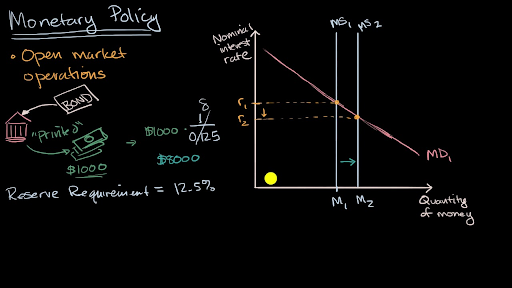
Our focus today is on how the central bank shifts that vertical money supply curve.
Tool 1: Open Market Operations (OMOs)
Open Market Operations are the most frequently used and important monetary policy tool. They involve the central bank buying or selling government bonds (also called securities) on the open market.
- Expansionary Policy (To increase Money Supply): The central bank buys government bonds from commercial banks or the public. It pays for these bonds by creating new money, which is credited to the seller's bank account. This injection of new money increases the reserves of the banking system. Through the money multiplier effect you learned about, this initial increase in reserves leads to a much larger expansion of the total money supply.
- Contractionary Policy (To decrease Money Supply): The central bank sells government bonds. Buyers pay for these bonds with money from their bank accounts. This drains reserves from the banking system, and the money multiplier works in reverse to contract the total money supply.
The following reading explains this process clearly, showing how the central bank's actions in the bond market translate into changes in the money supply and, consequently, the interest rate.
10.2 Demand, Supply, and Equilibrium in the Money Market
This section from the online textbook "Macroeconomics Principles" provides a detailed, graphical explanation of how an expansionary monetary policy (buying bonds) works.
Please read the part of the text under the heading this section. Pay close attention to Figure 10.12, which illustrates the chain of events: the Fed buys bonds, bond prices rise, the money supply increases, and the equilibrium interest rate falls.
Calculating the Impact of OMOs
The total change in the money supply from an OMO depends on the money multiplier. Recall the simple money multiplier formula: Multiplier = .
Let's see how this works in practice. If the central bank buys bonds, the initial purchase becomes new reserves for the banking system. The maximum potential increase in the money supply is this initial amount multiplied by the money multiplier.
The following video provides an excellent walkthrough of this calculation. It also highlights an important distinction: whether the Fed buys bonds from the public or directly from a bank.
Macro 4.4B - Expansion of the Money Supply - How does the Money Multiplier Work?
This video from ReviewEcon, "Expansion of the Money Supply," breaks down the multiplier calculations for OMOs.
First, watch the segment on buying bonds from the public. This scenario shows the initial deposit increasing both demand deposits and reserves. Then, watch the next segment on buying bonds from a bank, where the funds go directly into the bank's excess reserves. Note how the total potential increase in the money supply can differ based on the seller.
Tool 2: The Reserve Requirement (RR)
The reserve requirement is the fraction of deposits that banks are legally required to hold in reserve and cannot lend out. While central banks adjust this tool infrequently, it is very powerful.
- To increase the money supply, the central bank can lower the reserve requirement. This means banks have more excess reserves for each dollar of deposits, which they can then lend out. This increases the size of the money multiplier, allowing for a larger expansion of the money supply from any given amount of reserves.
- To decrease the money supply, the central bank can raise the reserve requirement. This reduces banks' ability to lend and decreases the money multiplier.
Calculating the Impact of RR Changes
The effect is calculated directly through the money multiplier.
Let's assume the banking system has total reserves of $100.
- If (or 0.10), the money multiplier is . The potential money supply is .
- If the central bank lowers the RR to (or 0.05), the money multiplier becomes . The potential money supply expands to .
Tool 3: The Policy Interest Rate (e.g., The Discount Rate)
The policy rate is the interest rate at which commercial banks can borrow money directly from the central bank. In the US, this is called the discount rate.
- To increase the money supply, the central bank can lower its policy rate. This makes it cheaper for banks to borrow reserves, encouraging them to do so. These borrowed funds increase the banks' reserves, which can then be lent out, expanding the money supply.
- To decrease the money supply, the central bank can raise its policy rate, discouraging borrowing and thereby restricting the growth of reserves.
While the amount of money created this way is often small, changes in the policy rate serve as a powerful signal of the central bank's intentions, which can influence market expectations and other interest rates throughout the economy. Problem 6(d) in the resource LINK succinctly describes this mechanism.
Tying It All Together: A Numerical Example
Now, let's connect the change in money supply to the equilibrium interest rate using a quantitative model, which aligns with your preference for problem-solving. A central bank often has an interest rate target in mind and must figure out how much to change the money supply to achieve it.
Suppose we have the following money market:
- Real Money Demand: (where is the interest rate in percent)
- Nominal Money Supply () = 1000
- Price Level () = 2
The following video will walk you through solving for the equilibrium interest rate and then show how the central bank can adjust the money supply to hit a new interest rate target.
Macro Problem - Numerical Example with Money Demand and Supply - Find Equilibrium Interest Rate
This video, "Numerical Example with Money Demand and Supply" by economicurtis, provides a full quantitative demonstration.
First, watch the introduction to the model's equations. Next, see how to calculate the initial equilibrium interest rate by setting money supply equal to money demand. Then, observe the calculation of the new interest rate after the central bank increases the money supply. Finally, watch the most interesting part for a central banker: determining the money supply needed to achieve a target interest rate of 7%.
This step-by-step process of setting and solving for the unknown variable ( or ) is the core calculation for this topic.
Practice Problem
Let's apply these concepts with a comprehensive problem. The image below presents a multi-part question that tests your understanding of the reserve requirement, the money multiplier, and open market operations.

Take a few minutes to work through this problem on your own. Use the formulas and concepts we've discussed.
-
Part 1: Calculate the simple money multiplier and the total money supply for a reserve requirement of 15% and 10%, assuming total reserves are $100.
- Hint: Money Multiplier = . Money Supply = Money Multiplier Total Reserves.
-
Part 2: The Fed wants to increase the money supply by $100. The reserve requirement is 10%. How much in U.S. government bonds should it purchase?
- Hint: . You need to solve for the OMO purchase.
-
Part 3: This introduces a real-world complication: banks start holding excess reserves. This increases the actual reserve ratio from 10% to 20%. Calculate the new, smaller money multiplier. Then, calculate how much the Fed would need to buy in bonds to achieve the same $100 increase in the money supply.
-
Part 4: Consider why, in the real world, the Fed cannot precisely control the money supply. The options are key limitations we've touched upon.
Solutions:
- For RR=15%: Multiplier = . Money Supply = .
For RR=10%: Multiplier = . Money Supply = .
A lower reserve requirement is associated with a higher money supply. - With RR=10%, the multiplier is 10. To increase the money supply by $100, the Fed must make an initial injection that, when multiplied, equals $100.
. So, the OMO Purchase = $10. - If the actual reserve ratio becomes 20%, the new money multiplier is . To increase the money supply by $100, the Fed now needs to purchase more bonds:
. So, the new OMO Purchase = $20. - The correct statements are: "The Fed cannot control the amount of money that households choose to hold as currency" and "The Fed cannot control whether and to what extent banks hold excess reserves." Both of these factors cause the money multiplier to be smaller and less predictable than the simple formula suggests.
Conclusion
In this lesson, we have moved from theory to practice, examining the specific tools a central bank uses to conduct monetary policy. You now have the analytical framework to calculate how these actions influence both the money supply and the equilibrium interest rate.
Key Takeaways:
- The three main tools of monetary policy are open market operations (OMOs), the reserve requirement (RR), and the policy/discount rate.
- OMOs are the most common tool. Buying bonds increases the money supply and lowers interest rates; selling bonds does the opposite.
- Lowering the reserve requirement increases the money multiplier, expanding the money supply. Raising it has a contractionary effect.
- Lowering the policy rate encourages banks to borrow reserves, increasing the money supply.
- The ultimate impact of these tools on the money supply is determined by the money multiplier, while their impact on the interest rate is found by solving for the equilibrium in the money market.
In our next module, we will begin constructing the famous IS-LM model. The "LM" curve represents the money market equilibrium you are now an expert in. You will see how the interest rate, which we've learned the central bank can influence, becomes the critical link connecting the financial world (the money market) with the real economy of goods and services.