Introduction
In our previous lesson, we conducted a detailed welfare analysis of tariffs, calculating their impact on consumers, producers, government revenue, and overall social welfare. You learned to quantify the deadweight loss that arises when a tariff distorts the market from its free-trade equilibrium.
Today, we will analyze another significant tool of protectionism: the import quota. While a tariff is a tax, a quota is a direct physical limit on the quantity of a good that can be imported. Our objective is to calculate the welfare effects of an import quota and, crucially, to compare its impact to that of an equivalent tariff. You will find that while the two policies can appear similar on the surface, their welfare implications can differ in a very important way, hinging on a concept known as "quota rent."
How an Import Quota Works
Let's begin by establishing the mechanics of a quota. Unlike a tariff, which indirectly influences import levels by changing prices, a quota directly restricts the quantity. This restriction on supply inevitably leads to a price increase in the domestic market.
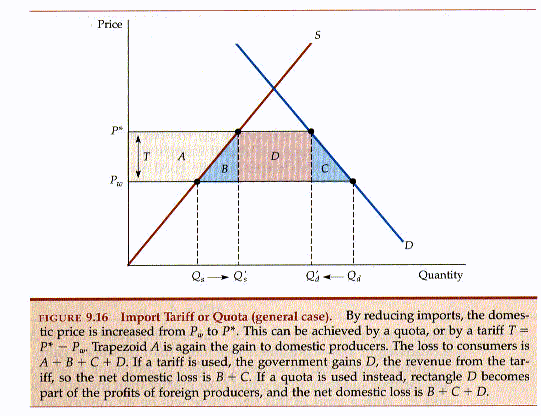
The general setup is very similar to what we saw with tariffs. A binding quota reduces imports, causing the domestic price to rise above the world price. This benefits domestic producers and harms domestic consumers.
To understand precisely how the new price is determined and how the welfare effects play out, let's watch a video that walks through the process graphically.
Trade Restrictions: Import Quota (An Input Limit)
The video "Trade Restrictions: Import Quota" by Econbusters provides an excellent step-by-step graphical explanation.
First, watch the section that sets up the initial free trade conditions and introduces the quota. Pay close attention to how a fixed quota amount leads to a new "Total Supply" curve, which is the domestic supply curve shifted horizontally by the quota amount. The intersection of this new curve with the demand curve determines the new, higher domestic price. Watch from the initial graph. Next, focus on the most critical part of the analysis, which explains what happens to the revenue rectangle (labeled 'F' in the video's diagram, equivalent to 'D' in the diagram above). The narrator explains the concept of a "quota license" and what happens when these licenses are given to foreign producers. This is the origin of "quota rent." Watch the segments from a crucial point and the summary from the summary analysis.
Comparing a Quota to an Equivalent Tariff
As the video highlighted, the central difference between a tariff and a quota lies in what happens to the revenue represented by rectangle D in the first diagram (or F in the video's diagram). An equivalent tariff is defined as a tariff that would raise the price to the exact same level as the quota, thus resulting in the same quantity of imports.
For a quota and its equivalent tariff:
- The increase in the domestic price is the same.
- The loss in consumer surplus is identical (Area A+B+C+D).
- The gain in domestic producer surplus is identical (Area A).
- The production and consumption deadweight loss triangles are identical (Areas B and D).
The sole difference is the disposition of Area C, the rectangle whose area is .
-
With a Tariff: This area is unambiguously government revenue. It is a transfer from consumers to the government and remains within the domestic economy. The net domestic welfare loss is just the two deadweight loss triangles (B + D).
-
With a Quota: This area is called quota rent. The critical question is: who gets this rent?
- Government Auctions Licenses: If the government sells the import licenses in a competitive auction, bidders will be willing to pay up to the full value of the rent () per unit. In this case, the government collects the quota rent as revenue. The outcome is economically identical to a tariff.
- Government Gives Licenses to Domestic Importers: If the government gives the licenses to domestic firms for free, these firms capture the quota rent as profit. They buy at and sell at . The rent is a transfer from consumers to domestic importers, staying within the country. The net domestic welfare loss is again just B + D.
- Government Gives Licenses to Foreign Producers/Governments: To avoid trade disputes, governments often give import licenses to foreign exporters. In this scenario, the quota rent is transferred abroad. Foreign producers now get to sell their goods at the higher price . From the domestic country's perspective, this rent is lost. The net domestic welfare loss is now B + D + C, which is strictly worse than the outcome under an equivalent tariff.
For your exam, unless stated otherwise, it is common to assume the third case—that quota rents are captured by foreigners—making quotas a less efficient method of protection than tariffs from a national welfare standpoint.
Quantitative Analysis of an Import Quota
Let's now apply this framework to a numerical problem. Your strong quantitative background will be an asset here as we solve for the specific welfare effects. We will analyze a hypothetical import quota on sugar.
The market for sugar is described by the following inverse demand and supply equations:
- Inverse Demand:
- Inverse Supply:
- World Price (): $20 per pound.
First, let's see the free trade equilibrium.
At :
- million lbs.
- million lbs.
- Imports = million lbs.
Now, suppose the government imposes an import quota of 50 million lbs. Since 50 < 70, the quota is binding.
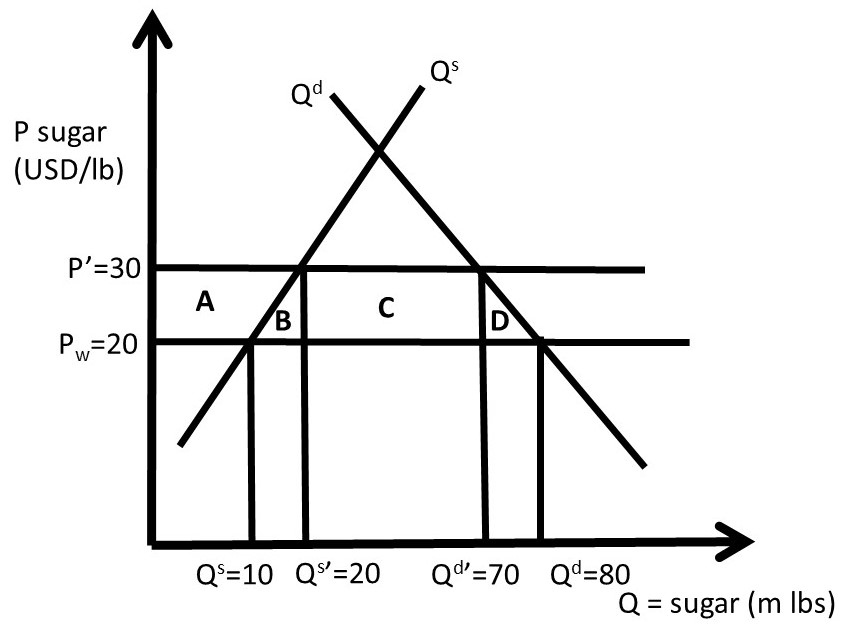
The new equilibrium price is where the difference between domestic quantity demanded and domestic quantity supplied equals the quota:
We can express and in terms of :
The new domestic price is $30.
The following resource provides a step-by-step calculation of the welfare effects based on this new price. Please work through it carefully.
Chapter 2. Welfare Analysis of Government Policies
This chapter from an agricultural economics textbook provides a clear quantitative example of a sugar quota.
Focus on the section "Quantitative Welfare Analysis of an Import Quota." Start from the calculation of the new equilibrium price (P'), which we just performed. Then, follow the calculations for the new quantities (Q_s' and Q_d') and verify the monetary values calculated for the change in consumer surplus (ΔCS), producer surplus (ΔPS), government revenue (ΔG, which is the quota rent), and the deadweight loss (DWL).
Practice Problem
To solidify your understanding, let's tackle another problem. This one is from a university problem set and is formatted in a way you should find familiar.
The market for strawberries in the nation of Bermuda is given by:
- Domestic Supply:
- Domestic Demand:
- World Price (): $10 per box.
Bermuda imposes an import quota of 400 boxes. Your task is to:
- Calculate the new domestic price of strawberries ().
- Calculate the new domestic quantity supplied () and quantity demanded ().
- Calculate the monetary value of:
a. The change (gain) in producer surplus.
b. The change (loss) in consumer surplus.
c. The quota rent.
d. The deadweight loss (production and consumption inefficiency losses).
Take some time to solve this on your own. You can use the method from the sugar example as a guide.
Click here for a hint on setting up the price calculation.
With the quota, the condition `Demand - Supply = 400` must hold. So, you need to solve the equation: $$ (1160 - 15P_q) - (60 + 20P_q) = 400 $$ Solve this for $P_q$. Once you have the price, you can find all the other values by calculating the areas of the relevant triangles and rectangles on the graph.After attempting the problem, you can check your full solution in the following resource.
[PDF] Economics 181: International Trade Homework # 4 Solutions
This document contains solutions to an international trade problem set.
Refer to Problem 1, parts (b) and (c). The section starts with the quota problem. Compare your calculated values for the new price, quantities, producer surplus gain (Area A), importer gain/quota rent (Area C), and total welfare loss (Areas B+D) with the solution provided.
Conclusion
In this lesson, we have dissected the economic impact of import quotas. By combining graphical analysis with algebraic calculation, you are now equipped to quantify the full range of welfare effects generated by this form of protectionism.
Key Takeaways:
- An import quota is a quantitative restriction that raises the domestic price by creating an artificial scarcity of imported goods.
- The welfare effects on consumer and producer surplus are analogous to those of an equivalent tariff.
- The crucial difference lies in the quota rent—the surplus created by the price gap for imported units.
- Who captures this rent (the government, domestic importers, or foreign exporters) determines the overall domestic welfare impact and is the key point of comparison with a tariff.
- If quota rents are transferred to foreigners, quotas are unambiguously more harmful to national welfare than tariffs that achieve the same level of import reduction.
In our next lesson, we will broaden our scope to the national and international accounts, examining how a country records all of its economic transactions with the rest of the world through the Balance of Payments.