Introduction
In our last lesson, we concluded our analysis of specific trade policies by dissecting the welfare effects of import quotas. We saw how a quantitative restriction impacts domestic prices and welfare, and we drew a critical comparison to tariffs, focusing on who captures the "quota rent."
We will now zoom out from individual policies to the big picture of a nation's global economic interactions. This lesson introduces the Balance of Payments (BOP), the comprehensive accounting system that countries use to record all economic transactions with the rest of the world. Your goal for this lesson is to learn how to calculate the balances of the current, capital, and financial accounts from international transaction data. This is a fundamental skill in macroeconomics, as these accounts provide a detailed snapshot of a country's trade performance, investment flows, and overall economic relationship with other nations.
The Structure of the Balance of Payments
The Balance of Payments is built on a double-entry bookkeeping system, a methodical approach that should resonate with your statistical training. Every international transaction is recorded twice, once as a credit and once as a debit, ensuring that the entire set of accounts always balances to zero.
Here's the fundamental rule:
- A credit (+) is a transaction that leads to a payment from foreigners, or an inflow of money into the country. Examples include exporting goods or selling a domestic asset to a foreigner.
- A debit (-) is a transaction that leads to a payment to foreigners, or an outflow of money from the country. Examples include importing goods or buying a foreign asset.
The BOP is primarily divided into two main accounts: the Current Account and the Financial Account. There is also a third, smaller Capital Account. Let's examine each in turn.
The Current Account (CA)
The Current Account records the flow of goods, services, income, and unilateral transfers. These are "current" transactions because they are completed within the present period and do not create future claims or liabilities.
The main components are:
- Balance of Trade (or Trade Balance): The value of exported goods and services minus the value of imported goods and services.
- Net Factor Income (also called Primary Income): Income earned by domestic residents on their foreign assets (e.g., dividends from foreign stocks, wages earned abroad) minus income paid to foreigners on their assets in the domestic country.
- Net Unilateral Transfers (also called Secondary Income): Transfers received from abroad (e.g., foreign aid, personal remittances) minus transfers sent abroad.
The Current Account Balance (CAB) is the sum of these components:
A positive CAB is a surplus, meaning the country earns more from the world than it pays out. A negative CAB is a deficit, meaning it pays out more than it earns.
To see how these components are identified and summed, let's watch a clear explanation from Khan Academy.
Balance of payments: Current account | Foreign exchange and trade | Macroeconomics | Khan Academy
The video "Balance of payments: Current account" provides an excellent walkthrough of the Current Account using US data.
Watch the video from the beginning to the final calculation. The presenter will: Introduce the concept of the BOP and the Current Account (introduction). Identify the inflows (credits) like exports and income receipts (inflows). Identify the outflows (debits) like imports, income payments, and net transfers (outflows). Calculate the final Current Account balance by summing the credits and subtracting the debits (calculation).
The Financial Account (FA) and Capital Account (KA)
While the Current Account tracks current flows, the Financial and Capital Accounts track transactions related to assets.
-
Financial Account (FA): This is the major account for asset transactions. It records the net acquisition of financial assets. This includes things like buying and selling stocks, bonds, or entire factories (foreign direct investment).
- When a domestic resident buys a foreign asset, it's a debit (a capital outflow).
- When a foreigner buys a domestic asset, it's a credit (a capital inflow).
The Financial Account Balance (FAB) is the net inflow of capital (credits minus debits). A surplus means more foreign money is coming in to buy domestic assets than domestic money is going out to buy foreign assets.
-
Capital Account (KA): This is a much smaller account that records specific asset transfers, such as debt forgiveness or the transfer of non-produced, non-financial assets like patents and trademarks. For our purposes, it is often very small and sometimes grouped with the Financial Account.
To help classify transactions, you can use the following decision-making framework.
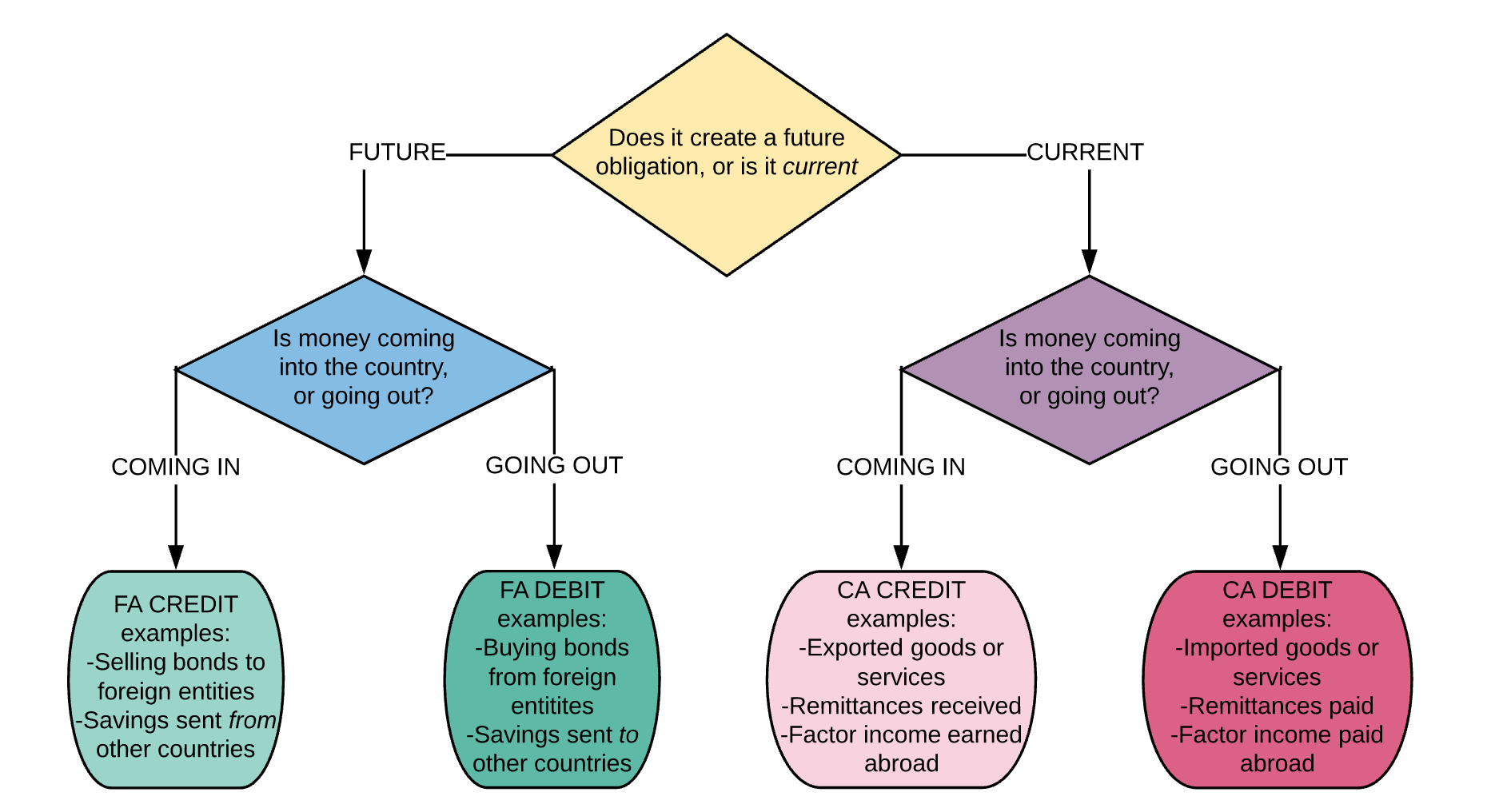
The Complete Picture: The BOP Identity
The fundamental principle of double-entry bookkeeping means the sum of all accounts must be zero.
This identity has a profound economic meaning: a country with a current account deficit (CAB < 0) must, by definition, have a surplus in its combined financial and capital accounts (FAB + KAB > 0). In simple terms, if a country spends more abroad than it earns (a CA deficit), it must finance this by borrowing from foreigners or selling assets to them (an FA surplus).
In practice, data collection is imperfect. To make the accounts balance, a Statistical Discrepancy (SD) is added. The practical identity is:
Let's walk through a complete calculation using official data.
[PDF] Topic 12: the balance of payments
This document provides a rigorous breakdown and calculation of the US Balance of Payments for 2016.
First, read the definitions to solidify your understanding. Read the definitions for the Current Account and its components. Notice how the calculation is performed by summing the trade balance, Net Factor Payments (NFP), and Net Unilateral Transfers (NUT). Then, read the section "Actual US data for 2016". This is the core of the exercise. Follow step-by-step how the author: Calculates the Current Account Balance (CAB). Calculates the 'private' Financial Account Balance (pFAB) from asset acquisitions. Notes the Official Settlements Balance (OSB), which reflects central bank actions and is part of the overall FAB. Shows that CAB + pFAB + OSB do not sum to zero, and therefore a Statistical Discrepancy is needed to achieve the balance. Finally, review the summary sections to reinforce the definitions and relationships.
The image below shows a simplified version of a Current Account calculation, similar to what you might build in a spreadsheet.

Practice Problem
Now, let's apply these principles. The following problem is adapted from a university problem set.
The nation of Kumar has a current account deficit of $500 billion. The non-reserve portion of its financial account has a surplus of $250 billion. (This 'non-reserve' portion represents all private transactions in assets). Assume the Capital Account and Statistical Discrepancy are zero for simplicity.
- What is Kumar's Official Settlements Balance (OSB)? (The OSB is the part of the Financial Account that reflects the central bank's transactions in foreign reserve assets).
- Does Kumar have an overall Balance of Payments surplus or deficit?
- What action must Kumar's central bank have taken regarding its foreign exchange reserves?
Hint: Use the identity CAB + FAB = 0. Remember that FAB is composed of the non-reserve financial account (NRFA) and the official reserve transactions (ORT), which is the negative of the OSB. So, CAB + NRFA - OSB = 0.
Click here to see the solution and explanation.
-
We start with the identity:
CAB + NRFA - OSB = 0.
Plugging in the given values:Kumar's Official Settlements Balance is a deficit of $250 billion.
-
The Official Settlements Balance is the measure of the overall Balance of Payments surplus or deficit. Therefore, Kumar has a BOP deficit of $250 billion.
-
An OSB deficit of $250 billion (
OSB = -250) means that the central bank's net sales of foreign assets were -$250 billion. In other words, its purchases of foreign assets exceeded its sales. This is incorrect. Let's re-read the definition. A positive OSB means the central bank is selling foreign reserves. A negative OSB means it is buying foreign reserves. Wait, let's check another source.Let's use the primary identity:
CAB + FAB = 0, whereFAB = NRFA + ORT.ORTstands for Official Reserve Transactions.ORTis a credit of $250 billion. A credit in the financial account means the country is selling assets. Since these are official reserve transactions, it means the central bank of Kumar sold $250 billion worth of its foreign exchange reserves (e.g., US dollars, Euros, etc.) to finance the overall deficit. The Official Settlements Balance (OSB) is often defined as the negative ofORT, soOSB = -ORT = -$250billion. This signifies a BOP deficit.This problem can be tricky due to conventions in definitions. The key takeaway is that the sum of the CA and the private part of the FA must be offset by the central bank's actions. Here, the country had a net outflow of $250 billion (
-500 + 250), which had to be financed by the central bank selling off its reserves.You can see a worked version of this exact problem in the resource below.
[PDF] Suggested Solutions to Problem Set 1
This document contains solutions to a Berkeley economics problem set.
Refer to Problem 4, part (a). You will find the calculation here: Official Settlements Balance. Note the different definitions and conventions can be confusing, but the underlying logic is what matters: the accounts must balance. The resource uses OSB = CA + NRFA, directly calculating the balance that the central bank must offset.
Conclusion
In this lesson, you've learned to deconstruct a country's vast web of international transactions into a structured set of accounts. You now understand the components of the Balance of Payments and the logic behind its calculation.
Key Takeaways:
- The Balance of Payments records all economic transactions between a country and the rest of the world using a double-entry system (credits and debits).
- The Current Account (CA) tracks flows of goods, services, income, and transfers.
- The Financial Account (FA) tracks transactions in financial assets, representing changes in the ownership of stocks, bonds, and physical capital.
- By accounting identity, a Current Account deficit must be financed by a Financial Account surplus, meaning a country that spends more than it earns abroad must borrow or sell assets to foreigners.
- The overall BOP always balances to zero, often requiring a Statistical Discrepancy to account for measurement errors.
The transactions we've catalogued today—imports, exports, and asset purchases—are the real-world activities that drive the supply and demand for currencies. In our next lesson, we will explore exactly how these forces determine the equilibrium exchange rate in the foreign exchange market.