Welcome back! In our last lesson, we took a major step in our journey to analyze software by learning how to parse Python source code into Abstract Syntax Trees (ASTs) and traverse them with a NodeVisitor. You built a simple analyzer that could identify functions and imports, turning raw code into structured data.
Today, we'll put that new skill to a powerful and practical use. Our goal is to compute code complexity metrics, such as cyclomatic complexity, from an AST. This isn't just a theoretical exercise; code complexity is a widely used proxy for technical debt. Code that is more complex is often harder to understand, maintain, and test, making it a prime candidate for refactoring. For your goal of building a technical debt prioritization tool, this metric is a foundational feature.
Let's begin by understanding what we're trying to measure.
What is Cyclomatic Complexity?
At its core, cyclomatic complexity is a quantitative measure of the complexity of a program. It was developed by Thomas J. McCabe, Sr. in 1976 and measures the number of linearly independent paths through a program's source code. In simpler terms, it counts the number of decisions in your code. A higher number means more branching (if, while, for, etc.), which can lead to more potential bugs and a greater testing burden.
To get a clear picture of what "paths" mean, let's look at how code maps to a Control Flow Graph (CFG).
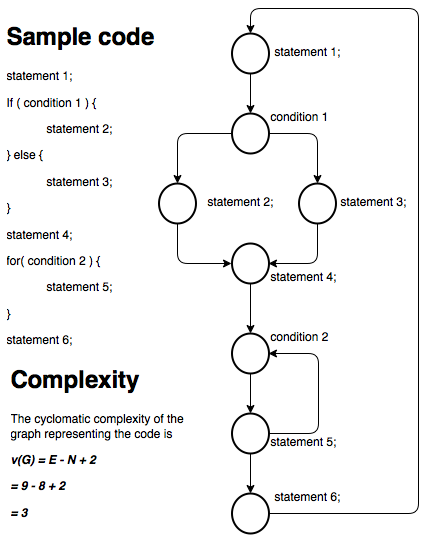
As you can see, every if statement and for loop creates a new branch in the execution path. The simplest way to calculate cyclomatic complexity is to start with a baseline of 1 (for the single path through a function with no branches) and add 1 for every branching construct.
To solidify this definition, the following reading provides a concise overview.
Introduction to Cyclomatic Complexity
Let's read a formal definition of cyclomatic complexity from the article 'Introduction to Cyclomatic Complexity' by Alex Vakhitov.
Please read the section 'What is Cyclomatic Complexity?'. It defines the metric and introduces the fundamental concept of counting branching points.
From Concept to Code: Finding Complexity in the AST
Our task is to translate this idea of "counting branches" into an algorithm that operates on an AST. Since you're now familiar with AST nodes from our previous lesson, we can map complexity-inducing statements directly to specific node types in the ast module:
- Conditional Statements: An
ifstatement creates a branch. This corresponds to theast.Ifnode. We add 1 for eachast.Ifwe find. Note that anif/elif/elsechain is represented by nestedorelseblocks within a singleast.Ifnode at each level, so we just need to count eachIfnode we encounter. - Loops:
forandwhileloops also create branches (the choice to enter the loop or not, and to continue or exit). These correspond toast.Forandast.Whilenodes. We add 1 for each. - Exception Handling: A
try...exceptblock introduces a new path if an exception occurs. Theexceptclause is represented by anast.ExceptHandlernode. We add 1 for each handler. - Boolean Operators: This is a crucial detail. A condition like
if user.is_active and user.has_permission:contains two logical decision points. The expression is parsed into anast.BoolOpnode with anopofast.And. This node'svaluesattribute holds a list of the conditions being joined. If there are n conditions, there are n-1 operators, adding n-1 to the complexity. For example,a and b and chas three conditions and two operators (and), so it adds 2 to the complexity.
The image below shows an AST visualizer that has calculated complexity. The tool does exactly what we're describing: it traverses the tree on the right and counts the relevant nodes to arrive at the final number.

Implementation: Building a Complexity Analyzer
Now, let's build on the ast.NodeVisitor class we created in the last lesson. We'll write a new visitor that is specifically designed to calculate cyclomatic complexity. It will traverse the AST of a function and increment a counter whenever it encounters one of the branching nodes we just identified.
The following resource provides an excellent, well-structured example of a ComplexityAnalyzer.
Understanding Abstract Syntax Trees | MatterAI Blog
The article 'Understanding Abstract Syntax Trees' from the MatterAI Blog contains a practical implementation of a complexity analyzer. This will serve as a great foundation for our tool.
Focus on the code block under the heading '2. Code Metrics Analyzer'. Study how the ComplexityAnalyzer class uses different visit_* methods to increment its complexity count. Pay special attention to visit_FunctionDef and visit_BoolOp.
Let's adapt that example into a complete, runnable script. This script will define the ComplexityAnalyzer class, parse a Python file, and report the cyclomatic complexity for each function it finds.
Create a new Python file named complexity_analyzer.py and add the following code:
import ast
import sys

class ComplexityAnalyzer(ast.NodeVisitor):
    """
    A NodeVisitor class to calculate cyclomatic complexity of functions.
    """
    def __init__(self):
        self.functions = {}
        self._current_function = None
        self._complexity = 0

    def visit_FunctionDef(self, node):
        """
        Called when visiting a function definition.
        Sets the context for a new function and initializes its complexity count.
        """
        self._current_function = node.name


        # Start with a base complexity of 1 for each function
        self._complexity = 1


        # The 'generic_visit' method ensures that we visit all child nodes
        # of this FunctionDef, such as the statements in its body.
        self.generic_visit(node)


        # After visiting all children, store the final complexity score.
        self.functions[self._current_function] = self._complexity
        self._current_function = None


    # --- Increment complexity for each branching construct ---

    def visit_If(self, node):
        self._complexity += 1
        self.generic_visit(node)

    def visit_For(self, node):
        self._complexity += 1
        self.generic_visit(node)

    def visit_While(self, node):
        self._complexity += 1
        self.generic_visit(node)

    def visit_ExceptHandler(self, node):


        # This node represents an 'except' block
        self._complexity += 1
        self.generic_visit(node)

    def visit_With(self, node):


        # 'with' statements can add complexity if they have multiple context expressions
        self._complexity += len(node.items) -1
        self.generic_visit(node)

    def visit_BoolOp(self, node):


        # For 'and' and 'or', add complexity for each additional condition
        # e.g., 'a and b' adds 1, 'a and b and c' adds 2
        self._complexity += len(node.values) - 1
        self.generic_visit(node)

    def report(self):
        """Prints the complexity of each function found."""
        print("--- Cyclomatic Complexity Report ---")
        if not self.functions:
            print("No functions found.")
            return

        for func_name, complexity in sorted(self.functions.items()):
            print(f"Function '{func_name}': Cyclomatic Complexity = {complexity}")

def analyze_file_complexity(file_path):
    """
    Parses a Python file and analyzes the cyclomatic complexity of its functions.
    """
    try:
        with open(file_path, 'r') as f:
            source_code = f.read()
        tree = ast.parse(source_code)

        analyzer = ComplexityAnalyzer()
        analyzer.visit(tree)
        analyzer.report()

    except FileNotFoundError:
        print(f"Error: File not found at '{file_path}'")
    except SyntaxError as e:
        print(f"Error: Could not parse file due to a syntax error. {e}")


# --- Example Usage ---
if __name__ == "__main__":


    # To test this script, create a file named 'sample_code.py'
    # with some Python functions, or pass a path to another python file.

    sample_code_content = """
def simple_function():
    print("Hello")

def function_with_if(x):
    if x > 10:
        return "Large"
    else:
        return "Small"

def complex_function(items, user_is_admin):
    count = 0
    for item in items:
        try:
            if item.is_valid() and (item.value > 100 or user_is_admin):
                count += 1
        except AttributeError:
            print("Warning: item has no 'is_valid' or 'value' attribute")
    return count
"""


    # Create a dummy file for analysis
    with open("sample_code.py", "w") as f:
        f.write(sample_code_content)

    print("Analyzing 'sample_code.py':")
    analyze_file_complexity("sample_code.py")
To run this:
- Save the code above as
complexity_analyzer.py. - Run it from your terminal:
python complexity_analyzer.py.
The script will create a sample_code.py file and then analyze it. The expected output is:
Analyzing 'sample_code.py':
--- Cyclomatic Complexity Report ---
Function 'complex_function': Cyclomatic Complexity = 6
Function 'function_with_if': Cyclomatic Complexity = 2
Function 'simple_function': Cyclomatic Complexity = 1
Let's break down the complex_function score of 6:
- Base complexity: 1
for item in items: +1 (now 2)try...: +0 (thetryitself doesn't branch, theexceptdoes)if item.is_valid() and (...): +1 for theif(now 3)... and ...: +1 for theandoperator (now 4)... or user_is_admin: +1 for theoroperator (now 5)except AttributeError:: +1 for theexcepthandler (now 6)
You have now successfully created a tool that statically analyzes Python code and extracts a meaningful metric for quality and maintainability.
Conclusion
In this lesson, we bridged the gap from parsing code to extracting a valuable feature for ML models. You now have a tangible tool for quantifying one aspect of technical debt.
Here are the key takeaways:
- Cyclomatic Complexity is a metric that counts the number of independent execution paths in a function, serving as an indicator of its complexity.
- It can be calculated by traversing a function's AST and counting branching nodes like
If,For,While,ExceptHandler, andBoolOp. - The
ast.NodeVisitorpattern is highly effective for implementing this kind of analysis, allowing you to isolate logic for each node type in separatevisit_*methods.
Preview of the Next Lesson:
So far, we have mined data from two key software artifacts: Git history for change metrics and source code for complexity metrics. For a project like flaky test detection, another critical data source is the output of your CI/CD pipeline.
In our next lesson, we will shift focus to "Parse CI/CD test execution logs to extract pass/fail histories and timing data." You'll learn how to read and process log files to build a historical record of test outcomes, which is the primary dataset needed to identify which tests are flaky.