Hello. Last time, you explained why precipitation can produce red light high above green light and a purple lower edge. Color tells you where and how the atmosphere emits; it does not yet explain why that light forms a ring around a magnetic pole, a long arc, or a moving curtain. This lesson connects those visible shapes to the pattern of electrons arriving along Earth’s magnetic field. Allow about 35–40 minutes.
The oval: a map of where electrons arrive
Imagine marking every place in the upper atmosphere where substantial auroral precipitation is occurring at one moment. From above Earth, those marks tend to form a broad, irregular oval around each magnetic pole. The oval is a region of enhanced precipitation, not a solid ring of light: some portions may be bright, others faint or difficult to see.
The field-line picture from the first module explains why this region is polar. Electrons accelerated within the magnetosphere can travel along Earth’s magnetic field toward the atmosphere. The acceleration regions connect, through those field lines, to a set of atmospheric arrival locations. That set surrounds the magnetic pole rather than covering the whole planet or converging on one point. The pattern of arriving electrons determines the oval; the atmosphere emits light where those electrons deposit energy.
Aurora Tutorial | NOAA / NWS Space Weather Prediction Center
Read this part of NOAA’s Aurora Tutorial to connect the electron source in the magnetosphere with its mapped arrival region in the atmosphere.
In “What Causes the Aurora?”, begin with the paragraph opening “One subtle note about the source of the auroral electrons.” Read through the oval explanation. Stop before the paragraph beginning “The figure below shows Earth with its magnetic field lines.” Focus on why the electrons producing aurora need not be solar-wind electrons that traveled directly into the atmosphere.
The two views below show different parts of that explanation. The magnetosphere diagram is a side view: it distinguishes the Sun-facing side from the long nightside tail, where processes can supply electrons for prominent nighttime aurora. The oval image is closer to a view of the arrival region around a pole. Neither image means that every field line, or every part of the oval, is equally active at once.
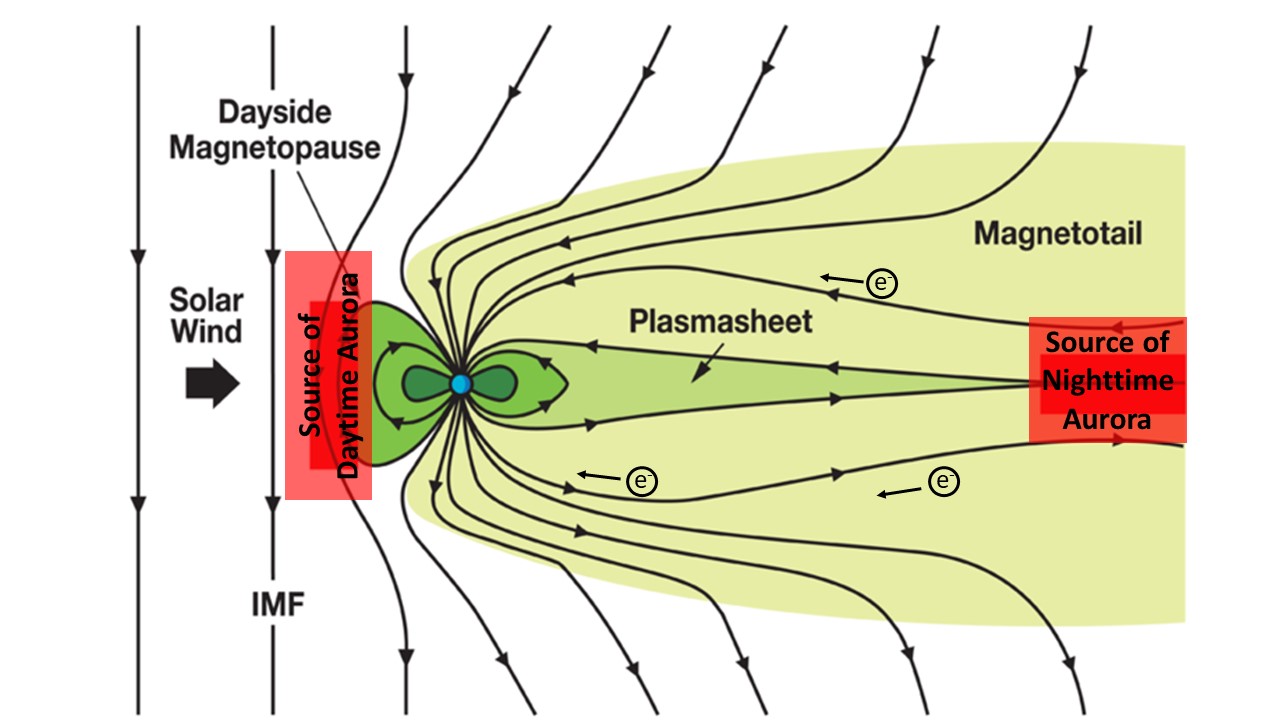
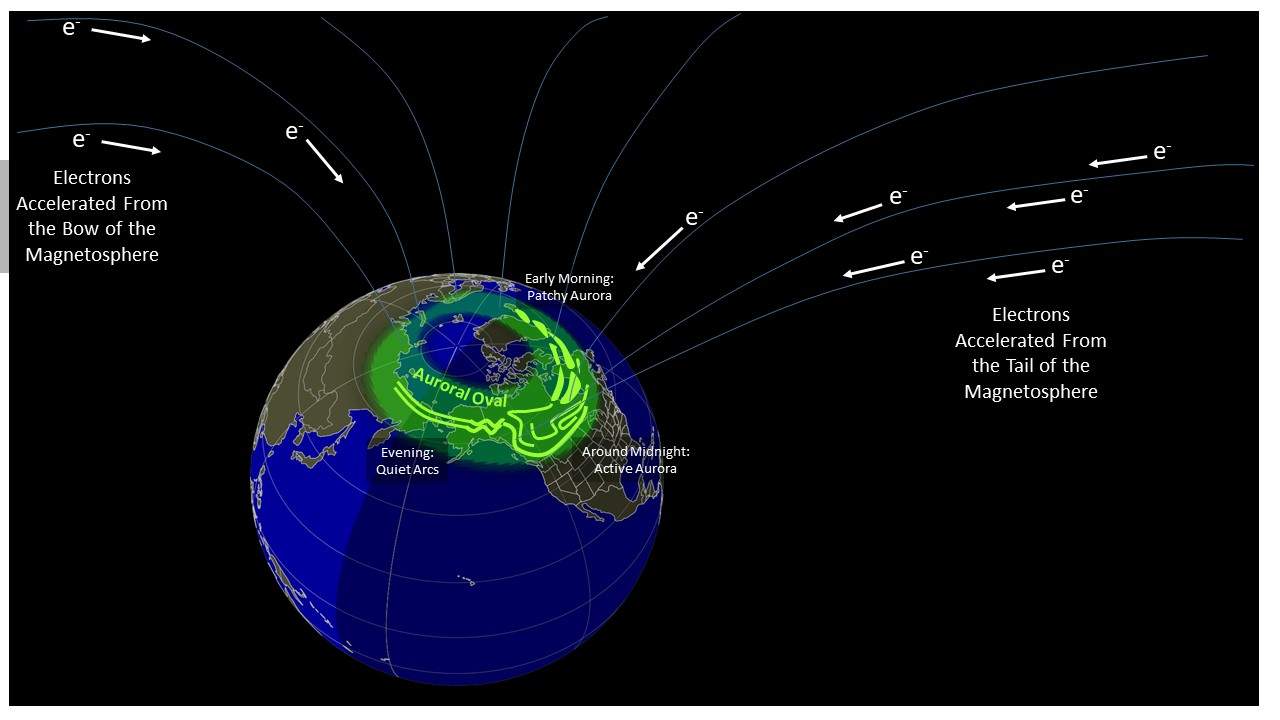
An oval can expand toward lower magnetic latitudes when geomagnetic activity increases. That changes where auroral emissions are possible, but it does not make the entire expanded region uniformly bright. Keep that distinction in mind: the oval describes a spatial tendency, while a particular display is a local, changing part of it.
The arc: a long, narrow part of the oval
Now move from the whole oval to one of its bright features. A quiet aurora often appears as an arc stretching roughly east–west across the sky. Think of it as an elongated strip within the oval where precipitation is stronger than in the neighboring sky. It may extend a great distance along the oval while remaining relatively narrow across it.
The orientation comes from the spatial arrangement of the precipitation. Many neighboring magnetic field lines guide electrons into neighboring locations in the upper atmosphere. When the strongly precipitating locations form a long, narrow band, the light forms an arc. The field lines themselves are not glowing wires: atmospheric atoms and molecules emit because electrons arriving along those lines excite them.
The NOAA tutorial describes how a quiet arc can develop into multiple arcs and then more intricate moving forms. Read its account as a description of changing precipitation patterns, rather than a sequence that every display must follow.
Aurora Tutorial | NOAA / NWS Space Weather Prediction Center
Return to NOAA’s Aurora Tutorial for its description of arcs and how auroral structure changes through a moderately active night.
In “Shapes and Morphology of the Aurora,” start at the paragraph beginning “Aurora exists nearly all the time.” Read the descriptions of arcs and activity, ending in the “Morning” bullet just after the comparison between patches and bright midnight rays. Pay particular attention to the “Evening” and “Near Midnight” bullets: notice how an arc can remain recognizable even as rays, ripples, and additional arcs appear.
An arc’s apparent position also depends on where you stand relative to the oval. A distant arc may sit low near the horizon; a nearer one may span the sky or pass overhead. The shape seen from the ground is therefore a perspective view of light emitted high in the atmosphere, not a traced line on Earth’s surface.
The curtain: an arc with height and structure
An arc is not flat. Precipitating electrons excite atmospheric particles over a range of heights. If the bright precipitation occupies a narrow strip horizontally but extends through a substantial vertical range of emitting air, its luminous volume resembles a sheet. Seen from an angle, that sheet can look like a hanging curtain.
Bright, approximately vertical-looking streaks within it are called rays. They tend to align with the local magnetic field because the incoming electrons are guided along that field. Put the two directions together: the curtain may stretch a long way across the sky, while its rays reveal the field-aligned structure through its height. Its lower edge and upper glow can differ in color for the altitude-dependent reasons you studied last time.
NOAA’s short PDF description provides useful physical scale for this picture.
Read this brief passage from NOAA’s aurora PDF to picture how a feature can be narrow across its width yet tall and extensive across the sky.
On the printed page marked 3, find the paragraph beginning “Auroral features come in many shapes and sizes.” Read through the description of arcs and curtains. Stop before the next paragraph beginning “Auroral arcs can nearly stand still.” Focus on the contrast between a curtain’s small width and its much greater height and length; the measurements are examples, not required dimensions for every aurora.
A curtain can fold, ripple, brighten in one place, or seem to race across the sky. This is not a physical fabric being blown by wind. You are seeing changes in which parts of an extended precipitation region are delivering enough electrons to make the atmosphere shine. During active periods, several arcs and folds can coexist; after activity subsides, precipitation may instead appear as less sharply bounded patches. The evening arcs, active near-midnight features, and morning patches in the oval image are examples of that variation, not fixed rules for each hour.
Keeping the three scales distinct
The words oval, arc, and curtain describe related things at different scales and viewpoints:
| What you describe | What the precipitation is doing | Typical view |
|---|---|---|
| Oval | Reaching a broad region around a magnetic pole, unevenly across that region | Best understood on a view from above |
| Arc | Becoming concentrated in a long, comparatively narrow part of the oval | A band across the sky |
| Curtain | Producing an arc-like sheet with visible height, often resolved into field-aligned rays | A folded or rippling drape |
This distinction prevents a common misunderstanding: the oval does not have to become a curtain everywhere to produce one striking curtain in a photograph. A photograph captures one viewpoint and one interval within a larger, changing pattern.
The central connection is that magnetic field lines guide precipitating electrons, and the spatial pattern of that precipitation sets the aurora’s shape. Around each magnetic pole, the affected region is an oval; within it, concentrated precipitation can form long arcs; an arc’s height and field-aligned rays can make it appear as a curtain. Color then tells you something different—what emitted the light and at what heights.
Next, you will use this picture to interpret auroral-oval maps and geomagnetic activity forecasts, while keeping a crucial distinction: a forecast of activity is not a guarantee that an aurora will be visible from a particular spot.