Hello. In the previous lesson, you followed the immediate light-making mechanism: precipitating electrons excite atmospheric particles, and some of those particles emit photons as they return to lower-energy states. Now the question is why those photons produce a green curtain in one part of the sky, a red glow above it, or a purple edge below it. This lesson connects color to the emitting species, its particular transition, and the altitude where it can emit. Allow about 35–40 minutes.
A color identifies an emission, not just a gas
The photon-energy relationship from the previous lesson gives us a starting point: a transition between two internal energy states produces a photon with a particular wavelength. Visible wavelengths are perceived as colors. But “oxygen makes green” is incomplete. Atomic oxygen can produce both green and red light, because those colors come from different excited states and transitions of the same species. Nitrogen has its own emissions, including blue and violet light.
Read the opening of NOAA’s Aurora Tutorial for this distinction. You do not need to memorize the names of the oxygen states; notice that NOAA assigns green and red to different states of atomic oxygen.
Aurora Tutorial | NOAA / NWS Space Weather Prediction Center
Read NOAA’s short introduction to auroral colors to connect the photon mechanism with specific atmospheric emitters.
In “Colors of the Aurora,” read from the paragraph beginning “The different colors of the aurora are produced” through its sentence about nitrogen, just before the mention of a typical auroral spectrum. Focus on oxygen and nitrogen, and particularly on why the two oxygen colors need not have the same explanation.
There is a second question, though. If an oxygen atom can emit red light, why is red often seen higher than green? The answer is not simply that Earth has neatly separated layers of colored gas. Altitude changes both the available atmospheric particles and how often they collide. Whether an excited particle gets to emit its photon before another collision interrupts it can matter as much as which species is present.
Why red tends to sit above green
Consider two excited states of atomic oxygen. The state responsible for the familiar green emission typically releases its photon after roughly a second. The state responsible for red emission can retain its energy for much longer—on the order of a hundred seconds. These are characteristic times, not timers that make every atom emit at exactly the same moment.
Lower in the atmosphere, surrounding particles are more crowded together. An excited oxygen atom there is more likely to collide with another particle before it emits. That collision can remove the excitation energy without producing the expected visible photon, a process called collisional quenching. It is especially consequential for the slow red emission: the atom must remain undisturbed for much longer. High above Earth, where collisions are less frequent, red-emitting oxygen has a better chance to radiate. Green-emitting oxygen can succeed in somewhat denser air because it emits sooner.
NOAA’s next passage develops this timing explanation and also describes a faster nitrogen emission. Read it for the relative heights and lifetimes, rather than treating each quoted altitude as a hard boundary.
Aurora Tutorial | NOAA / NWS Space Weather Prediction Center
Continue in NOAA’s “Colors of the Aurora” section to see why an emission can be suppressed even when its emitting species is present.
Begin with the paragraph opening “Different auroral colors come from different heights in the atmosphere,” immediately after the introductory color paragraph. Read the height explanation through the description of the purplish nitrogen border. Pay particular attention to the comparison between long-lived red oxygen, quicker green oxygen, and prompt nitrogen emission.
The result is a useful typical vertical pattern: red oxygen light high up, green oxygen light below or overlapping it, and nitrogen-rich purple or pink light toward the lower edge. Green is the most common conspicuous auroral color. Its familiar bright region is often roughly 100–200 km up, although green emission can extend higher. Red oxygen is associated with thinner air, often around a few hundred kilometres above Earth. These ranges overlap and vary; the physics of collisions matters more than a single cutoff height.
What makes blue and purple?
Nitrogen complicates the picture in a productive way. Molecular nitrogen—two nitrogen atoms joined together—and ionized molecular nitrogen can produce visible emissions, including blue and violet. Molecular nitrogen also has red emissions. When emissions overlap in the same apparent part of an aurora, their combined light can look purple, magenta, or pink. A purple border is therefore not necessarily one uniquely “purple” photon produced by one type of particle.
Some nitrogen emissions occur promptly after excitation. They can remain visible where the denser air would quench oxygen’s slower emissions. Moreover, sufficiently energetic precipitating electrons can penetrate farther down before depositing much of their energy. This helps explain why a bright green curtain may acquire a pink-purple lower fringe: the precipitation reaches air where nitrogen emission contributes strongly, while the green oxygen emission is increasingly suppressed.
The National Park Service’s The Colors of the Aurora puts the lifetime, penetration, and color-mixing arguments together. Its altitude estimates differ somewhat from NOAA’s, a useful reminder that the boundaries are approximate rather than fixed atmospheric shelves.
The Colors of the Aurora (U.S. National Park Service)
Read the National Park Service’s explanation to distinguish a species being present from its emission actually escaping quenching.
Within “Light Emission in Aurora,” start at the paragraph beginning “The time that a molecule or atom can store the energy,” following the introductory discussion of photons. Read the color account through the paragraph explaining why red oxygen emission needs infrequent collisions. Stop before the photograph following that paragraph. Focus on its account of the green lower edge, deeper-reaching electrons, and nitrogen’s blue and red emissions mixing into purple.
The following schematic is a quick way to hold the vertical pattern in mind.
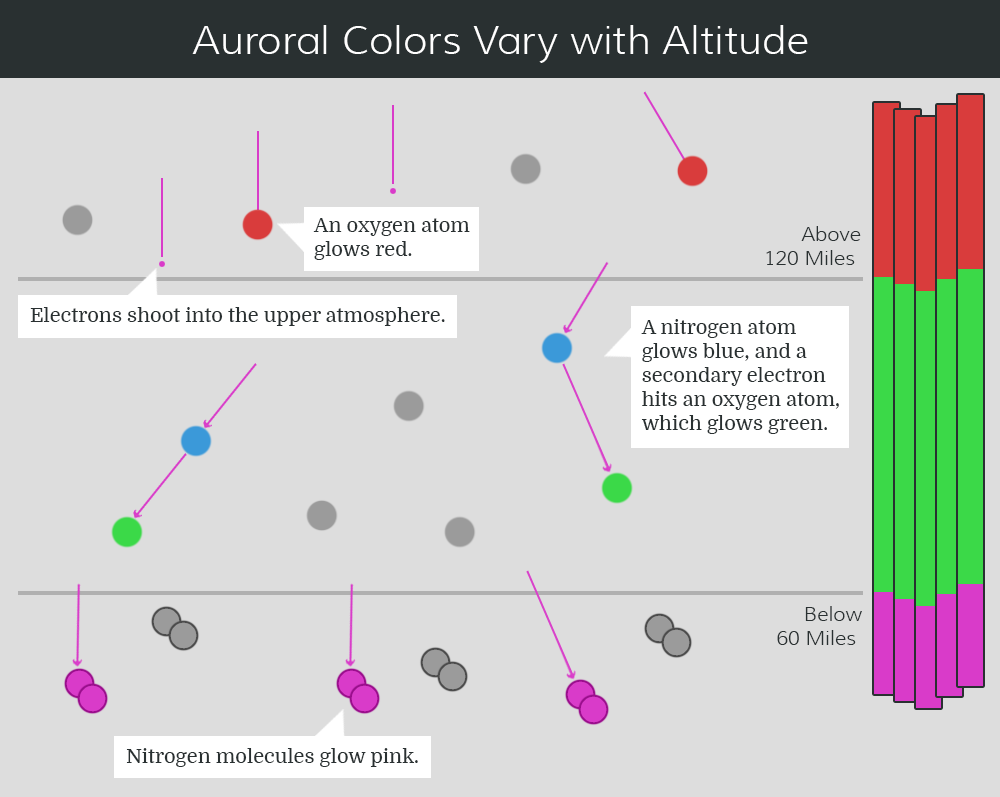
Read the image with one qualification: its blue “nitrogen atom” is a simplified depiction. For an explanation of common auroral blue and violet, molecular nitrogen and its ions are important; do not infer from the drawing that blue always comes from isolated nitrogen atoms. Likewise, an oxygen atom can emit green without requiring the exact two-collision sequence drawn beside it.
A compact account of the main colors is:
| Apparent color | Principal contributor | Why that height is favorable |
|---|---|---|
| Green | Atomic oxygen | Its green-emitting state can radiate in air denser than the air required for red oxygen emission; common bright displays are often around 100–200 km. |
| Red | Atomic oxygen, in a different excited state | Its slow emission is readily quenched lower down, so it favors thin air at higher altitudes, often a few hundred kilometres up. |
| Blue/violet | Nitrogen emissions, notably from molecular nitrogen and its ions | Relatively prompt emissions can contribute where precipitation reaches nitrogen-bearing air, including lower auroral regions. |
| Purple/pink | A mixture of nitrogen emissions, often alongside other auroral light | It commonly appears along a curtain’s lower border, where deeper-reaching precipitation and fast nitrogen emissions are important. |
This table describes tendencies, not a method for reading an exact altitude off a photograph. An image flattens light from different depths of the atmosphere into one view; colors may overlap along your line of sight. Camera sensitivity and human night vision can also make the same faint display appear differently in a photograph and to an observer.
Putting the color pattern together
The reliable explanation has three parts. Species and transition determine the emitted wavelengths. Altitude affects which particles are present and how often collisions quench an emission. The energy and location of precipitation affect where the atmosphere is excited. Those factors jointly produce the familiar green, high red, and sometimes blue or purple lower-edge light—not rigid, permanently colored layers in the sky.
In the next lesson, you will keep the same precipitating electrons in view but change scale: instead of asking which color a patch emits, you will ask why the patches arrange themselves into auroral ovals, arcs, and curtains.