Hello. The course has followed energy from the solar wind into Earth’s magnetosphere. This module asks what happens when that energy reaches the atmosphere: first, how auroral light is made; then why it has different colors and shapes. Here we will focus on one event repeated on an enormous scale—an incoming electron collides with an atmospheric particle, and the atmosphere emits light.
From a moving electron to an excited gas
The electrons that produce a typical aurora precipitate into the upper atmosphere: they travel downward from Earth’s magnetosphere along magnetic-field lines and encounter increasingly dense air. Solar-wind activity helps supply energy to the magnetosphere, but it is misleading to picture a beam of sunlight, or usually a stream of solar electrons, shining directly through the sky to make the aurora. The immediate source of auroral light is the atmosphere itself.
NOAA’s Aurora Tutorial gives a compact account of this last part of the journey. Read its definition of the aurora and its explanation of what the incoming electrons do on collision.
Aurora Tutorial | NOAA / NWS Space Weather Prediction Center
Read NOAA’s Aurora Tutorial to connect electrons traveling along Earth’s magnetic field with collisions and light emission in the upper atmosphere.
In “What is the Aurora?”, read the opening definition, beginning the definition, including the comparison with a neon light. Then, under “What Causes the Aurora?”, find the paragraph immediately after the illustration of Earth, its magnetic-field lines, and the auroral oval. Read from the collision explanation; stop before “Geomagnetic Activity and Aurora.” Focus on which particles bring in energy, which particles emit the photons, and the order in which those events occur.
A fast incoming electron carries kinetic energy, the energy of motion. When it collides with an oxygen atom or a nitrogen molecule, it can give up some of that energy. The atmospheric particle may then be left in an excited state: its internal energy is higher than before the collision. In an atom, this can be described as one of its bound electrons occupying a higher-energy state. The incoming electron and the bound electron have different roles. The incoming electron transfers energy; the atom or molecule that was struck can later produce the light.
That distinction matters because “electrons hit air and glow” leaves out the central step. The atmosphere is not simply reflecting incoming light. A collision changes an atmospheric particle’s internal state, and that particle can subsequently release energy as a new packet of light—a photon.
The brief interval between impact and light
The diagram below portrays the process across a broad band of the upper atmosphere. Treat it as a schematic, not a scale drawing or a claim that every collision between the marked heights produces light.
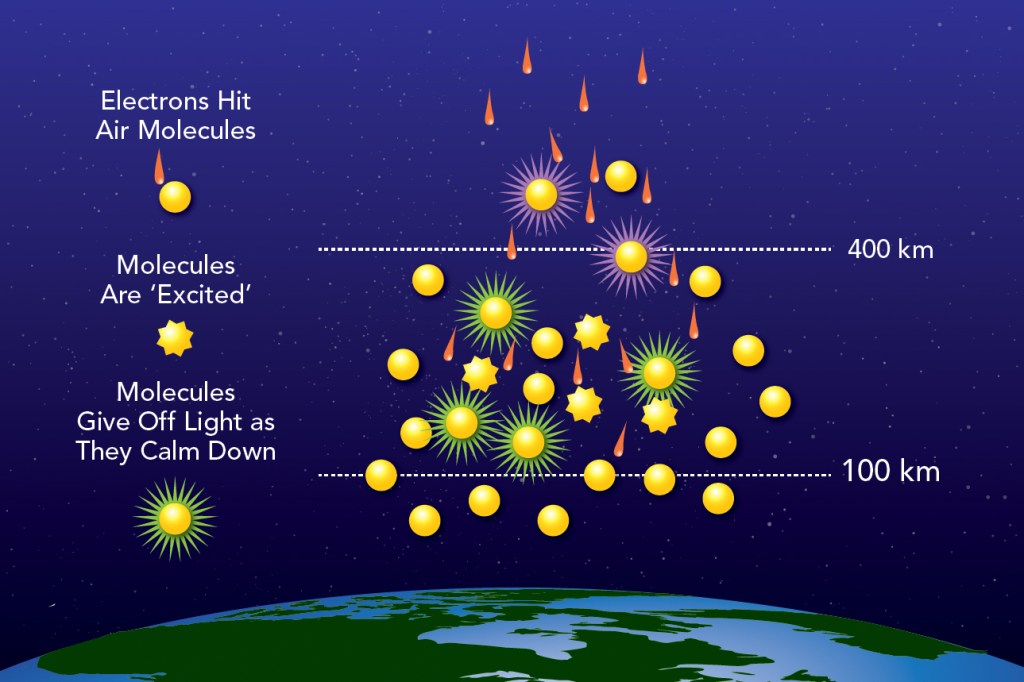
Follow one imagined atmospheric atom through the diagram. Before impact, it occupies a lower-energy state. A precipitating electron collides with it and transfers enough energy to leave it excited. The atom does not need to glow at the instant of impact. After some interval, it can move to a lower-energy state and emit a photon. If many atoms and molecules do this in a region of sky, their combined light becomes visible as an aurora.
The word state is useful here. An atom cannot hold just any arbitrary amount of internal energy; it has particular allowed states. The energy difference between the higher and lower states determines the energy of a photon emitted in that transition:
A photon’s energy is related to its frequency and wavelength by
Here is Planck’s constant, is frequency, is the speed of light, and is wavelength. You do not need to calculate a wavelength to explain this lesson’s mechanism. The important implication is that different transitions can produce different wavelengths of light. Molecules also have allowed internal states, so the same collision-and-emission principle applies to them.
Think of the collision and the photon emission as distinct events. The incoming electron loses some energy in the encounter; the excited atmospheric particle later releases energy. The energy of one incoming electron need not become the energy of exactly one visible photon. It may undergo more than one encounter, and the energy it gives the atmosphere can have other outcomes.
Why collisions do not guarantee a visible photon
Excitation is one possible result of an electron’s collision with air, not a promise made by every collision. Depending on the encounter, energy can go into other processes, including removing an electron from an atmospheric particle—ionization—or into motion that contributes to heating. Even when a particle is excited, a later collision with another atmospheric particle can take away its excitation energy before it emits the photon you might otherwise expect. And some emitted photons have wavelengths outside human vision.
This is why it helps to separate three claims:
- Precipitating electrons reach the upper atmosphere. They bring energy into a region containing oxygen and nitrogen atoms and molecules.
- Some collisions excite those particles. Energy is transferred into allowed higher internal states.
- Some excited particles emit photons. When they move to lower states, the emitted light can contribute to a visible aurora.
The upper atmosphere provides the setting for all three. Air there is thin compared with air at the surface, yet it contains enough particles for incoming electrons to make many encounters. Aurora is a collective display: no single glowing atom accounts for the luminous band in a photograph. Large numbers of emissions, spread over a substantial region, produce the light you see.
The neon-light comparison in NOAA’s tutorial is helpful for precisely this reason. In both cases, energetic electrons excite a gas, and the gas emits light. The comparison concerns the light-making mechanism, not the source of the electrons: a lamp uses an electrical supply, while auroral electrons arrive through a space-weather process involving Earth’s magnetosphere.
The explanation to carry forward
You can now connect activity on the Sun to visible light without treating it as a single collision between “solar particles” and the sky. Solar-wind activity affects the energy available in Earth’s magnetosphere. Electrons precipitating from the magnetosphere collide with upper-atmosphere oxygen and nitrogen. Some collisions excite those atoms or molecules; when they move to lower-energy states, they emit photons. Enough emissions together form an aurora.
The key separation is energy carrier versus light emitter: the incoming electron delivers energy, while the atmospheric particle emits the photon. Next, we will use that mechanism to explain why auroras can appear green, red, blue, or purple—and why the emitting altitude matters.