Welcome back. In the previous lesson, you saw how a southward interplanetary magnetic field can make reconnection at Earth’s Sun-facing boundary more effective. The solar wind can then transfer energy into the magnetosphere, but that does not mean auroral electrons immediately fall into the atmosphere.
This lesson follows the energy between those two events: its transport into the magnetotail, its storage and release there, and the precipitation of electrons into the upper atmosphere. Allow about 35–40 minutes, including the readings and time to inspect the diagram.
How the magnetotail stores energy
The solar wind flows past Earth rather than stopping at the dayside boundary. As discussed previously, it can carry newly opened magnetic-field configurations toward the nightside. Earth’s field becomes stretched into a long magnetotail. Within the tail, relatively sparse regions of magnetic field lie on either side of a central plasma sheet, which contains a denser population of charged particles.
Stretching the field changes the magnetosphere’s magnetic configuration and stores energy in it. Descriptions sometimes call this storage magnetic tension. That is a useful picture so long as field lines are not mistaken for physical cords: the energy belongs to the magnetic field and plasma system, not to ink lines on a diagram.
Read the latter part of the European Space Agency’s explanation to connect dayside reconnection with storage and release on the nightside.
ESA Science & Technology - Magnetic Reconnection
The European Space Agency’s “Magnetic Reconnection” explains how solar-wind flow stretches the tail and how reconnection there can release stored energy.
In the text accompanying the animation, move past the account of northward and southward interplanetary magnetic fields. Begin where the paragraph says the solar wind drags reconnected field lines toward the nightside. Read the tail sequence through the paragraph’s closing words about producing auroras. Focus on the difference between storing energy as the tail is stretched and releasing it when the tail’s magnetic configuration changes.
The solar wind is the continuing energy supply. A stretched tail is one place that supplied energy can accumulate; it is not necessary for a solar eruption to be underway at the instant an aurora brightens. Nor does storage imply that every addition of energy produces a sudden release. The strength and timing of the response vary.
What a release in the tail changes
Under suitable conditions, reconnection also occurs within the magnetotail. Magnetic connections rearrange there, and some of the stored magnetic energy is transferred to moving plasma, energetic particles, and electromagnetic processes. Part of the release travels away from Earth; part is directed earthward. An episode of enhanced nightside activity associated with this reconfiguration is called a substorm.
Use the diagram to locate the regions involved before following an individual electron.
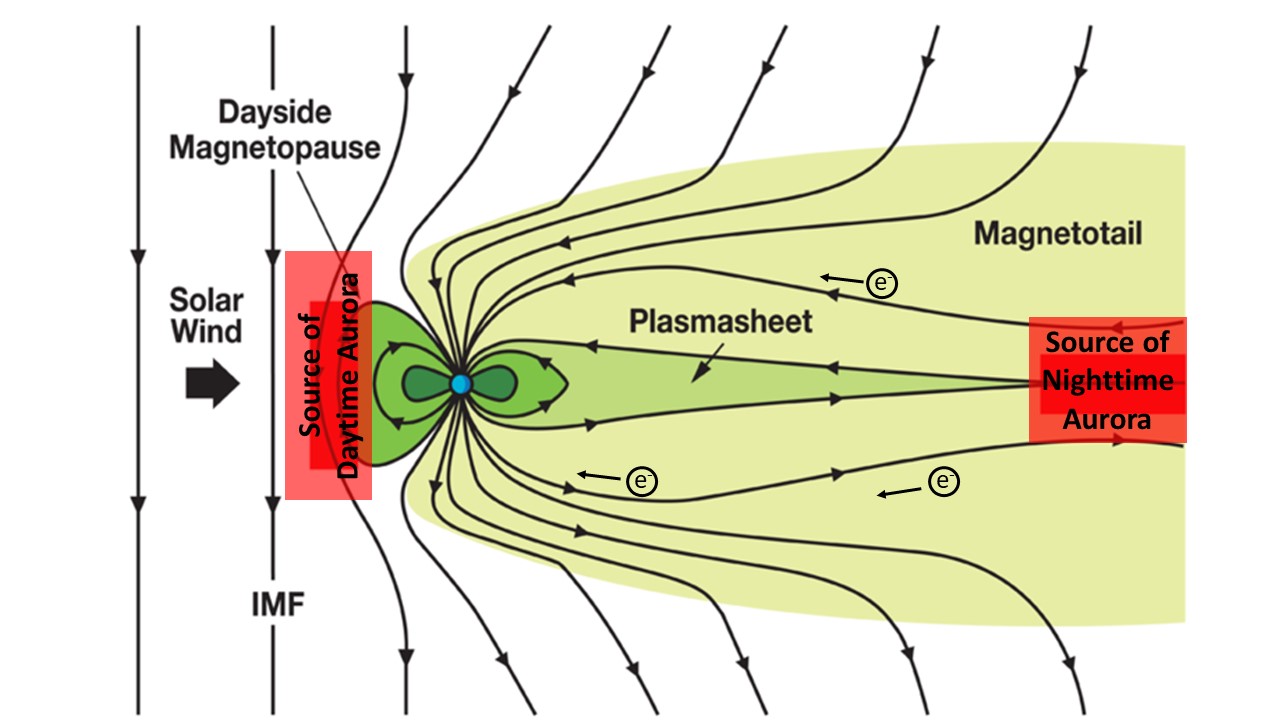
Read this as a map of regions, not a photograph of one electron’s journey. Earth is near the center-left; the long yellow tail extends rightward, away from the incoming solar wind. The plasma sheet occupies its central region. The far-right red label identifies a broad source region associated with nighttime aurora; it does not mark a single fixed point where every auroral electron is accelerated. The red dayside label also matters: not all auroras require the nightside tail pathway.
The drawn curves represent magnetic-field geometry. Their arrows should not be read as proof that every particle travels along an entire drawn curve in that direction. Reconnection and the resulting energy transfer are processes in plasma, not a literal opening of a tunnel from the Sun to the atmosphere.
From a tail release to precipitating electrons
A useful distinction now becomes essential: the origin of the energy is not necessarily the immediate origin of the electrons. Solar-wind flow helps supply energy to the magnetosphere. For the nighttime aurora described here, many of the electrons that enter the atmosphere come from populations already within the magnetosphere, notably its tail and plasma sheet. It would be misleading to picture a stream of solar-wind electrons crossing Earth’s dayside boundary and flying straight into a nighttime aurora.
The NOAA Space Weather Prediction Center tutorial makes this distinction explicitly.
Aurora Tutorial | NOAA / NWS Space Weather Prediction Center
NOAA’s “Aurora Tutorial” identifies the source of nighttime auroral electrons and explains how energized electrons reach the upper atmosphere.
Under “What Causes the Aurora?”, find the paragraph beginning “One subtle note about the source of the auroral electrons,” after the introductory discussion of solar events. Read the electron pathway through the paragraph explaining why the acceleration regions correspond to an auroral oval. Stop before the following paragraph that begins “The figure below shows Earth.” Attend especially to the distinction between solar-wind energy and magnetospheric electrons.
Tail reconnection is part of the release, but a field-line sketch cannot show every step by which an electron gains energy. Changing electromagnetic fields, including electric fields and waves, can transfer energy to particles. Some energized electrons then travel along magnetic-field routes toward Earth. A portion precipitates: instead of remaining confined in the magnetosphere, those electrons enter the upper atmosphere, generally in high-latitude regions connected magnetically to their source.
This also clarifies a point from the earlier lesson. A magnetic field can guide a charged particle without its magnetic force, by itself, increasing the particle’s kinetic energy. The energy gain occurs through electromagnetic energy transfer; guidance determines where an energized particle can go. Once precipitating electrons collide with atmospheric atoms and molecules, some of their energy can ultimately appear as visible light. The collision-and-emission mechanism is the subject of the next lesson.
Only a fraction of the solar-wind energy delivered to the magnetosphere becomes auroral light. Energy can also go into plasma motion, heating, and electrical currents. Likewise, an energized electron does not automatically reach the atmosphere. The tail pathway explains an important source of nighttime aurora, not a guarantee that every interval of enhanced solar wind will produce a visible display.
Keep the pathway and its participants separate
The full account is easier to retain if you track energy, magnetic configuration, and electrons separately:
- Energy enters: solar-wind flow couples to Earth’s magnetosphere, particularly effectively through dayside reconnection when the incoming field is southward.
- Energy is stored: continued flow stretches magnetic-field configurations into the nightside magnetotail.
- Energy is released and redistributed: tail reconnection can convert stored magnetic energy into plasma motion and particle energization, with effects directed both earthward and away from Earth.
- Electrons precipitate: some energized magnetospheric electrons follow magnetic-field routes into the upper atmosphere, where their collisions can contribute to auroral light.
The important correction to the simplest “Sun sends particles that glow” story is that solar-wind energy can power light produced by electrons already in Earth’s magnetosphere. The magnetotail provides both a place for energy to accumulate and a route by which its release can affect the nightside atmosphere.
Key takeaways
Dayside coupling lets the solar wind supply energy to Earth’s magnetic environment. The flow stretches the magnetotail, where energy can be stored in the magnetic configuration. Reconnection in the tail can release and redistribute that energy; some magnetospheric electrons become energized and precipitate along magnetic-field routes into the upper atmosphere. The diagram helps locate these regions, but it cannot show every step of particle energization or promise an aurora at a particular place and time.
This completes the Sun-to-magnetosphere part of the course. Next, you will examine what happens when those precipitating electrons collide with atmospheric atoms and molecules—and how those collisions produce light.