Hello!
In our last lesson, we dove deep into session-based authentication. We established that it's a stateful approach: the server creates a session, stores the user's information on the server-side (e.g., in Redis), and gives the client a simple "ticket"—the session ID—in a secure cookie. This works exceptionally well for many applications.
However, its stateful nature introduces a dependency. Every server handling a request must be able to access a central session store. In large-scale, distributed systems (like microservice architectures), this can become a bottleneck and add complexity.
This brings us to a different paradigm: stateless authentication. What if the server didn't have to remember anything? What if the client could carry a secure, self-contained credential that proves its identity with every request?
This is the core idea behind token-based authentication. This lesson directly addresses the learning outcome: Explain the structure of a JSON Web Token (JWT) and compare token-based vs. session-based authentication.
We will cover:
- The fundamental structure of a JSON Web Token (JWT), the industry standard for tokens.
- The step-by-step flow of how a client authenticates using a JWT.
- A detailed comparison of the trade-offs between stateful sessions and stateless tokens, covering scalability, security, and performance.
Let's begin by dismantling the token itself.
The Anatomy of a JSON Web Token (JWT)
Where a session ID is an opaque, random string, a JWT (pronounced "jot") is a structured, self-contained token. It's a long string, but it's not random. It's composed of three distinct parts, separated by dots (.).
header.payload.signature
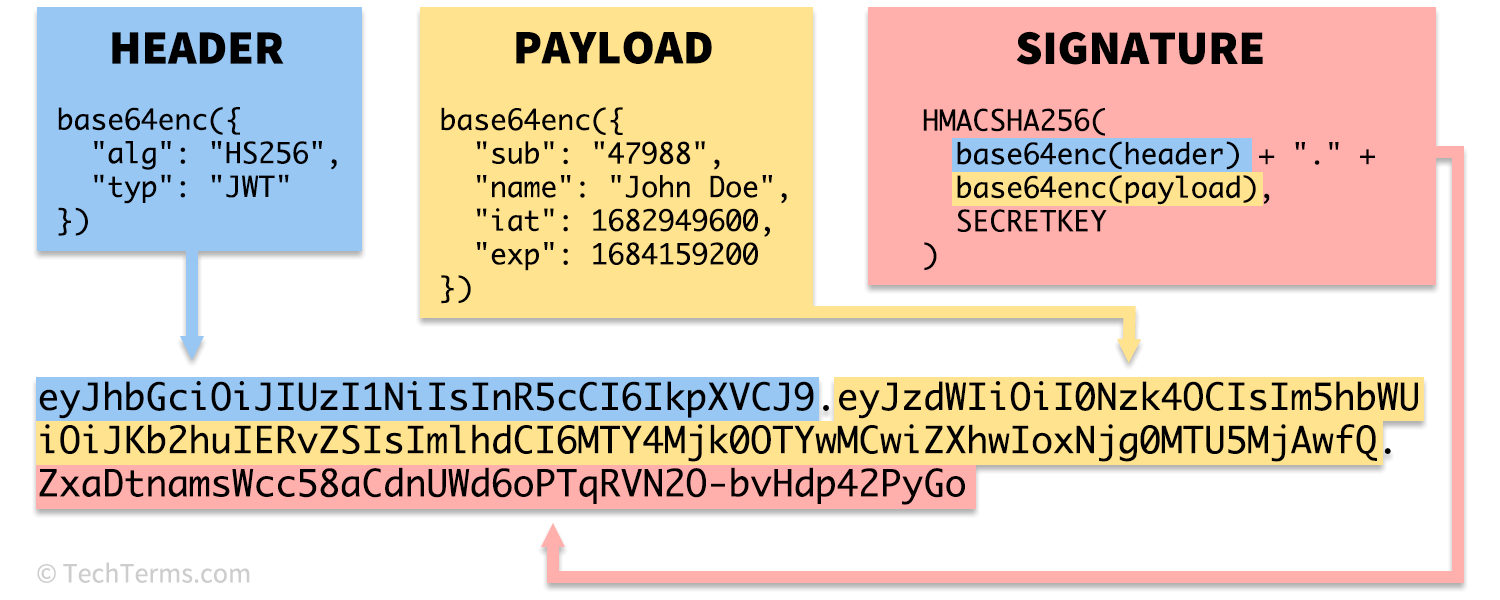
Let's examine each part.
A developer's guide to RFC 7519, part 1: JWT structure and ...
This article from Stytch provides a clear, developer-focused breakdown of the JWT structure, grounding the explanation in the official RFC 7519 specification. It will give us the precise definitions for each component.
Please read the sections 'The JWT structure' and 'The JWT payload and claims'. Pay close attention to the purpose of the header, the different types of claims in the payload, and how they are all encoded.
As you just read, the components are:
-
Header (Metadata): A JSON object that specifies the token type (
typ, which is "JWT") and the signing algorithm used (alg, e.g., "HS256"). This header is then Base64Url encoded to form the first part of the JWT.{ "alg": "HS256", "typ": "JWT" } -
Payload (The Claims): A JSON object containing the "claims"—statements about the user and the token itself. This is where you put the data needed for authentication and authorization. Claims include:
- Registered Claims: Standardized claims like
sub(subject, e.g., user ID),exp(expiration time), andiat(issued at). - Custom Claims: Any other data you want to include, like
role: "admin"orname: "John Doe".
This payload is also Base64Url encoded to form the second part of the JWT.
{
  "sub": "user123",
  "role": "admin",
  "exp": 1678886400
}
Critical Security Point: Base64Url encoding is not encryption. It's a reversible encoding scheme. Anyone who intercepts a JWT can easily decode the header and payload and read their contents. You must never store sensitive information (like passwords or credit card numbers) in a JWT payload.
- Registered Claims: Standardized claims like
-
Signature (The Verification): This is the key to a JWT's security. To create the signature, you take the encoded header, the encoded payload, a secret key known only to the server, and sign them with the algorithm specified in the header.
HMACSHA256(
  base64UrlEncode(header) + "." +
  base64UrlEncode(payload),
  your-256-bit-secret
)
This signature ensures that the token is authentic (it was issued by your server) and that its contents have not been tampered with. If an attacker changes even a single character in the payload (e.g., changing their role from "user" to "admin"), the signature will no longer be valid.
Now, let's watch a video that walks through this structure and the token authentication flow visually.
Authentication on the Web (Sessions, Cookies, JWT, localStorage, and more)
This segment from the 'Authentication on the Web' video provides a great visual walkthrough of the token-based flow and a detailed explanation of JWT's structure and its security implications.
Please watch the following two segments: Token-Based Authentication Flow (09:36 - 13:05): This outlines the high-level process of a client logging in, receiving a token, and using it for subsequent requests. JWT Deep Dive (13:05 - 18:03): This part focuses specifically on JWTs. It shows how to decode the parts of a token and explains the crucial role of the signature and the security risks, particularly XSS attacks when storing JWTs in localStorage.
Session-Based vs. Token-Based Authentication: The Trade-Offs
Now that we understand both mechanisms, we can compare them. This isn't a matter of one being universally "better"; it's about choosing the right tool for the job based on your application's architecture and requirements. The decision hinges on a series of trade-offs.
Here is a fantastic diagram and table that summarize the differences in flow and features.

Let's use a more detailed table to break down the most important points of comparison.
Sessions vs Tokens — Complete Guide for Backend Engineers
The article 'Sessions vs Tokens — Complete Guide for Backend Engineers' provides a clear and concise comparison table that perfectly summarizes the core differences. We'll also look at the sections explaining the pros and cons in more detail.
Please read the section '⚔️ Session vs Token — Direct Comparison'. The table there is an excellent reference that we will build upon.
Here's an expanded breakdown of those key differences:
| Feature | Session-Based (Stateful) | Token-Based (Stateless) |
|---|---|---|
| State Management | Stateful. The server must store session data for every active user. | Stateless. The server stores nothing. All required user data is in the token. |
| Storage | Server-side (e.g., Redis, database). The client stores only a small, opaque session ID. | Client-side (e.g., localStorage, HttpOnly cookie). The client stores the entire token. |
| Scalability | Harder. Requires a centralized session store that all server instances can access. Can be a performance bottleneck. | Easier. Any server instance can validate a token as long as it has the secret key. Perfect for microservices and horizontal scaling. |
| Revocation | Easy & Instant. To log a user out or invalidate a session, simply delete the session record from the server-side store. | Hard. A JWT is valid until it expires. You cannot easily "kill" a stolen token. Workarounds (like token blacklists) reintroduce state, defeating the purpose. |
| Performance | Requires a database/cache lookup on every request to retrieve session data. | Potentially Faster. Can avoid a database lookup if all necessary data is in the token's claims. Verification is a CPU-bound cryptographic operation. |
| Data Security | High. All sensitive session data remains on the server. The client only sees a meaningless ID. | Lower. The payload is only encoded, not encrypted. Prone to data leakage if sensitive info is put in the payload. |
| Primary Vulnerability | CSRF (Cross-Site Request Forgery). Mitigated with CSRF tokens. | XSS (Cross-Site Scripting). If a JWT is in localStorage, an XSS attack can steal it and impersonate the user. |
To hear these points discussed with more nuance, let's watch the comparison segments from two excellent videos.
Session Vs JWT: The Differences You May Not Know!
The ByteByteGo and Code Realm channels both offer fantastic summaries of the pros and cons. Watching these will help solidify your understanding of the trade-offs.
First, watch this segment from ByteByteGo's 'Session Vs JWT' (05:06 - 06:38). It provides a concise summary of when to choose each approach.
Authentication on the Web (Sessions, Cookies, JWT, localStorage, and more)
Now, let's watch the more in-depth comparison from 'Authentication on the Web'.
Watch this segment from 22:47 to 29:08. It details the advantages and disadvantages of both methods, covering points like data staleness with JWTs and the security benefits of HttpOnly cookies for sessions.
When to Use Which? The Hybrid Approach
Given the trade-offs, the choice becomes clearer:
-
Use Sessions when:
- You're building a traditional, server-rendered web application (a monolith).
- Immediate and guaranteed session revocation is a high-priority security requirement (e.g., financial applications, admin panels).
- You prefer to keep all user data securely on the server.
-
Use Tokens (JWTs) when:
- You're building a stateless API for a Single-Page Application (SPA), mobile app, or third-party service.
- Your architecture is based on microservices, and you need a way for services to trust each other's authentication requests.
- Horizontal scalability is a primary concern.
The Modern Hybrid: Access Tokens + Refresh Tokens
The biggest drawback of JWTs is the difficulty of revocation. The modern solution to this is a hybrid approach that gives you the best of both worlds:
- Access Token: A standard JWT with a very short expiry (e.g., 5-15 minutes). This is used to authenticate API requests. Because it expires quickly, the window of opportunity for an attacker with a stolen token is small.
- Refresh Token: A long-lived, opaque, random string. This token is stored securely by the client (ideally in an
HttpOnlycookie) and is sent only to a special/token/refreshendpoint when the access token expires. - Server-Side Logic: The server does store and manage refresh tokens in a database. When it receives a valid refresh token, it issues a new, short-lived access token. If a user needs to be logged out, the server simply invalidates their refresh token in the database, preventing them from getting any new access tokens.
This model combines the stateless scalability of JWT access tokens with the server-side control and revocation capabilities of sessions.
Conclusion
You now have a robust mental model for both stateful and stateless authentication. You understand not just what a JWT is, but why it's structured the way it is and the specific architectural problems it solves—and creates.
Key Takeaways:
- JWT Structure: A JWT consists of a
header,payload, andsignature, separated by dots. The payload contains claims but is only Base64Url encoded, not encrypted. The signature guarantees integrity, not confidentiality. - Stateful vs. Stateless: Session-based authentication is stateful (server remembers the user), while token-based authentication is stateless (the token itself is the proof of identity).
- The Core Trade-Off: The primary trade-off is control vs. scalability. Sessions offer easy, instant revocation (control) but are harder to scale. Tokens scale effortlessly but are difficult to revoke before expiration.
- Security Context: Sessions are primarily vulnerable to CSRF, while JWTs stored in browser
localStorageare vulnerable to XSS. UsingHttpOnlycookies is a powerful defense for both session IDs and refresh tokens. - The Mental Model:
- Sessions: The server gives you a ticket and remembers who you are.
- Tokens: You carry a detailed, signed ID card that you must show everywhere.
Preview of the Next Lesson
Theory is essential, but practice makes it concrete. In the next lesson, we will put this knowledge to work. We will: Implement JWT authentication in a Django application, including token generation and validation middleware. You'll write the Python code to issue a JWT upon login and build the middleware to protect API endpoints by validating incoming tokens.