Hello! Welcome to the next lesson in our deep dive into asynchronous processing.
In our last lesson, we established that idempotency is critical for building reliable distributed systems because it allows us to safely retry operations that fail due to the inherent unreliability of networks. This naturally leads to the next question: how exactly should we perform these retries?
Simply retrying a failed operation as fast as possible can turn a temporary slowdown into a catastrophic outage. This lesson will equip you with the patterns to build services that are not just resilient, but also well-behaved. We will cover common retry strategies like exponential backoff and then explore what to do with messages that fail persistently, introducing the concept of a dead-letter queue (DLQ).
The Problem with Naive Retries
Imagine a downstream service is temporarily overloaded and starts timing out. If all its clients immediately retry their requests, they will flood the service with even more traffic, pushing it further into overload and preventing it from ever recovering. This self-inflicted denial-of-service is often called a "thundering herd" problem.
To build robust systems, we need more intelligent retry logic. The first video below perfectly illustrates how a simple, aggressive retry strategy can amplify a small problem into a system-wide failure.
Retries & Exponential Backoff - Deep Dive
This video from glich.stream sets up a realistic scenario of interdependent services and shows why a simple, constant-delay retry mechanism is problematic at scale.
Watch the segment from 00:13:25 to 00:19:07. Focus on how a fixed retry limit (e.g., 5 retries) multiplies the number of requests in the system and can crush a service that is trying to recover.
Strategy 1: Exponential Backoff
The core idea to solve this problem is exponential backoff. Instead of retrying with a fixed delay, we exponentially increase the waiting period between each successive retry.
For example, the client might:
- Attempt the operation. It fails.
- Wait 1 second, then retry. It fails again.
- Wait 2 seconds, then retry. It fails again.
- Wait 4 seconds, then retry.
- Wait 8 seconds, and so on.
This strategy gives the struggling downstream service progressively more "breathing room" to recover. The following video segment explains this concept clearly, complete with a formula and graph.
Retries & Exponential Backoff - Deep Dive
Let's continue with the same video to see how exponential backoff provides a much better solution.
Watch from 00:19:07 to 00:23:16. Pay attention to how the retry delay is calculated and how the delay grows exponentially over time.
Strategy 2: Exponential Backoff with Jitter
We can go even deeper. While exponential backoff is a huge improvement, clients that experience failure at the same time will still attempt to retry in synchronized waves. At scale, this can still create spikes of traffic.
The solution is to add jitter, which is simply a small, random amount of time added to the backoff delay. This randomization breaks the synchronization between clients and smooths out the retry attempts into a more distributed and manageable load.
The next segment of the video references a classic AWS architecture blog post to explain this refinement.
Retries & Exponential Backoff - Deep Dive
To build truly robust, large-scale systems, we need to add jitter to our backoff strategy. This segment explains why and how.
Watch from 00:23:16 to 00:30:07. Focus on the 'clustering' of requests even with exponential backoff, and how adding jitter (randomness) distributes the load more evenly. Also, note the concept of 'capping' the maximum delay.
The image below provides a fantastic summary of these retry patterns, visually contrasting a fixed backoff with an exponential one and illustrating various failure points.

Practical Application with Celery
Let's bring this theory into the context of your work with Python and Django. Celery, the popular task queue library, has excellent built-in support for these retry strategies.
You can configure a task to automatically retry on certain exceptions using autoretry_for and enable exponential backoff with retry_backoff=True.
A Deep Dive into Celery Task Resilience, Beyond Basic Retries
This article from GitGuardian provides a practical guide to implementing these resilience patterns in Celery. It's a great bridge from theory to code.
Read the section titled '2. Handling Expected Failures'. Notice how autoretry_for is used with specific exceptions and how retry_backoff=True enables the strategy we just learned about. The best practices callouts are particularly valuable.
To give you the complete technical details, the official Celery documentation specifies all the parameters you can use to fine-tune this behavior. You have control over the backoff factor, the maximum backoff delay, and whether jitter is applied.
Tasks — Celery 5.6.2 documentation
The official Celery documentation provides the definitive reference for all retry-related task options.
Skim through the sections 'Automatic retry for known exceptions' and the definitions for Task.retry_backoff, Task.retry_backoff_max, and Task.retry_jitter. This will show you the exact tools Celery gives you to implement exponential backoff with jitter and a cap.
By default, retry_backoff=True in Celery enables exponential backoff with jitter, which is an excellent, production-ready default.
Handling Unresolvable Failures: Dead-Letter Queues
Retry strategies are perfect for transient (temporary) failures. But what happens if a task fails for a permanent reason?
- A bug in your code that raises an unexpected exception.
- Malformed message data that your task can never process (a "poison pill").
If you keep retrying this task, it will fail every time, potentially forever. It will clog your queue, consume worker resources, and block other valid tasks from being processed. Dropping the message means you lose potentially critical data (e.g., a payment confirmation).
The solution is the Dead-Letter Queue (DLQ). A DLQ is a separate, dedicated queue where messages are sent after they have failed a certain number of times in the main queue.
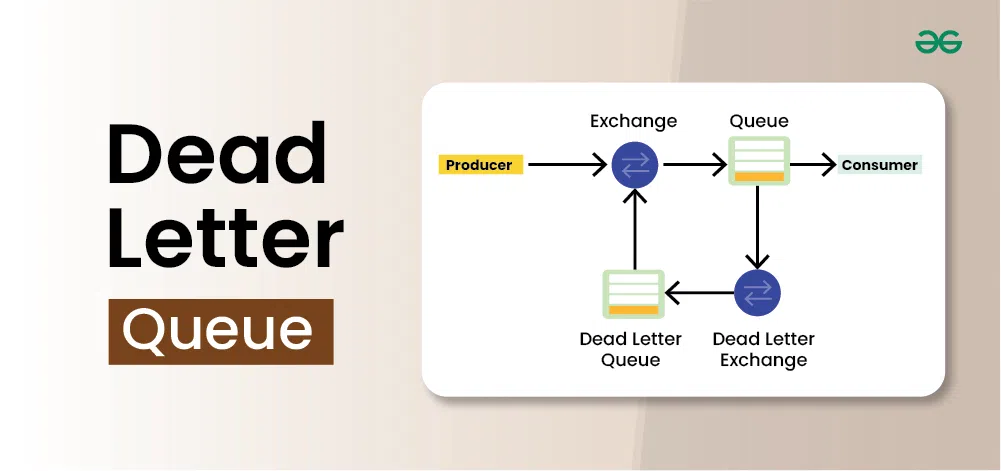
The purpose of a DLQ is not to retry, but to isolate and preserve failed messages. It serves several key functions:
- Unblocks the main queue: Moves the "poison pill" out of the way.
- Prevents data loss: The failed message is stored safely instead of being discarded.
- Enables debugging and observability: Developers can inspect the messages in the DLQ to diagnose the root cause of the failures.
- Allows for manual intervention: After fixing a bug or correcting the message data, a developer can choose to manually re-queue the message for processing.
The following video provides a great deep dive into the concept and its importance.
Deep dive into Dead-Letter Queues
This video from Software Developer Diaries explains the DLQ pattern, its benefits, and its role in a mission-critical system.
First, watch from 00:00 to 05:11 to understand why DLQs are necessary and to see the message flow. Then, skip to 10:04 and watch until the end (13:00) for a crucial discussion on the benefits, downsides, and the key point that a DLQ is a safety net, not a retry mechanism.
Dead-Lettering in Celery
Celery itself does not provide a universal DLQ feature because the implementation is highly dependent on the message broker you use (e.g., RabbitMQ, Redis). However, you can achieve the same result.
With a broker like RabbitMQ, which has first-class support for Dead Letter Exchanges (DLX), you can configure your queues so that rejected messages are automatically routed to a DLQ. Celery's Reject exception can be used to trigger this broker-level feature.
Tasks — Celery 5.6.2 documentation
The Celery documentation explains how to use the Reject exception to interact with broker features like Dead Letter Exchanges.
Read the short section on 'Reject'. This shows the mechanism Celery provides to tell the broker to reject a message, which is the hook needed for a broker-level DLQ.
You can also implement the principle of a DLQ at the application level. For example, you could define a try...except block in your task. After the final retry fails, the except block could catch the MaxRetriesExceededError and manually send the task's details to a separate "failed_tasks" queue for later inspection. The "Bonus" section of the GitGuardian article demonstrates a similar pattern, where tasks that time out are re-queued onto a different, more powerful queue—a specialized form of dead-lettering.
Conclusion
You now have a robust framework for handling failures in asynchronous systems. You're no longer just retrying; you're doing so in a way that promotes system stability and ensures no data is lost.
Key Takeaways:
- Naive, aggressive retries can cause cascading failures. Use exponential backoff with jitter to gracefully handle transient errors.
- Celery provides powerful, built-in support for these strategies with
autoretry_for,retry_backoff,retry_jitter, andmax_retries. - A Dead-Letter Queue (DLQ) is a critical safety net for handling messages that fail permanently after all retries are exhausted.
- The purpose of a DLQ is to isolate, preserve, and observe failed messages, not to automatically retry them. It unblocks the main processing pipeline and prevents data loss.
Preview of the Next Lesson
We've spent the last few lessons deep in the mechanics of asynchronous tasks. Now, we're going to zoom out and look at the bigger picture of system architecture. In the next module, we'll begin exploring system design and scaling. Our first lesson will tackle a fundamental concept: comparing vertical scaling ('scaling up') versus horizontal scaling ('scaling out') and understanding the limits of each. This will set the foundation for designing systems that can handle growth from ten users to ten million.