Hello! Welcome back to our deep dive into asynchronous processing.
In our last lesson, we explored the Publish/Subscribe pattern and how it enables resilient, scalable, event-driven architectures. A crucial point we touched on was the concept of "at-least-once" delivery, where a message broker guarantees a message is delivered, but might deliver it more than once in case of network failures or consumer crashes. We concluded that to handle this safely, consumers must be idempotent.
Today, we'll focus entirely on that concept. This lesson addresses the learning outcome: Explain idempotency and why it is critical for building reliable distributed operations. Understanding idempotency isn't just an academic exercise; it's a fundamental requirement for building robust backend systems that can gracefully handle the inherent unreliability of networks.
What is Idempotency?
At its core, idempotency is a property of an operation. An operation is idempotent if applying it multiple times has the exact same effect as applying it just once.
Think of it like this:
- Non-idempotent operation: Incrementing a counter (
x = x + 1). If you run this twice, the result (xis increased by 2) is different from running it once (xis increased by 1). - Idempotent operation: Setting a variable to a specific value (
x = 5). Running this once, twice, or a hundred times still results inxbeing 5.
Let's watch a short video that provides a crisp definition and some easy-to-understand examples.
Idempotency, a key term in distributed systems | Software Engineering Dictionary
This video from the 'Studying With Alex' channel provides an excellent, concise definition of idempotency and why it's important.
Watch the first 1 minute and 17 seconds of the video. Focus on the distinction between setting a variable (idempotent) and incrementing it (non-idempotent), and the real-world analogies like the crosswalk button.
Why Idempotency is Critical in Distributed Systems
In a single, monolithic application, you have a high degree of certainty. When you call a function, it either works or it throws an exception, and you know the outcome immediately. In a distributed system, where services communicate over a network, this certainty vanishes.
As soon as a client (like your web browser or another microservice) sends a request to a server, there are multiple points of failure:
- The request could be lost on its way to the server.
- The server could process the request successfully, but the response could be lost on its way back to the client.
- The server could crash mid-process.
From the client's perspective, a timeout or lack of response is ambiguous. It has no way of knowing which scenario occurred. The only safe assumption is to retry the operation. This leads to three possible delivery semantics:
- At-most-once: The client sends the request once and hopes for the best. If it fails, the operation is lost. This is unacceptable for critical tasks like processing a payment.
- At-least-once: The client retries the request until it receives a definitive success or failure response. This guarantees the operation will eventually be processed, but it might be processed multiple times.
- Exactly-once: The ideal state where the operation is processed once and only once.
"Exactly-once" is notoriously difficult to achieve at the network level. Instead, we build reliable systems by combining at-least-once delivery with idempotent receivers. This combination ensures that even if an operation is attempted multiple times, its effect on the system's state occurs exactly once.
This next video segment clearly illustrates how network unreliability forces us into this "at-least-once" scenario and sets the stage for idempotency as the solution.
Idempotency, a key term in distributed systems | Software Engineering Dictionary
Let's continue with the 'Studying With Alex' video to see how network failures lead to the 'at-least-once' problem and how idempotency solves it.
Watch from 01:17 to 05:07. Pay close attention to the distinction between 'at-most-once' and 'at-least-once', and the key conclusion: retrying an idempotent operation achieves an 'exactly-once' effect.
How to Implement Idempotency
So, how do we make our operations idempotent? There are two main strategies.
1. Use Inherently Idempotent Operations
Some operations are naturally idempotent. When designing APIs, especially RESTful ones, leveraging the semantics of HTTP methods is a great starting point.
The video below gives a clear breakdown of which common HTTP methods are idempotent and why.
Idempotency - What it is and How to Implement it
This video by Alex Hyett analyzes common HTTP methods through the lens of idempotency.
Watch from 01:02 to 03:30. Note the reasoning for why GET, PUT, and DELETE are idempotent, while POST and PATCH are generally not.
To summarize:
GET,HEAD,OPTIONS: These are safe methods (read-only), which makes them inherently idempotent.PUT: Idempotent. APUTrequest is meant to replace a resource entirely. Sending the samePUTrequest multiple times to/users/123will have the same result as sending it once.DELETE: Idempotent. Deleting/users/123once removes the user. Subsequent calls will likely return a404 Not Found, but the state of the system (the user is gone) remains the same.POST: Not idempotent.POSTis used to create a new resource. Sending the samePOSTrequest to/orderstwice will create two identical orders.PATCH: Can be idempotent, but isn't necessarily. APATCHto set a user's email is idempotent. APATCHwith an instruction like "append this item to a list" is not.
Similarly, in databases, an UPSERT operation (like INSERT ... ON CONFLICT DO UPDATE in PostgreSQL) is idempotent. It ensures a record is created if it doesn't exist or updated if it does, preventing duplicate entries from repeated INSERT attempts.
2. Make Non-Idempotent Operations Idempotent with a Key
For non-idempotent operations like POST, we need a mechanism to make them safe to retry. The standard industry practice is to use an Idempotency Key.
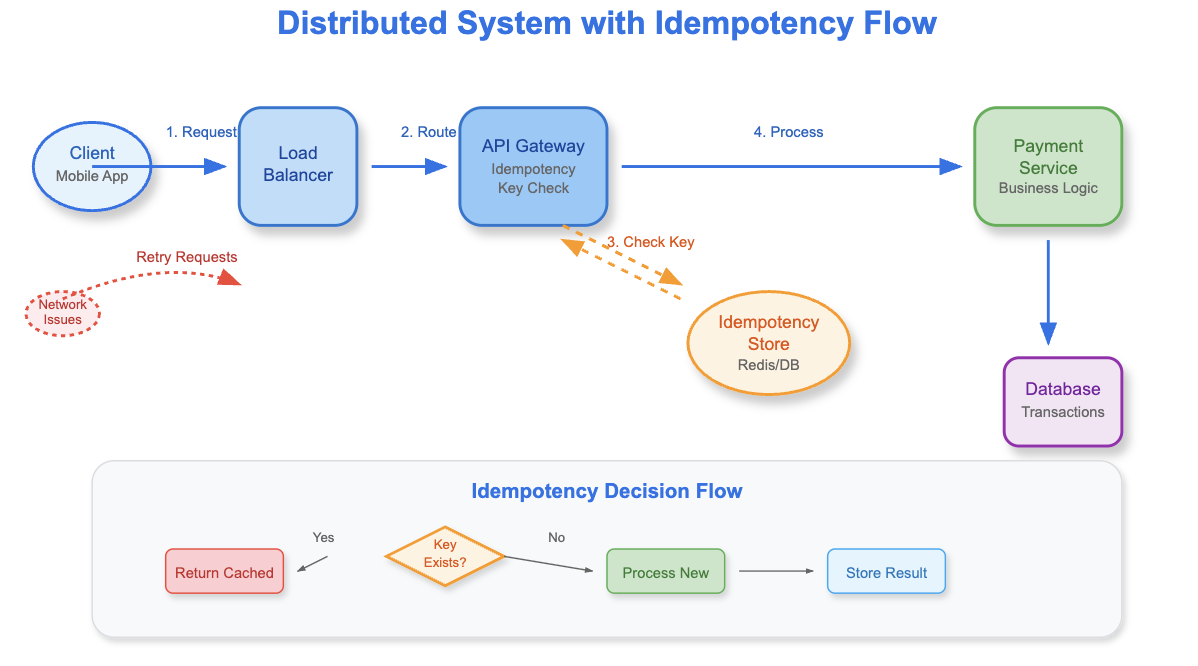
The flow works like this:
- The client generates a unique key (e.g., a UUID) for a specific user action or "intention." This key must be the same for the initial request and all subsequent retries of that request.
- The client sends this key in a request header, often named
Idempotency-KeyorX-Request-Id. - The server receives the request and performs the following logic, ideally within a single database transaction for atomicity:
a. It checks a persistent storage (like a Redis cache or a database table) to see if it has ever processed this idempotency key.
b. If the key exists: The server knows this is a retry. It stops processing, retrieves the original response it saved from the first time, and sends that back to the client.
c. If the key does not exist: This is a new operation. The server processes the request, saves the resulting HTTP status and response body, and then stores them against the idempotency key in the persistent store. Finally, it sends the response to the client.
This flow is visualized perfectly in the following diagram.
Let's watch a video that details this implementation strategy.
Idempotency - What it is and How to Implement it
Now that you understand the concept, let's see how it's implemented in practice. This video continues where the last one left off, explaining the use of idempotency keys.
Watch from 03:30 to 05:57. Focus on how a unique identifier (the idempotency key) is used, why it needs to be stored in a persistent key-value store like Redis, and the overall server-side logic.
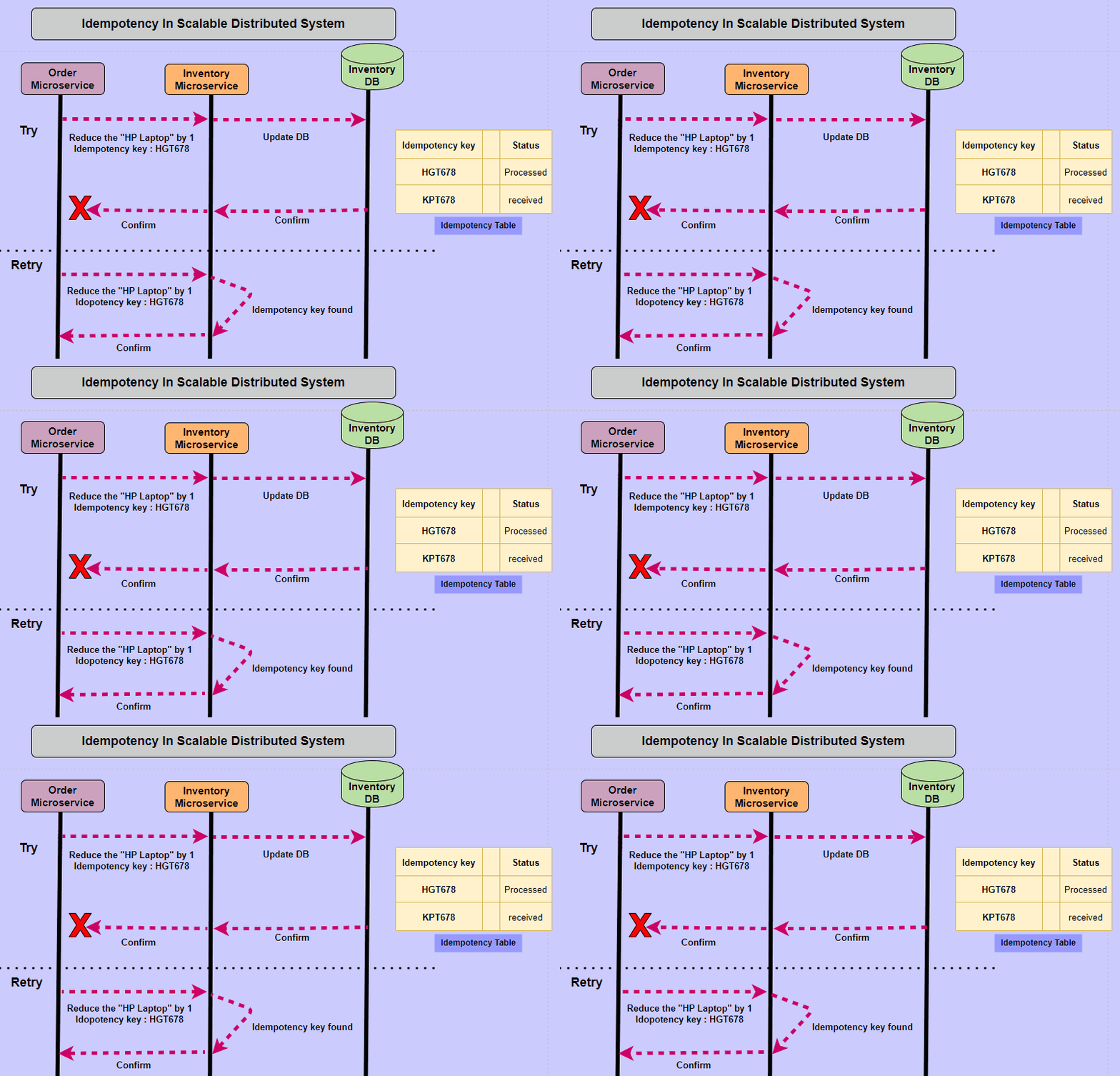
The following sequence diagram provides another excellent view, this time showing the interaction between two microservices during a retry scenario.
For a deeper textual explanation covering both request IDs and an alternative (but more complex) server-side fingerprinting method, the following article is an excellent resource.
Timeouts, Retries and Idempotency In Distributed Systems
This article from InfoQ, based on a talk by Sam Newman, provides a thorough, industry-level perspective on implementing idempotency.
Read the section titled '3. Idempotency'. It covers the two main strategies (request IDs and server-side fingerprinting) and discusses the critical detail of what response to send back on a retried request.
The Deep Dive: Practical Considerations
As you wanted, let's get into the nitty-gritty details you must consider when implementing this pattern.
- Key Generation: The key must be generated by the client to uniquely identify a single logical operation. A UUID is a common choice.
- Key Storage: In-memory storage (like a Python dictionary) is insufficient. If your server restarts or you have multiple instances behind a load balancer, the state is lost. You need a shared, persistent data store like Redis or a dedicated database table.
- Key Scope: A simple UUID might not be enough. To avoid potential (though astronomically rare) collisions and to organize keys, it's good practice to scope the key's uniqueness to a user and/or endpoint. The final key might be a composite like
<user_id>:<request_uuid>. - Storage Duration (TTL): You don't need to store idempotency keys forever. This would consume infinite storage. Keys are typically stored for a period that safely covers any reasonable client retry window, often 24 to 48 hours. Most key-value stores like Redis support a "Time-To-Live" (TTL) feature to automatically expire old keys.
- Atomicity: This is the hardest part. The sequence "check key -> perform business logic -> store key and response" must be atomic. If your service crashes after charging a credit card but before saving the idempotency key, a retry will result in a double charge. For ultimate safety, this flow should be wrapped in a database transaction if possible.
- Body Validation: What if a client mistakenly reuses an idempotency key for a different request? For example, the key is the same, but the payment amount has changed. Some systems (like Stripe's API) will return an error in this case. This can be achieved by also storing a hash of the request body and comparing it on retries.
Conclusion
You now have a solid, deep understanding of idempotency. It's not magic; it's a deliberate design choice that is essential for creating reliable, fault-tolerant distributed systems.
Key Takeaways:
- Idempotency is a property of an operation where multiple executions have the same effect as one.
- It is critical in distributed systems to safely handle retries, which are inevitable due to network unreliability.
- Combining at-least-once delivery with idempotent operations allows us to achieve an effective exactly-once processing guarantee.
- The primary implementation technique for non-idempotent operations is the Idempotency Key, a unique identifier sent by the client and tracked by the server.
- A robust implementation requires careful consideration of key generation, persistent storage, key lifetime (TTL), and atomicity.
Preview of the Next Lesson
We've established that systems must retry failed operations. But how should they retry? Retrying immediately and aggressively can overwhelm a struggling downstream service, making a bad situation worse.
In our next lesson, we will cover the practical mechanics of failure handling. The learning outcome will be to describe common retry strategies (e.g., exponential backoff) and the purpose of a dead-letter queue. This will equip you with the patterns to build clients and workers that are not just correct, but also well-behaved citizens in a complex distributed ecosystem.