In our last lesson, we explored conflict as the engine of narrative, driven by a character's goals and the escalating obstacles they face. You learned to identify different types of conflict and analyze how filmmakers build tension through "progressive complications." Now, we'll examine the vehicle that this engine powers: the most common and influential narrative framework in storytelling.
This lesson is dedicated to understanding and analyzing the three-act structure. Your learning outcome is to be able to dissect a film's narrative using this powerful framework. For you as a filmmaker, this isn't just an analytical tool; it's a structural blueprint. Mastering it will allow you to consciously shape the pacing, tension, and emotional journey of your own stories. We will approach this not as a rigid formula, but as a flexible and time-tested model for organizing a compelling narrative.
The Blueprint of Story: A Beginning, a Middle, and an End
At its core, the three-act structure is an intuitive model that divides a story into three distinct parts: the Setup, the Confrontation, and the Resolution. This idea goes back to Aristotle's Poetics, which observed that a satisfying story must have a beginning, a middle, and an end, linked by a chain of cause and effect.
To get a sense of this fundamental shape, the following short video provides an excellent introduction.
Three Act Structure: The Ultimate Guide
This video from Reedsy, "Three Act Structure: The Ultimate Guide," offers a concise historical overview and explains why this structure is so deeply ingrained in how we tell and understand stories.
Watch the introductory segment from the beginning until this point. Focus on the core idea that this isn't a restrictive formula but a natural shape for storytelling that mirrors how we process problems and learn lessons.
As the video explains, modern screenwriting has codified this ancient concept. While the exact length can vary, a common guideline for proportion is:
- Act I: The Setup (approx. 25% of the story)
- Act II: The Confrontation (approx. 50% of the story)
- Act III: The Resolution (approx. 25% of the story)
The following diagrams provide two visual representations of this structure. The first is a classic, linear view, while the second offers a more detailed "beat sheet" with key plot moments mapped out.
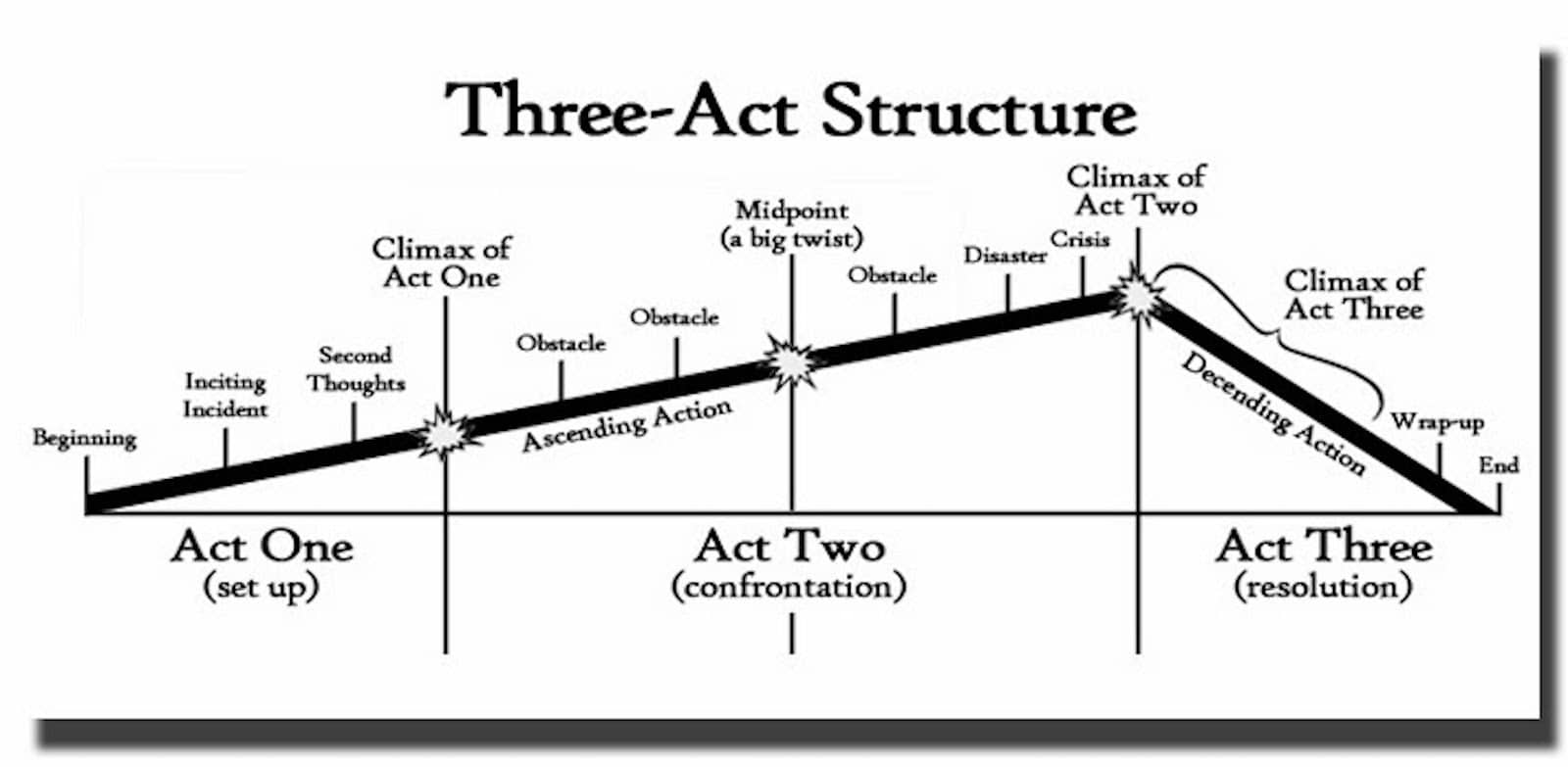

Now, let's explore what defines each of these acts and the key moments, or "beats," that give them their shape.
Deconstructing the Three Acts
To understand the function of each act, we need to look at the key narrative events that occur within them. The following article from StudioBinder provides a clear, high-level definition of each act.
Three Act Structure in Film: Definition and Examples
This article clearly defines the three-act structure and the fundamental purpose of each act.
Read the section under the heading THREE ACT STRUCTURE DEFINITION. This will give you a solid, top-level understanding of the Setup, Confrontation, and Resolution.
With those core definitions in mind, we can break down each act into more granular components. A highly detailed and practical approach comes from the Arc Studio blog, which we will use as our primary guide, supplemented by video examples.
Act I: The Setup
The first act is all about laying the foundation. It establishes the protagonist, their world, their goals, and the internal and external conflicts they face. It ends when the protagonist is irrevocably propelled into the main conflict of the story.
The Three-Act Structure in Screenwriting
This article breaks down Act I into a series of clear, actionable beats. Its structured approach is excellent for analysis.
Read the section Act I – The Setup. Pay close attention to the distinct beats it outlines: Opening Image & Setup: The introduction to the protagonist and their "ordinary world." Theme: The underlying want vs. need of the character. Call To Action (Inciting Incident): The event that disrupts the status quo. Resistance: The character's hesitation to embrace the call. The article uses The Matrix and Up as examples. As you read, think about how these beats establish everything we need to know for the journey ahead.
To see these first-act beats in action, let's watch how the film Jurassic Park handles them.
Three Act Structure Explained — The Secret to Telling a Great Story
This video, "Three Act Structure Explained," provides a clear analysis of the opening of Jurassic Park, breaking it down into the key beats of Act I.
Watch the segment covering Act I from this point. Notice how the video identifies: The Hook, which grabs the audience's attention. The Inciting Event, where Hammond invites the scientists. The First Plot Point, the point of no return when they see the dinosaurs for the first time, which launches the story into Act II.
Act II: The Confrontation
This is the longest and most substantial act. The protagonist, having committed to the journey, now faces a series of escalating challenges—the "progressive complications" we discussed in our previous lesson. The stakes are raised, new characters are introduced, and the protagonist is pushed to their limits, leading to a major turning point or crisis.
The Three-Act Structure in Screenwriting
The Arc Studio article continues its detailed breakdown for Act II, showing how conflict is developed and escalated.
Read the section titled Act II – The Confrontation. This section is dense but crucial. Focus on understanding the sequence of events: Crossing The Threshold: The hero enters the "new world." Fun and Games: The "promise of the premise," where the hero explores this new world and faces initial tests. Midpoint: A major event that pivots the story, often a false victory or false defeat. External to Internal (Bad Guys Close In): The opposition gets stronger, and the hero's internal flaws are tested. All Is Lost & Dark Night of the Soul: The hero hits rock bottom, a moment of apparent defeat that forces them to find new strength.
Let's return to Jurassic Park to see how these mid-story beats create rising tension and shift the narrative's direction.
Three Act Structure Explained — The Secret to Telling a Great Story
The StudioBinder video continues its analysis, focusing on the key structural points of the second act.
Watch the segment covering Act II, from this point. The video explains: The First Pinch Point, which reminds the audience of the antagonistic force (the storm). The Midpoint, the iconic T-Rex escape that transforms the film from wonder to survival horror. The Second Pinch Point, Nedry's death, which raises the stakes by removing any easy solution.
Act III: The Resolution
The final act is about resolving the central conflict. After the low point at the end of Act II, the protagonist rallies, using everything they've learned to face the antagonist in a final showdown. The story reaches its climax, and the aftermath shows the result of the protagonist's journey and transformation.
The Three-Act Structure in Screenwriting
This final reading from the Arc Studio article details the components of the story's conclusion.
Read the section titled Act III – Resolution. This explains the beats that bring the story to a satisfying close: The Fix: The hero's realization or breakthrough. Finale: The final confrontation, including the climax. Closing Image: The new status quo, mirroring or contrasting the opening image to show transformation.
Finally, let's complete our analysis of Jurassic Park by seeing how its third act is constructed.
Three Act Structure Explained — The Secret to Telling a Great Story
The video concludes its structural breakdown, showing how the conflicts of Jurassic Park are resolved.
Watch the final analytical segment from this point. This covers: The Third Plot Point, where Ellie restores power (a false victory) but unleashes the raptors (a new, greater threat). The Climax, the kitchen scene and final battle with the raptors. The Resolution, where the characters escape, and Alan's character arc is complete.
A Complete Analysis: Putting It All Together
You have now examined all the key beats of the three-act structure. To see how these pieces form a complete, coherent whole, the StudioBinder article you first looked at contains an excellent written breakdown of Jurassic Park. This serves as a perfect model for the kind of analysis you are learning to perform.
Three Act Structure in Film: Definition and Examples
This section provides a complete, beat-by-beat analysis of Jurassic Park, synthesizing all the concepts we've discussed into a single case study.
Read the entire section under the heading 3 Act Structure Breakdown. As you read, connect each beat described (The Hook, Inciting Event, First Plot Point, etc.) back to the definitions you learned earlier in the lesson. Notice how each event logically causes the next, driving the narrative forward.
Conclusion
In this lesson, you have deconstructed the three-act structure, the most foundational blueprint in narrative filmmaking. You have moved from a high-level understanding of a beginning, middle, and end to a granular analysis of the specific plot beats that give a story its shape, momentum, and emotional power.
Here are your key takeaways:
- A Universal Framework: The three-act structure (Setup, Confrontation, Resolution) is not a rigid rule but a powerful and flexible framework for organizing a story and managing audience engagement.
- Act I: The Setup establishes the character, their world, and their goal, culminating in the First Plot Point, a point of no return that launches the main story.
- Act II: The Confrontation is the longest act, where the protagonist faces escalating obstacles ("progressive complications"). Key beats include the Midpoint (a major turning point) and the All Is Lost moment (the character's lowest point).
- Act III: The Resolution begins after the protagonist rallies. It drives toward the Climax, the final confrontation that resolves the central conflict, and ends with a Resolution showing the transformed character in their new reality.
In our next lesson, we will sharpen our focus on the most critical signposts in this structure. We'll perform a deep dive into how to identify the inciting incident, turning points, climax, and resolution, building directly on the framework you've learned today.