Welcome to the second module of our course, where we shift our focus from the building blocks of film language to the architecture of storytelling itself. In the previous module, we concluded by examining cinematic point of view, exploring how filmmakers guide the audience to be either detached observers or immersed participants in a character's experience. That choice is fundamental, because it determines whose struggles we invest in. Today, we will explore the very nature of those struggles.
This lesson tackles the engine of every narrative: conflict. Your goal is to learn how to identify the different types of conflict—internal, interpersonal, and external—and analyze how filmmakers both establish and escalate it. For you as a filmmaker, understanding how to construct and layer conflict is not just a theoretical exercise; it is the core craft of creating a story that is engaging, meaningful, and emotionally resonant.
What is Conflict?
At its most basic level, conflict is what happens when a character wants something, and an obstacle stands in their way. This opposition between a character's goal (intention) and the forces that prevent them from achieving it (obstacle) is what generates narrative momentum. A story without conflict is merely a sequence of events. A story with conflict becomes a compelling journey.
Filmmakers use three primary arenas to stage these struggles. A fantastic video from StudioBinder provides a clear and concise overview of these categories, which they label as inner, personal, and extrapersonal conflict.
How to Write the Main Conflict of the Story — The Engine of a Narrative
This video, "How to Write the Main Conflict of the Story," uses excellent film examples to illustrate the main categories of conflict. It will give you a strong visual and conceptual foundation.
Please watch the following sections: The introduction provides a simple, powerful definition of conflict as intention plus obstacle. Inner conflict explores the struggles that take place within a character's own mind. Personal conflict covers the obstacles created by other characters. Extrapersonal conflict deals with opposition from large-scale forces like nature or society.
As the video demonstrates, we can group these into three core types that you will look for in your analysis:
- Internal Conflict (Character vs. Self): This is the battle waged within a character's mind—a struggle with their own fears, flaws, desires, or moral dilemmas. It's what makes characters feel three-dimensional and relatable.
- Interpersonal Conflict (Character vs. Character): This is a direct struggle between two or more characters who have opposing goals or values. This is the most common form of conflict and often forms the backbone of the plot.
- External Conflict: This category encompasses struggles against forces outside of the character. Interpersonal conflict is one type, but it also includes:
- Character vs. Society: A struggle against the rules, traditions, or institutions of the world they live in.
- Character vs. Nature: A struggle for survival against the natural world, such as a storm, a wilderness, or an animal.
To solidify these definitions, the following article provides more detailed explanations with different film examples.
How to Build Strong Conflict in a Story
This article from Industrial Scripts offers clear, text-based definitions for each type of conflict, which will reinforce what you learned in the video.
Please read the following short sections: Internal Conflict, which uses Black Swan as a powerful example of a character's psychological unraveling. External Conflict, which introduces the idea of challenges beyond the self. Society Conflict, which describes clashes against societal norms or injustices. Character vs. Character Conflicts, which examines direct interpersonal opposition.
Establishing Compelling Conflict: The Unity of Opposites
Identifying the type of conflict is the first step. The next is understanding what makes it compelling. Why are some conflicts more engaging than others? Often, the most powerful stories establish conflict not just through disagreement, but by creating a situation where opposing forces are inextricably bound together.
Screenwriter James A. Hurst calls this principle the "unity of opposites." It's the idea that great conflict comes from trapping characters with opposing goals, values, or needs in a situation where neither can simply walk away. Their mutual dependency creates a narrative pressure cooker.
Screenwriter’s Secret to Unstoppable Conflict
This video, "Screenwriter’s Secret to Unstoppable Conflict," explains a structural principle that elevates simple arguments into profound narrative tension.
Watch these two key segments: First, the definition of the concept, which uses a simple, memorable pizza shop analogy to explain how trapping opposites together creates tension. Then, skip ahead to the analysis of Parasite. This is a masterful example of how the unity of opposites can be physicalized in filmmaking, with the two families literally living on different levels but unable to exist without each other.
As a filmmaker, thinking in terms of the "unity of opposites" moves you from creating isolated arguments to designing a story structure where conflict is an inevitable and constant consequence of the characters' relationships and circumstances.
Escalating Conflict: Progressive Complications
Once established, conflict cannot remain static; it must escalate. The pressure must build, the stakes must rise, and the characters must be pushed to their limits. This process of escalation keeps the audience engaged and drives the story forward.

A more technical term for this narrative technique is "progressive complications." The idea is that as the story unfolds, the obstacles the protagonist faces should become increasingly difficult to overcome.
Progressive Complications: How to Write Better Conflict in ...
This article by Savannah Gilbo provides a clear, practical framework for understanding and building escalating conflict. Its structured approach may resonate with your engineering background.
Please read the following sections: First, the definition of the term. Next, the reasons why they are crucial for building tension and revealing character. Finally, focus on Best Practice #2. This section explains the dual nature of escalation: the complications must get harder, and the stakes must get higher with each step.
Escalation isn't just about bigger explosions or louder arguments. It’s about increasing what the character stands to lose. The consequences of failure become more severe, forcing the character to take greater risks and make more difficult choices. This is how conflict drives character development.
Analysis in Action: Weaving It All Together
The most sophisticated films don't just use one type of conflict; they weave internal, interpersonal, and external conflicts together, with each layer influencing and exacerbating the others. A character's internal flaw might cause an interpersonal conflict, which is then complicated by a larger external force.
To see this in action, let's return to the StudioBinder video for a final case study.
How to Write the Main Conflict of the Story — The Engine of a Narrative
The video's concluding analysis of the film Hereditary is an excellent demonstration of how all three layers of conflict can be interwoven to create a rich, terrifying, and emotionally complex narrative.
Watch the final segment on Hereditary from this point to the end. Notice how Peter's internal guilt, his personal conflict with his mother, and the extrapersonal (supernatural) conflict of the coven all feed into one another.
To put this all into practice, you need a systematic way to analyze conflict in a scene. The article on progressive complications provides a simple but powerful method for doing just that.
Progressive Complications: How to Write Better Conflict in ...
This final reading gives you a concrete, repeatable process for deconstructing conflict escalation in a scene.
Read the sections titled Step 2 and Step 3. This outlines a method of listing and then ranking the obstacles a character faces to see if the conflict truly escalates. Finally, study the film example from Harry Potter and the Goblet of Fire, which applies this method to a real scene.
This analytical process—identifying the character's goal, listing the obstacles, and ranking their difficulty—is a practical tool you can use immediately, both to analyze films more deeply and to stress-test the scenes in your own scripts.
Conclusion
In this lesson, we have defined conflict as the engine of narrative and broken it down into its core components. You now have the vocabulary and analytical tools to identify not only what kind of conflict is present in a scene, but also how it is established and, crucially, how it is escalated to create tension and drive the story.
Here are your key takeaways:
- Conflict is born from opposition: A character has a goal, and an obstacle prevents them from achieving it.
- Three Core Types of Conflict:
- Internal: Character vs. Self (doubts, fears, moral dilemmas).
- Interpersonal: Character vs. Character (direct opposition from others).
- External: Character vs. larger forces (Society, Nature).
- Establishing Compelling Conflict: The "unity of opposites" principle shows that trapping characters with opposing goals together creates powerful, sustained tension.
- Escalating Conflict: This is achieved through "progressive complications"—a series of obstacles that get increasingly difficult and raise the personal and emotional stakes for the character.
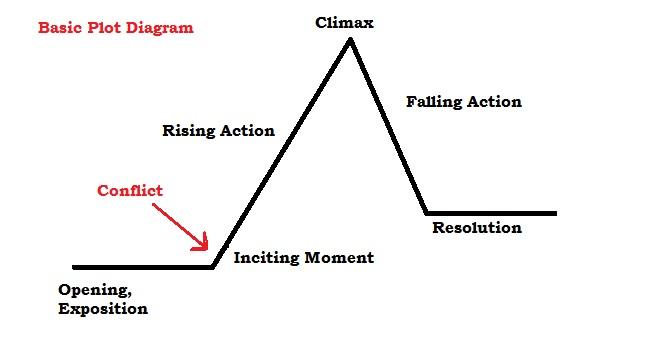
In our next lesson, we will see how this engine of escalating conflict powers the most common narrative framework in Western cinema: the three-act structure. We will map these rising complications onto a plot, showing how they build toward a story's ultimate climax and resolution.