Welcome to your next lesson on narrative structure. In our previous session, we mapped out the entire three-act structure, exploring the flow from Setup to Confrontation to Resolution. You learned to see a film's narrative as a complete architectural plan, with each act serving a distinct purpose.
Today, we will zoom in on the critical load-bearing pillars of that architecture. Your learning outcome is to identify the inciting incident, turning points, climax, and resolution in a film. These are not just abstract plot beats; for a filmmaker, they are the most powerful tools for launching the story, escalating stakes, resolving conflict, and ultimately, creating a satisfying emotional journey for the audience. Think of them as the key waypoints that guide your viewer through the narrative landscape.
Let's begin by recalling the overall shape of the story we're discussing. These two diagrams, which you saw in our last lesson, illustrate the dramatic arc and the key moments we'll be dissecting today.
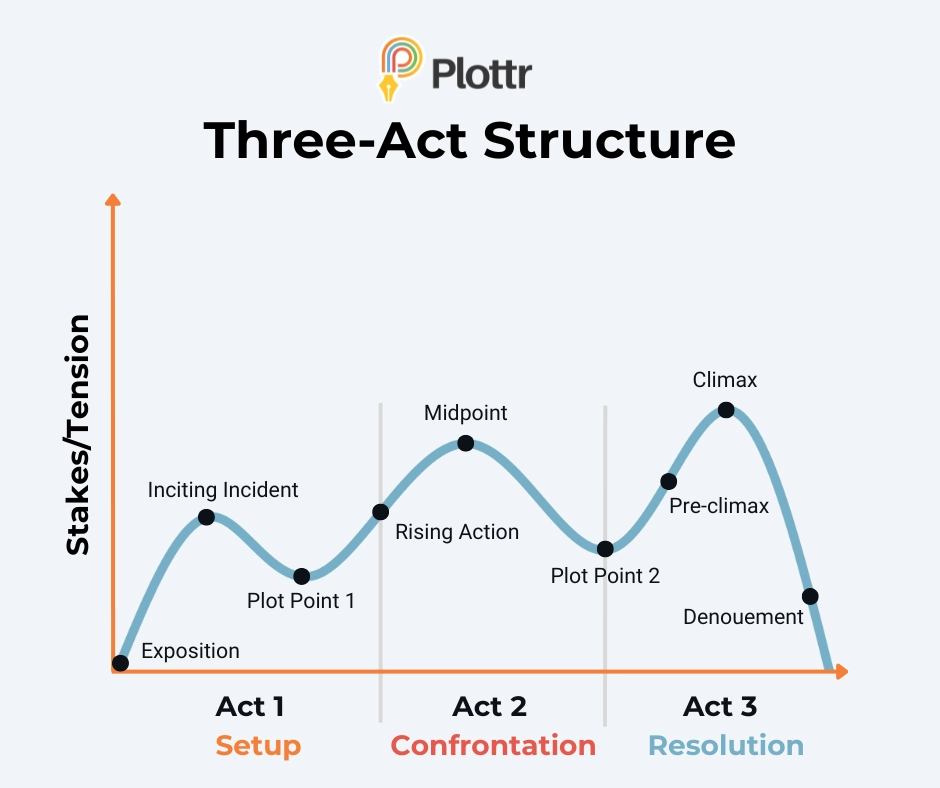

1. The Inciting Incident: The Spark That Ignites the Story
Every story begins with a state of normalcy, the "ordinary world." The inciting incident is the specific event that shatters this equilibrium and propels the protagonist into the main conflict. It's the call to adventure, the problem that can't be ignored, or the opportunity that's too good to pass up.
Crucially, it is distinct from any introductory conflict. A story might open with a thrilling action scene (the "hook"), but the inciting incident is what sets the central plot in motion.
Three Act Structure Explained Using Pixar
The video "Three Act Structure Explained Using Pixar" does an excellent job of clarifying this concept.
First, watch the segment on Finding Nemo from this point to see a classic inciting incident. Then, jump to a later section from this part, where the creator makes a vital distinction between general conflict and the specific event that begins the main story, using The Incredibles and Toy Story as examples.
The key function of the inciting incident is to present the protagonist with a choice or challenge that drives the rest of the narrative. It’s the event that poses the central dramatic question of the film.
Three Act Structure in Film: Definition and Examples
The StudioBinder article we used previously provides a concise definition and a solid example.
In the section "Act I: Setup," read the short portion about the inciting incident, which uses the film Man on Fire. Then, review the analysis of the inciting event in Jurassic Park under the main breakdown, specifically the subsection The Inciting Event. Notice how John Hammond's invitation is the moment that sets the core plot in motion.
2. Turning Points: Changing the Direction of the Narrative
Once the story is underway, turning points are major events that escalate the stakes and lock the narrative into a new direction. They are often described as "points of no return." For your work as a filmmaker, these are the moments where you can pivot the story, surprise the audience, and deepen the conflict. We will focus on the three most significant ones.
The First Plot Point (The Break into Act Two)
This is the true point of no return. The protagonist moves from their ordinary world into the "new world" of the central conflict. They are now fully committed—voluntarily or not—to the journey.
Three Act Structure Explained — The Secret to Telling a Great Story
The StudioBinder video, "Three Act Structure Explained," visualizes this moment perfectly.
Watch the section explaining the First Plot Point. Pay attention to the idea of the "threshold of no return" and how the example from Jurassic Park (the characters seeing the dinosaurs for the first time) irrevocably changes their perspective and commits them to the story.
The Midpoint
As the name suggests, the Midpoint occurs around the halfway mark of the film. It's a major event that often changes the game entirely. This can be a false victory, a crushing defeat, or a significant revelation. Critically, it shifts the protagonist from a reactive state (surviving the new world) to a proactive one (taking control and fighting back).
Three Act Structure Explained — The Secret to Telling a Great Story
Let's return to the StudioBinder video for a clear explanation of this crucial pivot.
Watch the segment on the Midpoint. Note how the T-Rex escape in Jurassic Park transforms the film from a story of wonder into one of survival, forcing the characters into a proactive mode.
The Third Plot Point (The Break into Act Three)
This turning point launches the final act. It's often an "all is lost" moment where the protagonist hits rock bottom after a major setback. Their initial plan has failed, and all hope seems gone. This forces them to dig deep, integrate everything they've learned, and come up with a new, final plan. It sets the stage for the Climax.
Three Act Structure Explained Using Pixar
The "Pixar" video provides a fantastic and memorable explanation of this beat.
Watch the segment from the start of Act Three, which defines the "all is lost" moment. The visual montage of sad characters from various films powerfully illustrates how universal this beat is.
3. The Climax and Resolution: The Peak and The Aftermath
After the final turning point, the story hurtles toward its conclusion, which consists of two key parts: the Climax and the Resolution.
The Climax
The climax is the ultimate confrontation where the central conflict is resolved. It is the moment of highest tension and emotional stakes, where the protagonist must face the antagonistic force head-on. The central dramatic question of the film is finally answered here.
Understanding Story Structure: The Essential Steps
This article from Industrial Scripts gives a clear definition of the climax.
Read Step#5 – Climax. Notice how it's described not just as a physical battle, but as the final test of character and the culmination of the story's emotional journey.
The climax of Jurassic Park, for instance, is the kitchen scene with the raptors, culminating in the T-Rex's unexpected intervention. This moment resolves the immediate survival conflict and reinforces the film's theme that nature cannot be controlled.
The Resolution
The resolution, or dénouement, is the final part of the story. It shows the aftermath of the climax and establishes the protagonist's "new normal." It's a moment for the audience to breathe and see how the journey has transformed the characters and their world. It ties up remaining subplots and provides a sense of closure.
Understanding Story Structure: The Essential Steps
The same Industrial Scripts article provides an equally clear definition of the resolution.
Read Step#6 – Resolution. The key takeaway is that the resolution demonstrates the consequences of the climax and validates the character's journey.
Synthesis: A Full Structural Breakdown
To see how all these signposts work together in a complete film, the Industrial Scripts article provides a great case study.
Understanding Story Structure: The Essential Steps
This case study of Little Miss Sunshine walks through the entire structure, identifying each key plot point we've discussed today.
Read the full section Story Structure Case Study: Little Miss Sunshine. As you read, actively identify each of the key beats: the inciting incident (the phone call), the midpoint (Grandpa's death), the climax (the family dance), and the resolution (driving home united).
Conclusion
In this lesson, you've learned to identify the most critical structural moments that give a narrative its shape and drive. From a practical filmmaking perspective, understanding these points allows you to control the flow of information, manage tension, and guide the audience's emotional experience with precision.
Here are your key takeaways:
- Inciting Incident: The event that disrupts the ordinary world and launches the main conflict.
- Turning Points: Major events that change the story's direction and raise the stakes. Key examples are the First Plot Point (point of no return), the Midpoint (game-changing pivot), and the Third Plot Point (the "all is lost" moment).
- Climax: The peak of the story; the final confrontation that resolves the central conflict.
- Resolution: The aftermath of the climax, which establishes the new status quo and shows character transformation.
Now that we have examined the architectural pillars of the story, our next lesson will focus on what gives that structure life and meaning: character arcs. We will analyze how a character's internal journey of change drives the external plot forward and makes a story resonate.