Welcome to the next lesson in our module on narrative structure. In our last session, we dissected a film's skeleton by identifying its key structural plot points: the inciting incident, the turning points, the climax, and the resolution. We saw how these moments form the architectural blueprint of a story.
Today, we'll give that skeleton its heart and muscle. Your learning outcome is to analyze character arcs and how they drive narrative progression. A story is not just a sequence of events; it's the chronicle of a character's transformation in response to those events. For you as a filmmaker, understanding how to construct and analyze a character's internal journey is the key to creating a narrative that is not only structured but also emotionally resonant and meaningful. We will explore how a character's inner conflict pushes the external plot forward, turning your structural blueprint into a living, breathing story.
1. The Engine of Character: Want vs. Need
At the core of almost every compelling character arc is a fundamental conflict between what a character wants and what they truly need.
- The Want (or Conscious Desire) is the character's external goal. It's what they are actively pursuing and what typically drives the plot. Examples include winning a competition, finding a treasure, or getting revenge.
- The Need (or Unconscious Desire) is the internal, often subconscious, lesson the character must learn or the flaw they must overcome to find true fulfillment. This might be learning to trust, finding self-worth, or letting go of the past.
The story's tension arises from the pursuit of the want, while its meaning is derived from the journey toward the need.
Character Arcs, Flaws, & Lies Don't Need to Be Confusing (Writing Advice)
To start, let's watch a concise explanation from the YouTube channel Writer Brandon McNulty. This video introduces the core concepts of an arc, a character's flaw, and the "Lie" they believe, which is a fantastic framework for understanding the "Want vs. Need" dynamic.
Watch the first few minutes, which cover the definitions of a character arc, a character flaw, and the character lie. Think of the "Lie" as the flawed belief that keeps the character from recognizing their "Need."
The article "Character Arc: The Secret Sauce" further clarifies this essential dichotomy using the terms conscious and unconscious desire.
Character Arc: The Secret Sauce to Showing a Hero's Growth
This article from Script Reader Pro provides a screenwriter-focused perspective on these concepts.
Please read the first part of the article, from the start down to the section on genre. Focus on the definitions under these headings. The key takeaway is that these different terminologies—Want/Need, Outer/Inner Goal, Conscious/Unconscious Desire—all point to the same fundamental conflict within the protagonist.
The resolution of this conflict between the want and the need determines the story's ending and its ultimate emotional impact on the audience.
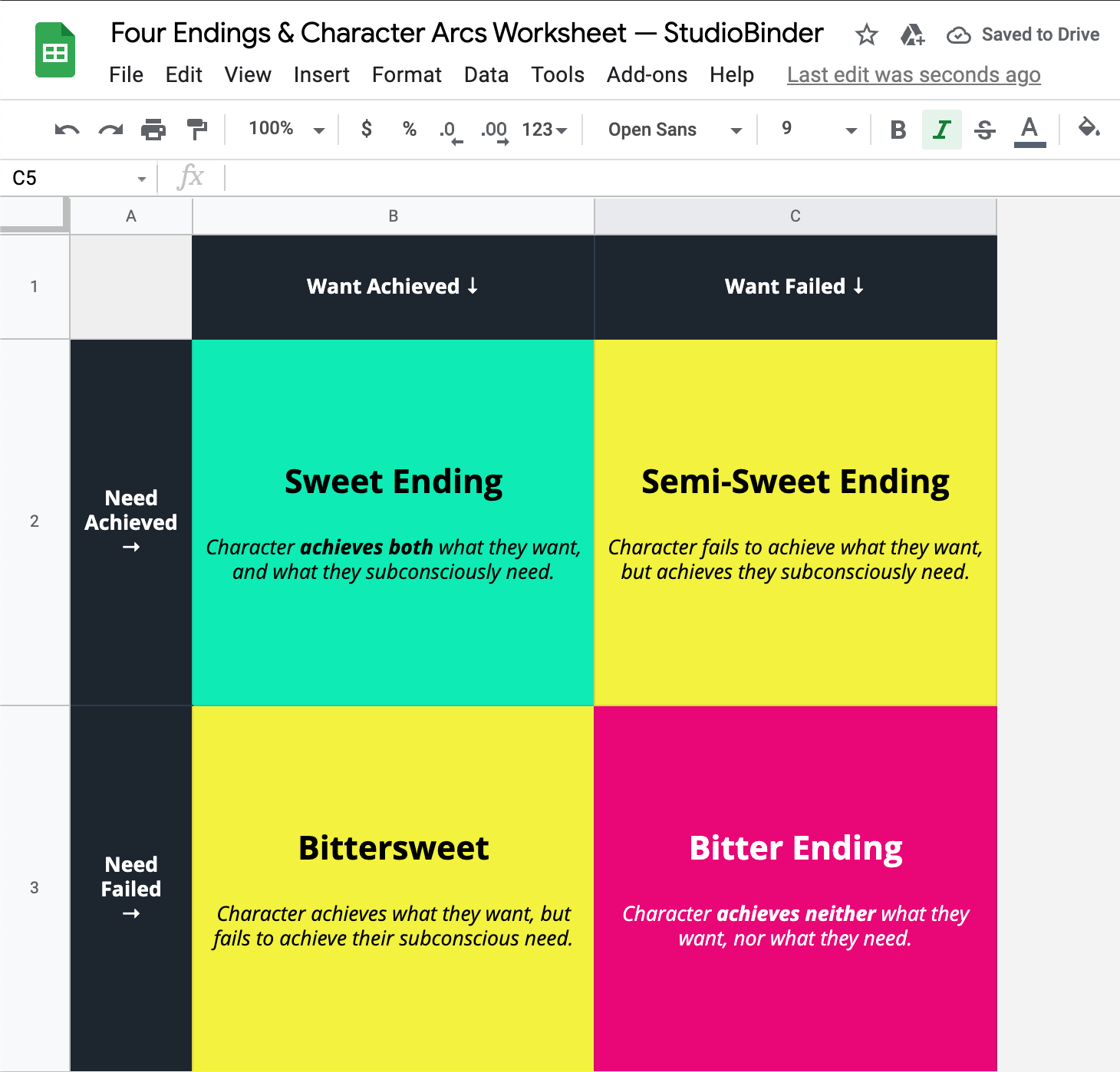
2. Types of Character Arcs
Based on how a character navigates their internal journey, we can identify a few primary types of arcs.
What is a Character Arc in Screenwriting? | No Film School
The website No Film School provides a clear breakdown of the four most common arc types, with excellent film and television examples for each.
Read the section titled The Four Kinds. As you read, think about how each type reflects a different resolution of the Want vs. Need conflict: Transformative/Maturation Arcs (Positive Arcs): The character overcomes their flaw and embraces their need. Declining Arcs (Negative Arcs): The character succumbs to their flaw, often achieving their want at a terrible moral cost. Alteration Arcs: The character experiences a smaller, more subtle shift in perspective.
It's also important to recognize that some protagonists don't change at all. These are Static Characters who follow a Flat Arc. Their function is often to be a catalyst for change in the world and the characters around them.
4 Types of Characters in a Film — Flat vs. Round & Static vs. Dynamic
This StudioBinder video explains the narrative function of static characters.
Watch the segment explaining how static characters, like The Dude in The Big Lebowski or Ferris Bueller, can be effective protagonists. Pay attention to how they can serve the narrative by acting as a consistent source of conflict or by inspiring change in others.
3. How Character Arcs Drive the Plot
This is where our last two lessons converge. The external plot points are not random events; they are the crucibles that test the character, forcing them to confront their flaw and move along their arc. The character's decisions at these junctures, in turn, propel the plot forward.

The three-act structure provides the framework for this journey.
- Act 1: Establishes the character in their "normal" life, governed by their flaw and their conscious want. The Inciting Incident and First Plot Point thrust them into the central conflict.
- Act 2: The character pursues their want through a series of trials. These challenges force them to confront their limitations, and they begin to glimpse their deeper need. The Midpoint is often a major turning point in this internal awareness.
- Act 3: Following the "all is lost" moment (the Third Plot Point), the character must integrate the lessons learned. To succeed in the Climax, they must typically act from their need, not just their want.
The following reading provides concrete examples of this dynamic.
Character Arc: The Secret Sauce to Showing a Hero's Growth
Let's return to the Script Reader Pro article to see how this plays out in practice.
First, read the section How a character arc fits in 3-act structure, which uses American Beauty and Wedding Crashers to show the character's progression through the acts. Then, continue to the next section, Creating arcs using key plot points. This part explicitly connects the character's internal state (their want vs. need) to the key plot points we discussed in the last lesson.
In truly character-driven stories, the character's emotional journey is the story. The plot exists to facilitate and reveal that change.
4 Types of Characters in a Film — Flat vs. Round & Static vs. Dynamic
The StudioBinder video we watched earlier makes this point very clearly.
Watch the segment on dynamic characters. Notice how it states that in character-driven stories, the character's arc "doubles as the story arc," using About Schmidt as an example.
4. Case Study: Sideways
To synthesize these ideas, let's analyze a complete character arc. The film Sideways offers a masterful example of a protagonist, Miles, whose internal journey from a flawed "want" to a fulfilling "need" is perfectly intertwined with the plot structure.
Character Arc: The Secret Sauce to Showing a Hero's Growth
This detailed case study from the same article breaks down Miles's arc beat by beat.
Read the entire section Case study: Sideways. As you read, pay close attention to how Miles's conscious desire (to have a relaxing wine trip and get back with his ex) clashes with his unconscious desire (to move on and find a genuine connection) at each of the major plot points, from the Inciting Incident to the Climax. This is a perfect demonstration of how plot forces character change, and how character choices drive the plot.
Conclusion
In this lesson, we moved from the "what" of story structure to the "why." You've learned that a character arc is the emotional and psychological transformation a character undergoes, typically driven by the conflict between their external want and their internal need.
Here are your key takeaways:
- Want vs. Need: This core conflict is the engine of most character arcs. The want drives the plot, while the need provides the theme and emotional depth.
- Types of Arcs: Arcs can be positive (transformation/growth), negative (decline/corruption), or flat (a static character who changes the world around them).
- Arcs Drive Narrative: The plot points of a story are not arbitrary. They are designed to challenge the character, forcing them to confront their flaws and make choices. These choices, born from the character's evolving internal state, are what drive the narrative forward from one beat to the next.
In our previous lessons, we built the structural foundation of a story. Today, we populated it with a character on a meaningful journey. In our next and final lesson of this module, we will explore linear vs. non-linear narrative structures, examining how filmmakers can play with the sequence of these events to manipulate suspense, reveal information, and create powerful effects for the audience.