Welcome back. In our last lesson, we explored the internal engine of narrative: the character arc. We saw how a character's journey from their external "want" to their internal "need" gives a story its emotional weight and propels the plot forward. We've established the structural beats of a story and the transformative journeys of the characters who inhabit it.
Now, we will address a fundamental choice every filmmaker has: in what order should these events be revealed to the audience? Your learning outcome for this lesson is to compare linear vs. non-linear narrative structures and their effects on audience engagement. We'll move beyond the chronological default to see how manipulating a story's timeline can become one of your most powerful tools for creating suspense, generating mystery, and exploring complex themes. For you as a filmmaker, this isn't just theory; it's a practical decision about how to assemble your scenes to maximize their impact.
1. The Two Fundamental Timelines: Linear and Non-Linear
At its core, narrative structure is about the relationship between two timelines:
- Story (Fabula): The raw, chronological sequence of events. This is what happened, from beginning to end.
- Plot (Syuzhet): The order in which those events are presented to the audience in the film.
The choice of how to arrange the plot defines whether your narrative is linear or non-linear.
Linear Narrative
A linear narrative presents events in chronological order. The plot follows the story's timeline directly (A → B → C). This is the most common and intuitive form of storytelling, mirroring how we experience life. It's excellent for building straightforward momentum and clear cause-and-effect relationships.
Non-Linear Narrative
A non-linear narrative deliberately deviates from chronological order. The plot scrambles, repeats, or omits events from the story's timeline (e.g., B → A → C). This is done for a specific artistic purpose.
To get a clear overview of these concepts and see them in action, let's watch an explanation from the YouTube channel Dapper Mr Tom.
What Is Linear & Non-Linear Narrative? | Let's Talk Theory
This video provides a concise and clear breakdown of the fundamental differences between linear and non-linear structures, using well-known film examples.
Please watch the main explanatory segment from the introduction of narrative through the examples of non-linear films. Pay attention to how a film like Forrest Gump, which seems chronological, is technically non-linear due to its framing device.
As the video illustrates, "non-linear" is not a single technique but a category that includes various approaches, such as:
- Framing Stories: Starting near the end and flashing back to tell the main story (e.g., Saving Private Ryan).
- In Medias Res: Starting in the middle of the action.
- Anachronic Order: Presenting scenes out of chronological sequence to create a puzzle for the audience (e.g., Memento).
2. Why Go Non-Linear? The Purpose Behind the Puzzle
If a linear narrative is the most natural way to tell a story, why would a filmmaker intentionally complicate it? The answer lies in the unique effects a non-linear structure can have on the audience. Scrambling the timeline isn't about being confusing; it's about controlling the flow of information to generate specific emotional and intellectual responses.

The key insight is that a story’s power comes from the audience's emotional experience, not necessarily from a strict chronological presentation. A non-linear film still needs to guide the audience through a carefully structured emotional journey. Scenes may be out of chronological order, but they are in the correct emotional order.
The video essay channel StoryBrain provides a brilliant analysis of how this works in Quentin Tarantino's films.
Pulp Fiction and the Secret of Non-Linear Storytelling. - StoryBrain
This video explores the "secret" to successful non-linear storytelling, arguing that it's about delivering the correct emotional beats, even if the chronological beats are out of order.
First, watch the section on the emotional process. The key idea here is that what's important is "that the emotional process happens the right way." Next, watch the longer segment that explains how scenes in a non-linear film serve the same functional purpose as in a linear one. Notice how an "opening scene" needs to feel like an opening (lower energy, introducing characters/conflict) even if it's not the chronological start of the story.
To see this principle in a more structured, analytical form, consider this visualization of Pulp Fiction's narrative.
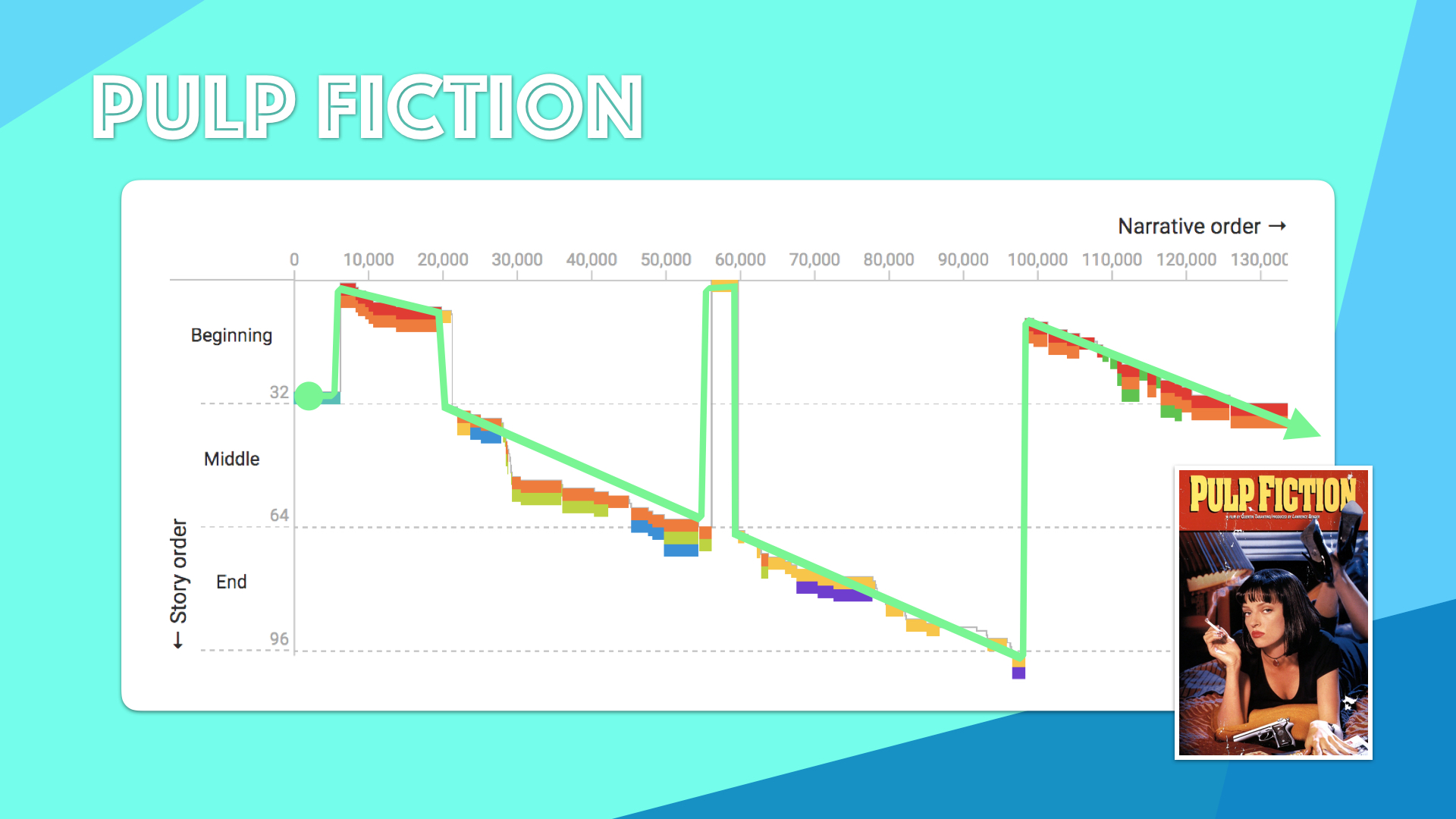
3. Crafting a Non-Linear Narrative: A Filmmaker's Guide
Choosing a non-linear structure introduces significant creative challenges. It requires meticulous planning to ensure the narrative is compelling rather than merely confusing. For you as a filmmaker with an engineering background, you might think of this as designing a more complex system that requires tighter tolerances and a more robust underlying blueprint.
The article "Unraveling Time" from Beemgee offers excellent practical advice for storytellers venturing into non-linear territory.
Unraveling Time: Non-Linear Narratives in Modern Storytelling
This article breaks down the mechanics of building a non-linear story from the ground up, focusing on the practical steps a creator must take.
Please read the following sections, focusing on the advice for the storyteller: Start with The Mechanics of Time Manipulation. This reinforces a crucial first step: you must know the chronological story perfectly before you can break it. Next, read Crafting the Jigsaw. This is a fantastic analogy for thinking about scenes as puzzle pieces. Then, review the sections on Conceptual Groundwork. To guide the audience, your film's world needs clear rules and your characters need consistent motivations. Finally, read about Anchors of Familiarity and Navigating Editing and Transitions. These are the practical tools—in scripting and in editing—that you use to keep the audience oriented.
The core principle is that complexity requires clarity. A non-linear narrative must provide the audience with "anchors"—recurring motifs, clear character goals, a consistent visual language—that allow them to navigate the temporal shifts without getting lost. Your role as the filmmaker is not to obscure, but to guide the audience through a different kind of journey.
Conclusion
In this lesson, we have compared the straightforward progression of linear narratives with the intricate designs of non-linear ones. You've seen that the choice is not arbitrary but is a powerful tool for shaping audience engagement.
Here are your key takeaways:
- Linear vs. Non-Linear: Linear narratives follow a chronological path (A-B-C), while non-linear narratives purposefully reorder events (B-A-C) to achieve specific effects.
- The Goal is Emotional, Not Chronological: Successful non-linear stories work because they still follow a carefully crafted emotional arc. Scenes are placed to maximize suspense, surprise, and thematic resonance, guiding the audience's experience.
- It Requires Careful Craft: Creating a non-linear narrative is an act of deliberate construction. It demands a solid understanding of your chronological story, clear internal logic, and the use of "anchors" to orient the viewer.
As a filmmaker, you can experiment with these structures even in short films. Try starting at the end, or telling a story from two different points in time, and see how it changes the story's feel and impact.
This lesson concludes our module on Narrative Structure. We have built a complete toolkit for analyzing a film's narrative engine, from its basic structural beats and character arcs to the very order in which it unfolds. In our next module, we will shift our focus from story to spectacle, beginning our exploration of visual storytelling with the fundamental elements of Mise-en-Scène.