Introduction
Welcome back. In our last two lessons, we built the foundation of your email marketing system. You crafted a welcome email to deliver your lead magnet and make a great first impression, followed by a value email that delivered on a promise and established your expertise without asking for anything in return. You've successfully built trust and rapport.
Now, it's time to bridge the gap between providing value and generating revenue. This lesson focuses on writing a sales pitch email. The goal isn't to be pushy or "salesy," but to logically present your paid product as the perfect solution to a problem your audience already cares about. You've earned their attention; now you'll show them the next step in their journey.
Today, we'll focus on this learning outcome: Write a sales pitch email that connects a customer's problem to your paid product's solution.
The Psychology of the Pitch: From Problem Aware to Solution Aware
Before writing, it's crucial to understand your subscriber's mindset. A person on your email list isn't a random stranger. They downloaded your lead magnet and opened your value email, which means they are, at the very least, aware they have a problem or a desire that you can help with.
This image illustrates the "Customer Journey Hooks," showing how a person's awareness evolves.

Your job in a sales email is to meet them where they are and guide them from "I have this problem" (Problem Aware) to "Your product is the specific thing I need to fix it" (Product Aware).
To do this systematically, we'll use a classic copywriting formula that is perfect for this task: Problem-Agitate-Solution (PAS).
The Problem-Agitate-Solution (PAS) Framework
The PAS framework is a simple, three-step process for structuring persuasive messages. It's effective because it mirrors the natural way humans make decisions: we identify a problem, feel the discomfort it causes, and seek a solution to relieve that discomfort.
Email Marketing Copywriting Tutorial: Problem Agitate Solution (PAS) Formula With Examples 📧
To get a solid grasp of this powerful framework, watch this tutorial from the paidcopywriter YouTube channel. It breaks down each component of PAS and explains the psychology behind why it works so well.
Watch from the beginning to 6:38. Pay close attention to: 0:00 - 2:25: The introduction to the PAS formula and why starting with a problem is so effective. 2:25 - 6:38: The detailed breakdown of Problem, Agitate, and Solution, using a clear weight-loss example. Notice the distinction made between 'agitating' as a manipulative tactic versus a way to build empathy.
To supplement the video, let's dive deeper into the written structure of a PAS email.
PAS Copywriting for Cold Email (5 Key Strategies and Templates)
The article 'PAS Copywriting for Cold Email' from GMass provides an excellent, detailed walkthrough with 'before and after' rewrites. While it's framed for cold email, the principles are directly applicable to our warm audience.
Read the sections from the beginning down to the end of section 4, 'Call-to-Action: How to End Your PAS Email.' Focus on how each part of the formula is constructed: Problem: How to identify and state the prospect's pain point. Agitate: How to 'twist the knife' by describing the consequences of inaction. Solve: How to position your product as the ideal solution. Call-to-Action: How to write a clear and simple closing request.
Deconstructing Your Sales Email with PAS
Let's assemble these components into an email structure you can use for your own digital product.
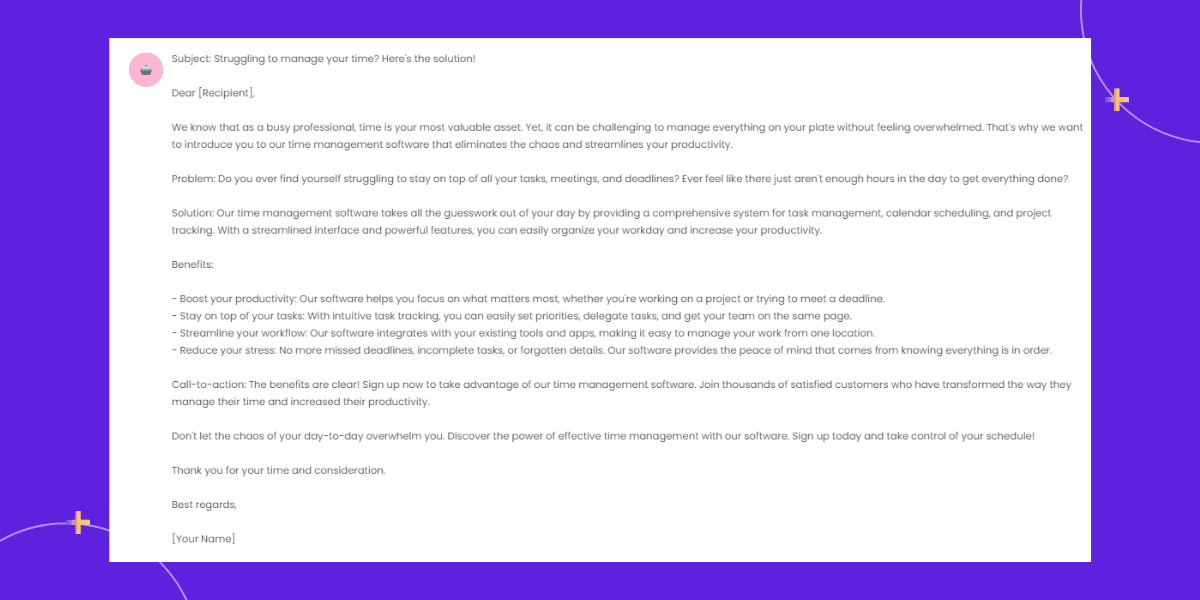
1. The Subject Line: Be Direct
For a sales email, clarity trumps cleverness. Your subject line should signal that you have a solution to offer. You can borrow ideas from the article LINK, "Digital Product Launch Email," such as:
[Product Name] is Live! See What You’ve Been MissingA Real Solution for [Problem]Tired of [Problem]? I made something for you.
2. P = Problem
Start by stating the problem you know they have. This should connect directly to your lead magnet and value email.
- Example: If your lead magnet was a free icon set, the problem might be: "You have a few icons, but creating a consistent, professional-looking set for your whole project is time-consuming and frustrating."
3. A = Agitate
Now, amplify the problem. Show you understand their struggle. This builds empathy.
- Example: "You end up spending hours searching for matching icons, or worse, trying to design them yourself, only to have them look mismatched. It makes your whole project feel amateurish, and that wasted time could have been spent on more important things."
4. S = Solution
This is where you introduce your paid product. Frame it as the definitive answer to the problem you've just agitated. Focus on benefits (what it does for them) over features (what it is).
The LINK article, in the section "Introduce the Digital Product," suggests answering these key questions:
-
What problem does it solve?
-
How does it improve their life? (e.g., saves time, makes them look more professional)
-
Why is it better than alternatives?
-
Example: "That's why I created the [Product Name], a complete pack of 100+ minimalist vector icons. It’s designed to give your projects a clean, professional aesthetic in minutes, not hours. With this pack, you can stop searching and start creating, ensuring every icon in your design is perfectly consistent."
5. The Direct Call-to-Action (CTA)
You've made your case. Now, tell them exactly what to do next. Be confident and clear.
This Email Marketing Strategy BLEW UP my Digital Product Sales Everytime
In the previous lesson, we looked at 'soft' CTAs. Now, we're making a direct 'ask.' Watch this clip from Rochelle Be's video to understand the tone and structure of a direct sales email.
Watch the segment on the 'Direct Sales Email' from 14:31 to 16:00. Note the emphasis on being clear about the offer, defining who it's for, and giving a reason to act now (urgency).
Your CTA should be an unambiguous button or link, such as:
Get the Complete Icon Pack NowStart Designing Professionally TodayYes, I want to save time!
Your Task: Write Your Sales Pitch Email (25 minutes)
It's time to put this into practice. You will write the third email in your automated sequence—the one that pitches your first paid product.
-
Define Your Product & Connection:
- First, decide on a simple, paid digital product that is a logical upgrade from your free lead magnet.
- Example: If your lead magnet was a set of 5 minimalist wallpapers, your paid product could be a pack of 25 wallpapers with multiple color variations and device sizes.
- Write one sentence that connects the freebie to the paid product. "The free wallpapers give you a taste, but the full pack gives you a complete, cohesive aesthetic for all your devices."
- First, decide on a simple, paid digital product that is a logical upgrade from your free lead magnet.
-
Outline with the PAS Framework:
In a text editor, use the PAS framework to structure your pitch:- Product Name:
- Subject Line:
- Problem: (What issue does the user still have after getting the freebie?)
- Agitate: (Why is that issue frustrating? What time/effort does it cost them?)
- Solution: (How does your paid product eliminate that problem? List 3 key benefits.)
- CTA: (What is the clear, direct action you want them to take?)
- (Optional) Urgency: (Is there a launch discount? A bonus for the first 50 buyers? e.g., "For the next 48 hours, get the pack for 25% off.")
-
Draft the Email:
- Using your outline, write the full email. Keep paragraphs short and scannable.
- Use bolding to emphasize the pain points and the name of your solution.
- If you're using Gumroad or Payhip, you can create a draft in their email workflow tool. Set it to send 3-4 days after your value email. This gives space between your free content and your pitch.
You've now built a complete 3-part welcome sequence: Welcome & Deliver -> Nurture with Value -> Pitch the Solution. This is the core engine of automated digital product sales.
Conclusion
Congratulations on completing the core of your email funnel. You've learned to transition a subscriber from a curious visitor to a potential customer by building trust and then clearly presenting a solution to their problem.
Key Takeaways:
- A sales pitch is the logical conclusion of a value-driven relationship, not an unsolicited interruption.
- The Problem-Agitate-Solution (PAS) framework is a powerful, systematic tool for structuring a persuasive email that resonates with a subscriber's needs.
- Your pitch should focus on the benefits of your product—how it improves your customer's life—not just its features.
- A direct sales email requires a clear, confident, and direct Call-to-Action (CTA).
Preview of the Next Lesson
You've written the emails to sell your product. Now, where will you actually sell it? In our next lesson, we'll dive into the practical side of e-commerce. We will compare the fee structures, features, and payout options of Gumroad vs. Payhip to help you select the best sales platform for your new digital product business.