Introduction
Welcome to Module 2! In the first module, we focused on building your personal brand's visual foundation. You deconstructed minimalist aesthetics, created a mood board, and established a cohesive system of fonts and colors. You now have the core creative assets for your brand.
Now, we shift from creative foundations to market strategy. A great-looking brand is only effective if it offers products people actually want and need. This module is about understanding the market so you can find your unique place within it.
Today’s lesson directly addresses the learning outcome: to catalog the product ecosystem of a target creator, identifying lead magnets, entry-level products, and premium offerings. We'll break down how successful creators like Oliur structure their offerings to build an audience and generate income. This isn't just a random collection of products; it's a deliberate system designed to guide a customer on a journey.
By the end of this lesson, you'll have a systematic framework for analyzing any creator's business model, giving you a blueprint for your own future product strategy.
1. The Product Ecosystem: A Strategic Framework
Successful creators rarely sell just one product. Instead, they build a product ecosystem, often visualized as a "product ladder." This is a range of offerings at different price points, designed to meet customers wherever they are in their journey—from casual follower to loyal superfan.
This systematic approach creates multiple entry points into a brand and builds trust over time.
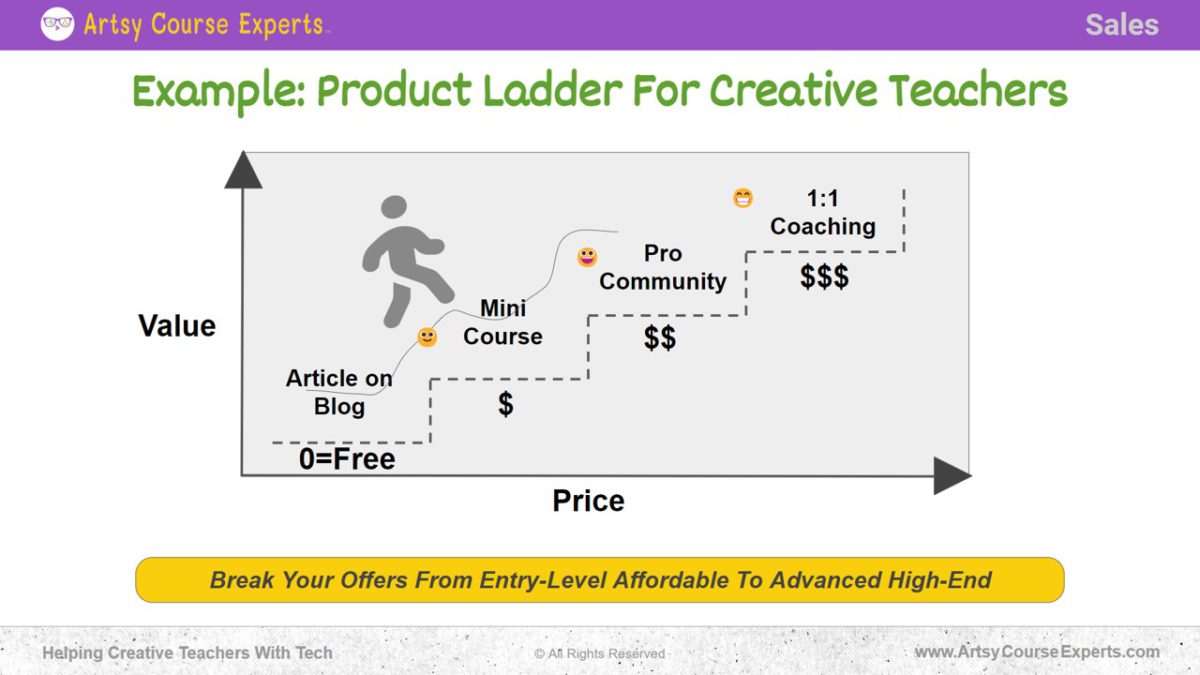
A typical product ladder can be broken down into three main tiers:
- Lead Magnets & Free Content (The Bottom Rung): The goal here is audience building. This includes free content that attracts attention (like YouTube videos or blog posts) and specific freebies offered in exchange for an email address, known as lead magnets.
- Entry-Level / Core Products (The Middle Rungs): This is where most sales happen. These products solve a specific problem at an accessible price point. They are typically scalable, meaning you can sell them an infinite number of times with little extra effort. Examples include templates, eBooks, icon packs, and self-paced video courses.
- Premium Offerings (The Top Rung): These are high-price, high-value offerings for your most dedicated customers. They often involve direct access to you and are less scalable. Examples include personal coaching, custom design work, or exclusive mastermind groups.
Understanding this structure is the key to deconstructing a creator's business strategy.
2. Deconstructing the Tiers: Key Concepts
Let's dive deeper into the specific types of products that populate these tiers. Since you prefer systematic approaches, we'll use a couple of well-defined frameworks from industry experts.
Tier 1: Understanding Lead Magnets
A lead magnet is a free, valuable resource you give away in exchange for contact information, usually an email address. Its purpose is to turn a passive follower into an active lead you can build a relationship with.
The following video provides an excellent, structured breakdown of the four primary types of lead magnets. Understanding these categories will help you identify them in the wild.
Lead Magnets Explained in 23 Minutes (4 Types + 5 Rules)
The video 'Lead Magnets Explained in 23 Minutes' from Course Creator 360 provides a clear, systematic way to categorize lead magnets. This will give you a precise vocabulary for your analysis.
Please watch from the beginning to 12:34. Focus on these key parts: The Definition (01:13 - 01:56): A simple, clear definition of a lead magnet and its purpose. The Four Types (03:12 - 11:14): Pay close attention to the explanation and examples for Clarifiers, Samplers, Starters, and Shortcuts. Note the distinct problem each type solves for the user. Which to Use? (11:14 - 12:34): This section connects each lead magnet type to a specific audience need, which will be useful for analysis.
Tiers 2 & 3: From Entry-Level to Premium
For the paid tiers of the product ladder, designer and educator Chris Do offers a simple yet powerful framework based on three levels of customer involvement. This model helps explain why different products have vastly different price points.
How to offer 3 options to boost sales
Chris Do's post, 'How to offer 3 options to boost sales', outlines his DIY, DWY, and DFY model. It explains the psychology behind tiered pricing and how it guides customer choice.
Read the short LinkedIn post and watch the embedded video. Focus on the definitions of: Do It Yourself (DIY): Low-cost, scalable products like templates or digital courses. This is a classic entry-level product. Done With You (DWY): The mid-range 'sweet spot' where you provide some guidance or customization. This could be a workshop or a more comprehensive course. Done For You (DFY): The high-ticket, 'white glove' service where you do all the work. This is a premium offering.
With these frameworks—the Product Ladder, the 4 types of lead magnets, and the DIY/DWY/DFY model—you now have a complete toolkit for cataloging any creator's product ecosystem.
3. Practical Exercise: Cataloging a Creator's Ecosystem
Now it's time to apply what you've learned. We'll analyze the product ecosystem of Oliur, a creator you're interested in.
Your task is to visit his online presence, identify everything he offers (both free and paid), and categorize it using the frameworks we've discussed.
Step 1: Gather Information (15 mins)
First, let's look at some real-world examples and then hear from Oliur himself.
The following article provides short case studies on how different creators built their product ladders. This will give you a feel for how these ecosystems look in practice.
Create and Sell Digital Products: A Starter's Guide
The article 'Create and Sell Digital Products: A Starter's Guide' by beehiiv includes several case studies of successful creators. This will show you different variations of the product ladder.
Read the section titled 'Who Is Crushing It Right Now Selling Digital Products?'. As you read about each creator (Brandon Storey, Linda Hwang, etc.), try to mentally map their offerings to the product ladder framework.
Next, watch this video where Oliur breaks down his income from digital products. He explicitly mentions what he sells and his philosophy on pricing.
The easiest form of passive income I've found
In this video, 'The easiest form of passive income I've found', Oliur provides direct insight into his digital product business, including what his best-sellers are and his pricing strategy.
Watch these three key segments to gather data for your analysis: His Products (03:40 - 04:27): He names the main types of products he sells. Pricing Strategy (07:07 - 08:27): He explains why he prices his products the way he does, contrasting his wallpapers with his presets. Marketing (10:22 - 12:21): He describes how his free content (YouTube videos) serves as indirect marketing for his paid products.
Step 2: Catalog the Ecosystem (10 mins)
Open your project management tool (Notion, Obsidian, etc.) and create a new page for this analysis. Based on the video and your own exploration of his website (store.oliur.com) and YouTube channel, create a table or a list that catalogs his product ecosystem.
For each item you find, identify the following:
- Offering: The name of the product or content type (e.g., "Minimalist Lightroom Presets," "YouTube Videos," "Wallpapers").
- Price: The cost of the offering (or "Free").
- Tier / Category: Classify it using our frameworks. Is it Free Content, a Lead Magnet, an Entry-Level/DIY product, a Core/DWY product, or a Premium/DFY offering?
Here's an example of how you might structure your table:
| Offering | Price | Tier / Category | Notes |
|---|---|---|---|
| YouTube Videos | Free | Free Content | Builds audience, demonstrates expertise, indirectly markets products. |
| The Minimalist Wallpapers | $14 | Entry-Level (DIY) | Low cost, high volume, scalable. |
| The Minimalist Lightroom Presets | $39 | Core Product (DIY) | Higher price, solves a more specific problem ("get my style"). |
| ??? | ??? | ??? | Keep exploring to see what else you can find! |
Look for everything: free newsletters, digital downloads, courses, physical products, services, etc. If something doesn't exist (e.g., you can't find a 1-on-1 coaching offer), that's also an important finding to note.
Conclusion
Well done. You've just performed your first piece of structured market research. By moving beyond a superficial look at a creator's work and systematically cataloging their entire business model, you've gained a much deeper understanding of how they operate.
Key Takeaways:
- Successful digital creators build product ecosystems (or ladders) to serve audiences at different levels of commitment and price sensitivity.
- This structure typically includes free content for audience growth, lead magnets for email capture, scalable entry-level/core products for revenue, and sometimes premium offerings for top-tier customers.
- Frameworks like the 4 Types of Lead Magnets and the DIY/DWY/DFY model give you a systematic language to analyze and understand these business models.
This analytical skill is fundamental. As you continue your journey, you'll be able to apply this lens to any creator or brand, quickly understanding their strategy and identifying opportunities.
Preview of the Next Lesson:
Cataloging what a creator sells is the first step. The next is understanding why it sells. In our next lesson, we will analyze the value proposition and target audience of a creator's main product categories. We'll move from "what" to "who" and "why," getting you one step closer to defining your own compelling product ideas.