Introduction
Welcome back! In our last lesson, you did a great job cataloging the product ecosystem of a successful creator, mapping their offerings to a "product ladder." You learned to identify free content, lead magnets, and different tiers of paid products. This gave you a structural map of what a creator sells.
Today, we're digging deeper to understand why those products sell. A successful product doesn't just exist; it solves a specific problem or fulfills a distinct desire for a particular group of people. This lesson is built to help you master the learning outcome: to analyze the value proposition and target audience of a creator's main product categories.
We'll move from the "what" to the "who" (the target audience) and the "why" (the value proposition). You'll learn a systematic framework to deconstruct the relationship between a product and its customer, a critical skill for developing your own successful digital products.
1. The Core Framework: The Value Proposition Canvas
To analyze products effectively, we need a reliable framework. The Value Proposition Canvas is a widely used tool in business and design that perfectly suits this task. It helps visualize, in a structured way, how a product creates value for a specific customer segment.
The canvas is split into two parts: the Customer Profile (the circle) and the Value Map (the square).
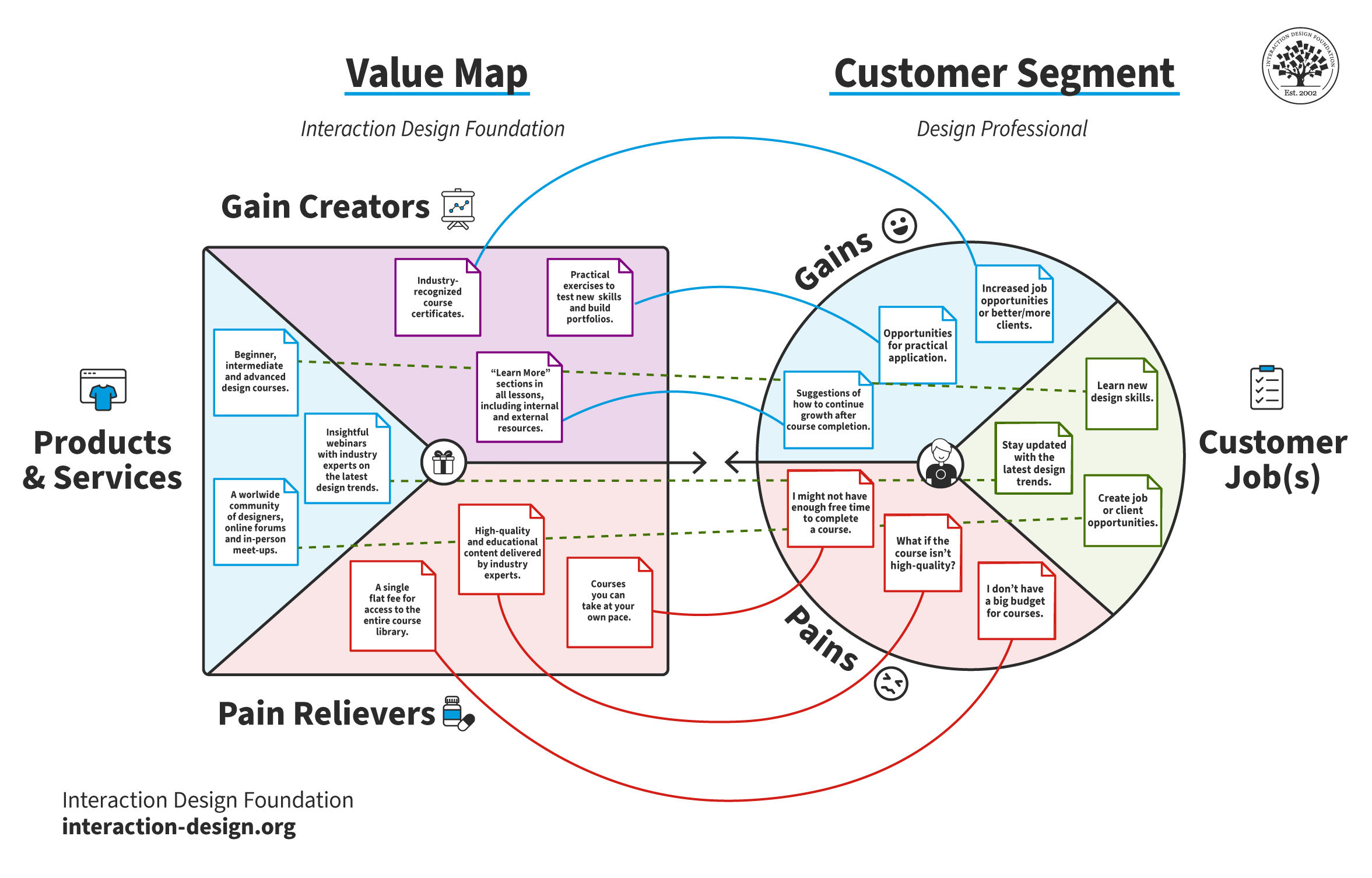
Let's break down the components:
The Customer Profile (Who is it for?)
This side helps you build a clear picture of your target audience.
- Customer Jobs: What is the customer trying to accomplish in their work or life? This could be a functional task (e.g., "organize my projects"), a social goal (e.g., "impress my clients"), or an emotional need (e.g., "feel in control of my finances").
- Pains: What are the negative outcomes, risks, and obstacles related to the customer's jobs? (e.g., "wasting time on repetitive tasks," "my designs look unprofessional," "risk of losing data").
- Gains: What are the positive outcomes the customer desires? This isn't just the absence of pain; it's about what success looks like. Gains can be required, expected, desired, or unexpected. (e.g., "save 10 hours a week," "a beautiful aesthetic," "a system that's easy to maintain").
The Value Map (Why is it valuable?)
This side describes how your product creates value.
- Products & Services: The list of what you offer. This is the what you identified in the last lesson (e.g., a Notion template, a wallpaper pack).
- Pain Relievers: How, specifically, do your products and services alleviate customer pains? (e.g., "pre-built formulas eliminate the need for coding," "high-resolution files ensure a crisp look").
- Gain Creators: How, specifically, do your products and services produce the gains your customer wants? (e.g., "the template includes a guide to help you launch in under an hour," "color variations allow for personal customization").
The goal is to find a "fit" where your Value Map perfectly aligns with your Customer Profile.
2. Evaluating the Strength of a Value Proposition
Having a value proposition is one thing; having a compelling one is what drives sales. How can we systematically evaluate whether a product is a "nice-to-have" or a "must-have"?
The following video from Harvard Innovation Labs provides a robust, academic framework for evaluating the problem a product solves. Since you appreciate systematic approaches, you'll find these concepts very useful.
Value Props: Create a Product People Will Actually Buy
The video 'Value Props: Create a Product People Will Actually Buy' offers two powerful frameworks for evaluating how much a customer needs a solution. This will help you analyze why some products can command much higher prices than others.
This video is quite dense, so focus your attention on these two critical sections: The '4 Us' Framework (10:03 - 31:20): Watch this segment to understand the four criteria for a powerful problem: Unworkable, Unavoidable, Urgent, and Underserved. Pay attention to how the speaker defines each 'U' with examples. The Gain-Pain Ratio (01:08:25 - 01:20:21): This section introduces the idea that for a customer to switch to your product, the gain must vastly outweigh the pain of adoption (cost, effort, risk). The speaker suggests a 10x improvement is often the benchmark.
To summarize the key ideas from the video:
- The "4 Us" Framework: A value proposition is strongest when it solves a problem that is:
- Unworkable: The consequences of not solving it are severe (e.g., losing money, failing a project).
- Unavoidable: The problem is tied to a fundamental reality (e.g., taxes, aging, industry regulations).
- Urgent: It's a top priority for the customer right now.
- Underserved: There are no good existing solutions.
- The Gain-Pain Ratio: A compelling offer delivers a benefit (gain) that is an order of magnitude (10x) greater than the customer's cost and effort to adopt it (pain).
3. Practical Analysis: Wallpapers vs. Templates
Now, let's apply these frameworks to the creator you're interested in, Oliur. In the last lesson, you cataloged his products. Today, we'll analyze the value proposition and target audience for two distinct product categories: his wallpaper packs and his website/Notion templates.
First, let's hear from Oliur himself on how he perceives the value of these different products.
Creating & Selling Your Own Digital Product - Easier than you realise!
In this clip from 'Creating & Selling Your Own Digital Product', Oliur explicitly compares the value proposition of his different products, which directly relates to our learning outcome.
Watch the section from 06:53 to 08:55. Listen for how he describes the value of a wallpaper pack versus the value of a Notion or website template. What key difference does he highlight?
As Oliur points out, wallpapers don't save you time or make you money, whereas templates do. This is the core of their different value propositions.
Your Turn: Apply the Frameworks
Now it's your turn to formalize this analysis. In your project management tool, create a new page for this lesson. Recreate and fill out the table below using the Value Proposition Canvas concepts and the "4 Us" framework. I've filled in some parts to guide you.
Value Proposition Analysis: Oliur's Products
| Feature | Wallpaper Pack ($14) | Notion/Website Template ($50+) |
|---|---|---|
| Target Audience | Fans of Oliur's aesthetic, tech enthusiasts who want a curated setup. | Freelancers, small businesses, students, creators needing an organizational system or a fast web presence. |
| Customer Job(s) | Personalize digital devices; express personal style. | Launch a client project quickly; organize a business; build a personal portfolio website. |
| Pains | Boring default wallpapers; spending time searching for high-quality, cohesive images. | [Your analysis here] |
| Gains | A beautiful, minimalist desktop/phone; feeling part of an aesthetic community. | [Your analysis here] |
| Value Proposition | Get a beautiful, minimalist aesthetic for your devices. | Save days of work and get a professional result instantly. |
| "4 Us" Analysis | Low Urgency. Mostly aesthetic. Underserved only if you want this specific creator's style. Not unworkable or unavoidable. | [Your analysis here. Consider if the problem is Urgent (deadlines?), Unworkable (lack of skill?), etc.] |
| Gain-Pain Ratio | Low Gain (aesthetic satisfaction) / Low Pain (low cost). A classic "nice-to-have." | [Your analysis here. Is the gain (time/money saved) 10x greater than the pain (cost)? For whom?] |
Take about 10-15 minutes to complete this table. Think critically about the mindset of someone buying a template versus a wallpaper. What are their priorities? What pressures are they under?
Conclusion
Excellent work today. You've moved beyond simply listing products and have started thinking like a strategist. By analyzing the "who" and the "why," you are building the foundational skill for creating products that people will actually buy.
Key Takeaways:
- A product's success is determined by the fit between its value proposition and the needs of its target audience.
- The Value Proposition Canvas provides a systematic way to map customer Jobs, Pains, and Gains to your product's Pain Relievers and Gain Creators.
- Strong value propositions often solve problems that are Unworkable, Unavoidable, Urgent, or Underserved.
- The Gain-Pain ratio is a powerful mental model to evaluate if your offer is compelling enough to overcome a customer's inertia and risk aversion.
Preview of the Next Lesson:
So far, we've focused on deconstructing the strategies of individual creators. In the next lesson, "Identify trending digital product categories on Gumroad, Payhip, and Creative Market," we will zoom out and look at the broader market. You'll learn how to research these platforms to spot trends, gather ideas, and see what's selling right now.