Introduction
In our last lesson, we established the legal rules for your business by drafting a refund policy and a Terms of Use agreement. These documents create a clear, professional contract between you and your future customers.
Now that the rules are set, it's time to tackle one of the most crucial decisions for any business: pricing. How much should you charge for your work? Setting a price isn't about picking a random number; it's a strategic decision that reflects your product's value, your position in the market, and your business goals.
In this lesson, you will explore pricing strategies (competitive, value-based, and penetration) and select an approach for your first product. We'll move beyond simple cost-plus models and examine how successful creators price their digital goods to build a sustainable business. Since you appreciate systematic frameworks, we'll focus on structured approaches to pricing that you can apply directly.
1. The Landscape of Pricing Strategies
There are numerous ways to price a product. To begin, let's get a broad overview of the most common strategies used in business. Many of these will feel intuitive, but understanding their formal definitions, advantages, and disadvantages is key to making an informed choice.
10 Most Practical Pricing Strategies (with real world examples) | From A Business Professor
The video '10 Most Practical Pricing Strategies' from Business School 101 provides an excellent, structured overview. It will give us a shared vocabulary for the rest of this lesson.
Please watch the following four segments. As you watch, note how each strategy positions a product in the market: Competition-Based Pricing (0:58 - 3:02) Skimming Pricing (11:29 - 14:33) Penetration Pricing (14:33 - 17:05) Premium Pricing (20:24 - 22:46)
To help visualize how these strategies relate to each other, here are two useful diagrams.
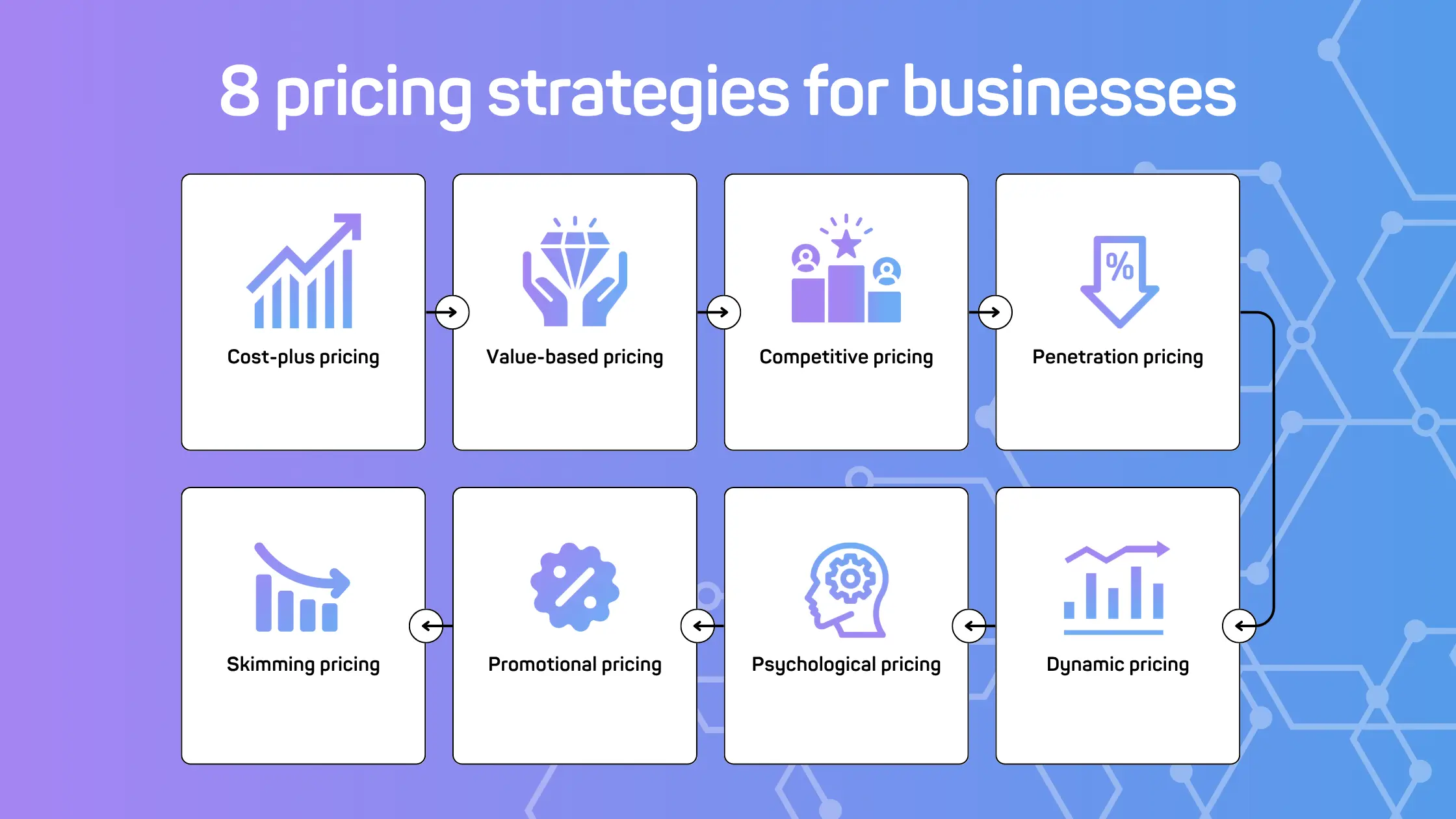
The following matrix is particularly useful because it plots strategies based on the two most important factors for a customer: price and quality.

Based on the video and diagrams, here is a summary of the key strategies relevant to your goals:
| Strategy | Definition | Best For | Pros | Cons |
|---|---|---|---|---|
| Penetration | Setting a low initial price to quickly gain market share. | Entering a new market; launching a first product to build an audience. | High initial adoption; discourages competitors. | Can create an expectation of low prices; may attract disloyal customers. |
| Competitive | Setting prices based on what competitors charge for similar products. | Saturated markets where products are similar (e.g., wallpaper packs, basic presets). | Simple to implement; low risk. | Hard to stand out; can lead to price wars; ignores your product's unique value. |
| Premium | Setting a high price to signal high quality, exclusivity, or luxury. | Products with a strong brand, unique features, or high perceived value. | High profit margins; reinforces brand image. | Smaller market size; requires strong brand justification. |
| Skimming | Launching with a high price and lowering it over time. | Tech products or trend-based items where early adopters are willing to pay more. | Maximizes revenue from different segments; high initial ROI. | Can anger early adopters; attracts competitors. |
You'll notice one key strategy from our learning outcome, Value-Based Pricing, isn't fully captured here. While related to Premium pricing, it's a distinct and more powerful concept that warrants its own deep dive.
2. A Deep Dive into Value-Based Pricing
Value-based pricing shifts the focus from your costs or your competitors' prices to one simple question: What is the measurable outcome or transformation your product provides to the customer?
This is the preferred model for many successful creators because it anchors the price to the result, not the effort. For someone like you who prefers systematic thinking over abstract "creativity," this model is ideal because it's based on a logical, investigative process. The Futur, a channel you're interested in, are masters of teaching this.
How To Price YOUR Work (Full Whiteboard AdobeMAX)
In this talk from Adobe MAX, Chris Do breaks down the exact conversation you need to have to uncover a product's true value. While he uses service-based examples like logo design, the principles are directly applicable to high-value digital products.
This is the core of the lesson. Please watch these three clips carefully: Uncovering Value with 'Why' Questions (28:37 - 37:24): Pay attention to the shift from asking about deliverables (a website) to asking about business impact (selling more units). Applying Value to 'Intangibles' (37:24 - 51:14): Observe how he connects an abstract goal ('get noticed') to a tangible business outcome, even for a logo. The Ultimate Question (1:10:09 - 1:12:55): This is a powerful technique for when a client questions how to measure the value you promise.
The core of Chris Do's method is a conversational framework designed to diagnose the client's problem and quantify the value of solving it.
The Value Conversation Framework:
- The Client's Stated Need: "I need a [product]." (e.g., "I need a Notion template for project management.")
- The First "Why": "Why is that important to you? What business problem does this solve?" (This moves from the deliverable to the problem.)
- Quantify the Problem: "How is this problem impacting you?" (e.g., "We miss deadlines, which costs us money/clients.")
- Quantify the Solution (The Delta): "If this problem were solved, what would that do for your business? How many more widgets would you sell? How much time would you save?" (This establishes the value.)
- Anchor the Price: Your price is then presented as a small investment to achieve that large, quantified value.
For a concise, written summary of this approach, the following article is a helpful reference.
How to Price for Design and Creative Services
This article from The Futur, 'How to Price for Design and Creative Services', recaps the core ideas of value-based pricing and the importance of asking the right questions.
Read the sections 'Three pricing models for creatives,' 'Value-based pricing,' 'How to choose the right pricing model,' 'How to measure the value of what you’re creating,' and 'Ask the right questions.' This will solidify the concepts from the video.
While you won't be having a live sales conversation for a self-serve digital product on Gumroad, you go through this process for your customer. You must deeply understand their problems so you can articulate the value in your product description—something we'll cover in the next lesson.
3. Choosing Your First Pricing Strategy
Now, let's bring it all together. The right strategy depends on your product, your goals, and your market.
Best Pricing Models for Selling Digital Products & Downloads
The article 'Best Pricing Models for Selling Digital Products & Downloads' offers a practical framework specifically for creators like you. It includes a fantastic summary table.
Focus on the sections 'Digital Product Pricing Factors to Consider' and 'Best Pricing Models for Digital Products'. Pay close attention to the summary table, as it's a great decision-making tool.
Here’s a simplified decision tree to help you choose:
- Is your product simple and in a crowded market? (e.g., wallpapers, basic Lightroom presets)
- Consider Competitive Pricing. Research what others charge and price your product similarly.
- Alternatively, use Penetration Pricing. Price it lower than the competition or even use a "Pay What You Want" model to attract initial customers and build your email list.
- Does your product solve a complex problem or provide a significant, measurable result? (e.g., an advanced Notion template that organizes a freelancer's entire business, saving them 10 hours a month; a set of Photoshop actions that automates a tedious design task)
- This is a perfect candidate for Value-Based Pricing. Calculate the potential time saved or money earned for your target customer, and price your product as a fraction of that value.
- Are you first to market with a unique, high-demand product?
- Consider Skimming Pricing. Price it high initially for the early adopters and lower it later if needed.
Activity: Select Your Pricing Strategy (15 minutes)
Let's apply these concepts. In the last lesson, you outlined policies for a hypothetical product: a pack of 5 minimalist desktop wallpapers.
-
For the Wallpaper Pack:
- Which pricing strategy would you choose? (e.g., Penetration, Competitive, etc.)
- Justify your choice in 2-3 sentences. Why is this the best fit for this specific product?
- Based on a quick (5 minute) search on a site like Gumroad or Creative Market for similar products, what is a specific price you would set?
-
For a Future Product:
- Now, imagine a more complex product you might create later, such as a "Student Productivity Hub" Notion template designed to manage classes, assignments, and notes for a high school or college student.
- Which pricing strategy would you choose for this product?
- Briefly explain how you would apply the Value-Based Pricing framework to determine its price. What questions would you ask about your target user (a student) to uncover the value? (Hint: Think about the value of better grades, less stress, or more free time).
Conclusion
You now have a structured understanding of how to approach pricing. It's not an art, but a strategic science. By moving beyond simply covering your costs and instead considering your market and the value you provide, you can price your products with confidence.
Key Takeaways:
- Pricing is a strategic choice that signals your product's position in the market. Key strategies include Penetration, Competitive, and Value-Based pricing.
- Competitive Pricing is simple and safe for saturated markets, but it makes it difficult to stand out.
- Penetration Pricing is excellent for market entry and building an initial audience for a new brand.
- Value-Based Pricing is the most powerful model for premium products. It anchors your price to the tangible outcomes and transformations you create for your customer, not your time or effort.
Preview of the Next Lesson
You've defined the rules and set a price. The final step before listing your product is convincing people to buy it. In our next lesson, we will focus on how to write an optimized product listing title and description using benefit-driven language and keywords. This is where you'll put your value-based thinking into practice, crafting a compelling narrative that turns visitors into customers.