Hello! Last time, we took a valuable step inward, using self-assessment to identify your default communication style—whether it leans toward being passive, aggressive, or assertive. This understanding of your general tendency, your "what," is the perfect foundation for today's lesson.
Now, we will shift our focus from the what to the how. Specifically, we're going to explore how your communication style actually shows up in your interactions. The goal for this lesson is to learn to observe how your own body language, tone, and word choice shape the way your message is received. We'll break down the three core channels of communication and see how their alignment—or misalignment—can dramatically change the impact you have on others. This is a crucial "how-to" skill for building the stronger relationships you're aiming for.
The Three Channels of Your Message
When you communicate face-to-face, you're sending information through more than just your words. Research has shown that our messages are conveyed through three distinct channels: our body language, our tone of voice, and the words we use.
Let's begin by reading a short article that introduces this concept and a famous, though often misunderstood, theory about it.
This article from Revolution Learning & Development breaks down the three core components of any face-to-face message. It introduces Dr. Albert Mehrabian's well-known "55/38/7 rule," which assigns percentages to the impact of body language, voice, and words.
Please read the first few sections of the article, from the beginning down to the part just before the heading "Communicating Via Different Channels." Focus on two things: first, the breakdown itself, and second, the examples of how a message can fail if these elements don't work together.
The key takeaway from this isn't that words only count for 7% of your message in all situations. That famous statistic applies most strongly when we are expressing feelings and attitudes, especially when our signals are mixed. The more important, practical lesson is that for a message to be received clearly and trusted by the listener, all three channels must be in alignment. When you say "I'm happy to help," your body language and tone must also say "I'm happy to help." If they don't, people will almost always believe the nonverbal message over the verbal one.
Body Language: The Silent Messenger
Since body language has such a powerful impact, let's zoom in on it first. It's often habitual and unconscious, which is why actively observing it is so important.
This short, animated video provides a clear example of how our nonverbal habits can send a message we don't intend.
This video from LearnFree uses a simple scenario to illustrate how body language is interpreted by others.
Watch the entire video (it's less than two minutes). Pay close attention to the example of Alice, where her posture and eye contact make her seem unapproachable, even if she feels friendly. The video also reinforces a key idea for our lesson: with awareness, you can notice and adjust your habits.
As the video shows, things like posture and eye contact send strong signals. To build your awareness, it helps to know what to look for. Body language isn't just one thing; it's a whole collection of signals.
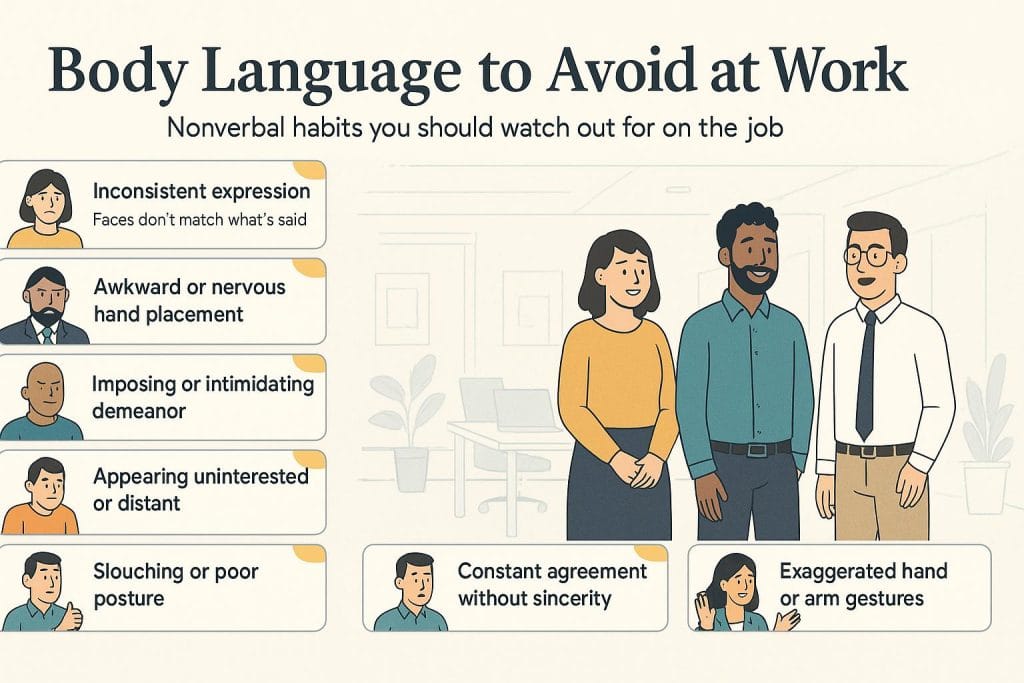
Take a look at the image above. Do any of these habits feel familiar? This isn't about judgment, but about observation. The article below provides an even more detailed list of the different types of nonverbal communication.
Body Language and Nonverbal Communication
This article from HelpGuide.org offers a comprehensive overview of nonverbal communication and its importance in building relationships.
Please read the sections titled "The importance of body language" and "Types of body language and nonverbal communication." As you read, focus on how your nonverbal signals tell others if you are being truthful and engaged. Also, make a mental note of the seven distinct types of nonverbal communication listed, from facial expressions to voice.
By breaking down "body language" into these smaller components—posture, gestures, eye contact, facial expressions—you give yourself a practical checklist for self-observation.
Tone of Voice: The Music Behind the Words
The last type of nonverbal communication mentioned in that article—voice—is so critical it deserves its own deep dive. Your tone of voice carries the emotional meaning of your words. The same sentence can express excitement, sarcasm, anger, or fear, depending entirely on how you say it.
This next video gives an excellent explanation and a powerful demonstration of the impact of tone.
Tone of Voice in Communication
In this video, communication coach Alexander Lyon breaks down what "tone of voice" really means and how it shapes our message.
First, watch the section that defines tone of voice, using the wonderful analogy of hearing instruments through a wall, and explains why we trust nonverbal cues, like in the "I'm fine" example. This is from the beginning of the video. Next, watch the practical demonstration where the speaker repeats the same seven-word sentence, but changes the meaning each time by emphasizing a different word. This is a must-see section from the demonstration. Finally, skip to the end and watch the section where he suggests two practical "checks" you can do to become more aware of your own tone. This is from the final minute.
The exercise with "I never said she stole the money" is a perfect illustration of how your vocal delivery shapes perception. A slight shift in emphasis can completely alter the listener's interpretation.
Word Choice: The Foundation
Even though nonverbals carry immense weight, the words you choose still form the foundation of your message. Your word choice is often a direct reflection of the communication style we discussed in the last lesson.
- A Passive style often relies on words that minimize the speaker's presence: "It's not a big deal," "I guess," frequent apologies, or questions when a statement is needed ("Is it okay if I...?" instead of "I would like to...").
- An Aggressive style uses words that assign blame, create control, or are absolute: "You always...," "You never...," "You should have...," or "That's a stupid idea."
- An Assertive style—the style we'll be working toward—uses clear, direct, and respectful language. This includes using "I" statements to express feelings and needs ("I feel frustrated when..." instead of "You're making me mad").
The key is that your words, tone, and body language should all work together.
The Power of Congruence
When your body language, tone, and words all send the same message, you are being congruent. This is the key to being seen as authentic, trustworthy, and easy to understand. When they are mismatched—or incongruent—you create confusion, tension, and mistrust.
Consider these two scenarios:
Scenario 1: Congruent Message
A coworker asks you for help.
- Words: "Of course, I can take a look at that with you."
- Tone: Warm, engaged, and willing.
- Body Language: You turn your body toward them, make eye contact, and put down what you were doing.
- Impact: Your coworker feels genuinely supported and that their request was welcome.
Scenario 2: Incongruent Message
The same coworker asks for help.
- Words: "Of course, I can take a look at that with you."
- Tone: Flat, with a sigh.
- Body Language: You don't look up from your computer screen and continue typing as you speak.
- Impact: Despite your "yes," your coworker feels they are bothering you and that your help is reluctant. They may hesitate to ask you for help in the future.
As you can see, the exact same words can have a completely different impact based on the nonverbal signals that accompany them.
Your Turn: A Self-Observation Exercise
Because your goal is practical skill-building, let's put this into practice. Over the next day or two, I want you to become a detective of your own communication.
Choose one simple, low-stakes interaction—like ordering a coffee, speaking with a cashier, or a brief exchange with a colleague. Immediately after the conversation, take a moment to reflect:
- My Words: What were the exact words I used?
- My Tone: How did I sound? (e.g., rushed, cheerful, tired, monotone?)
- My Body Language: What was my posture? Was I making eye contact? Was I smiling? What were my hands doing?
- Their Reaction: How did the other person respond to me (verbally and nonverbally)? Did they seem relaxed, tense, open, or closed off?
- Alignment Check: Did my words, tone, and body language all tell the same story?
This exercise isn't about being perfect; it's about building the muscle of self-awareness.
Conclusion
In this lesson, we've broken down how your messages are delivered and received through the three crucial channels of body language, tone of voice, and word choice. You now have a framework for observing how these elements combine to shape others' perception of you.
Here are the key takeaways:
- Communication is a package deal: Your message is a combination of what you say, how you say it, and what your body is doing.
- Congruence builds trust: When your words, tone, and body language are aligned, your message is clear and credible.
- Incongruence creates confusion: When your signals are mixed, people tend to believe the nonverbal message, which can lead to misunderstanding and mistrust.
- Self-observation is the first step: By consciously noticing your own habits in posture, vocal patterns, and word choice, you gain the power to communicate more intentionally.
You've now examined your overall communication style and the specific behaviors that bring it to life. The next logical step is to explore what drives these behaviors from within. In our next lesson, we will begin our journey into emotional intelligence by learning to identify and label your own emotions as they arise in social interactions. This will give you the insight needed to manage your reactions and choose your communication more effectively.