Welcome to our final lesson in the "Communication Fundamentals" module. In our last session, we delved into the three channels of communication—your words, tone, and body language—and saw how making them congruent is key to being understood and trusted.
Today, we'll build directly on that foundation. We will learn how to apply this knowledge to different social and professional landscapes. The goal for this lesson is to distinguish between formal and informal contexts and adjust your communication style accordingly. This is a fundamental "how-to" skill that allows you to navigate everything from a job interview to a casual chat with a friend, helping you build stronger, more appropriate connections in every part of your life.
Formal vs. Informal: What's the Difference?
At its core, communication style isn't about being "right" or "wrong," but about being effective for the situation. We naturally speak differently to a close friend than we do to a potential employer. The ability to consciously switch between these styles is sometimes called "code-switching," and it's a powerful tool for social and professional success.
Let's start with a clear overview of the two main styles. This short video breaks down the six key differences between formal and informal communication, from their purpose and structure to the language used.
Formal vs Informal communication | 6 Key differences
This video, "Formal vs Informal communication," gives a concise and structured comparison of the two styles.
Watch the video from the beginning to the end (entire video). As you watch, pay attention to the distinct purpose and audience for each style. This will help you start building a mental framework for when to use each one.
As the video explains, formal communication is structured, objective, and follows established rules, while informal communication is spontaneous, personal, and flexible. Neither is better than the other; they are simply tools for different jobs. The real skill lies in knowing which tool to use and when.
Reading the Room: When to Be Formal or Informal
So, how do you decide which style is appropriate? You need to analyze the context by considering three main factors:
- Audience: Who are you communicating with? A superior, a client, a stranger, a colleague, a friend, a family member? The less you know the person, or the more hierarchical the relationship, the more formal you should be.
- Purpose: What is the goal of the communication? Is it to make a formal request, deliver official information, or conduct a transaction? Or is it to build rapport, socialize, or share personal feelings? Official business usually calls for formal communication.
- Setting: Where is the communication taking place? In a boardroom, a classroom, or a government office? Or is it at a coffee shop, a party, or over text message? The environment itself provides strong cues about the expected level of formality.
The following resource provides a very practical breakdown of these differences and gives concrete examples of situations for each style.
[PDF] Transitioning Between Informal and Formal Communication Styles
This PDF from East Carolina University's advising center offers a clear, practical guide to understanding and using formal and informal communication.
Please read the slides titled "Communication Styles" and "Examples of Appropriate Situations for Using Each Communication Style." You can find them on pages 3 and 4 of the PDF. Focus on the two main sections: The definitions, which clearly contrast the characteristics of each style. The table of examples, which gives you real-world scenarios for written, oral, and even nonverbal communication.
The guiding principle is clear: your communication style must adapt to the context. A formal email to a friend to make weekend plans would feel strange and distant. Conversely, a casual, slang-filled message to a professor or a client could be perceived as disrespectful and unprofessional.
Adjusting Your Style: A Practical Guide
Once you've "read the room" and identified the context, you need to adjust your communication. This is where our previous lesson on the three channels—words, tone, and body language—becomes actionable.
1. Word Choice and Tone
Your choice of words is one of the most obvious ways you signal formality. This includes everything from greetings ("Dear Mr. Smith" vs. "Hey John") to vocabulary (using "additionally" vs. "also") and grammar (avoiding contractions like "don't" in formal writing).
The following video brings this to life with a series of short, engaging scenes. It vividly demonstrates the consequences of getting the style wrong—both by being too informal in a professional setting and too formal in a casual one.
Formal VS Informal English Vocabulary - Daily Life English Conversation
This video from English Speaking Course uses dramatic scenarios to show the real-world impact of choosing the right or wrong communication style.
This video is a little longer, so let's focus on the key parts: Watch the business scenario from this section. Notice how the employee's overly casual language and tone create a bad impression and lose a potential customer. Next, watch from the email correction scene. This provides excellent, specific examples of formal vs. informal vocabulary for professional writing. Finally, watch the scenes in the bar from this segment and this part. See how using overly formal language ("acceptable," "additionally") in a casual social setting comes across as awkward and prevents connection.
2. Written Communication: The Email Test
Emails are a perfect example of where this skill is tested daily. A professional email is structured differently, uses different language, and has a different tone than a quick message to a friend.
This image provides a brilliant side-by-side comparison.
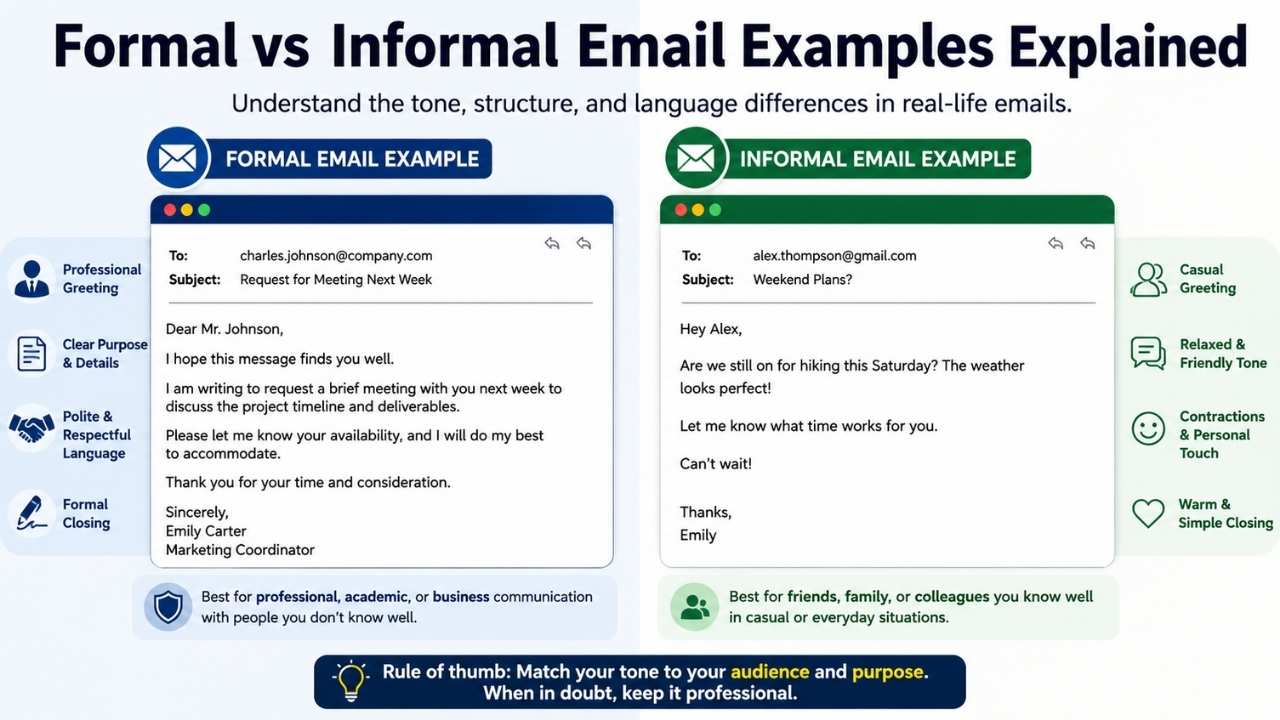
This infographic breaks down the key elements of a formal versus an informal email. Note the differences in greeting, phrasing, sentence structure, and closing, all guided by the audience and purpose.
As the image shows, the formal email has a clear, professional subject line, a formal greeting ("Dear Mr. Johnson,"), full sentences, polite phrasing ("I am writing to request..."), and a formal closing ("Sincerely,"). The informal email is the opposite: it's direct, uses casual language ("Hey Alex"), includes contractions ("Can't wait!"), and has a simple, warm closing ("Thanks,").
The rule of thumb at the bottom is perhaps the most important takeaway: "Match your tone to your audience and purpose. When in doubt, keep it professional."
3. Non-Verbal Communication
Finally, your body language and tone of voice must also align with the context.
This guide from the Queensland Government provides practical business communication advice. We'll focus on the sections dealing with non-verbal cues and first impressions.
Please navigate to the section "Non-verbal communication" and read the subsections on: Body language Eye contact Facial expressions Then, continue to the section "Meeting new people and introducing yourself" and read about: First impressions and introductions Pay close attention to how cultural differences can affect things like eye contact and handshakes.
In a formal setting (like a job interview or meeting a client), you would typically use:
- Posture: A more upright, attentive posture.
- Gestures: A firm handshake, controlled hand movements.
- Eye Contact: Consistent eye contact to show confidence and sincerity.
- Tone: A measured, clear, and professional tone.
In an informal setting (like hanging out with friends), you would use:
- Posture: A relaxed, open posture.
- Gestures: Hugs or casual waves, more expressive gestures.
- Eye Contact: More varied and relaxed patterns.
- Tone: A wider range of emotional expression, including humor and excitement.
By consciously adjusting all three channels—words, tone, and body language—you send a clear, congruent message that is perfectly suited to the situation.
Conclusion
In this lesson, we've explored the crucial difference between formal and informal communication. You've learned how to identify the context by analyzing the audience, purpose, and setting, and how to adjust your words, tone, and body language to match.
Here are the key takeaways:
- Context is King: The effectiveness of your communication depends on matching your style to the situation.
- Analyze Before You Act: Before communicating, quickly consider your audience, purpose, and setting to decide on the right level of formality.
- Adjust All Channels: To be effective, you must adapt your word choice, tone of voice, and body language to the context.
- When in Doubt, Lean Formal: It's almost always safer to be slightly too formal than too informal. You can always relax your style as you build rapport.
You have now completed the "Communication Fundamentals" module. You've reflected on your own style, learned about the channels of communication, and now have a framework for adapting to different contexts.
This sets us up perfectly for our next module, "Foundations of Emotional Intelligence." Having a grasp of the external mechanics of communication is vital, but true mastery comes from understanding the internal drivers—our emotions. In our next lesson, we will begin this journey by learning to identify and label your own emotions as they arise in social interactions. This skill is the bedrock for managing your reactions and building deeper, more authentic connections.