Hello! Welcome to your third lesson.
In our last session, we established a crucial concept: the difference between voiced (vocal cords vibrating) and voiceless (no vibration) sounds. You learned that all vowels are voiced, while consonants come in voiced/voiceless pairs.
Today, we will build directly on that foundation. The goal of this lesson is to organize all the sounds of English into their three main families: consonants, vowels, and diphthongs. Understanding these categories is like having a map of the English sound system. It provides the structure you need before we start exploring each sound in detail. This focus on the "theory behind sounds" aligns perfectly with your learning preference.
The Fundamental Difference: Airflow
The most basic way to distinguish between vowels and consonants is to think about airflow.
- A vowel is a sound produced with an open mouth, allowing air to flow freely from the lungs. The sound is shaped by your tongue and lips, but nothing blocks the air.
- A consonant is a sound produced by constricting or completely blocking the airflow at some point in your mouth. This blockage is what creates the consonant sound.
To see and hear this in action, please watch the following short video. It provides a simple and clear physical demonstration of this core principle.
What is a vowel? What is a consonant? Difference between a vowel and a consonant in English
The video 'What is a vowel? What is a consonant?' from Woodward English explains this key difference using straightforward examples.
Please watch from 00:14 to 01:58. Pay close attention to how the presenter demonstrates the open mouth for a vowel ('aaah') and the lip constriction for a consonant ('p').
The English Sound Inventory
In total, most dialects of English have around 44 distinct sounds (or phonemes). These are organized into consonants and vowels. This chart provides a great visual overview.
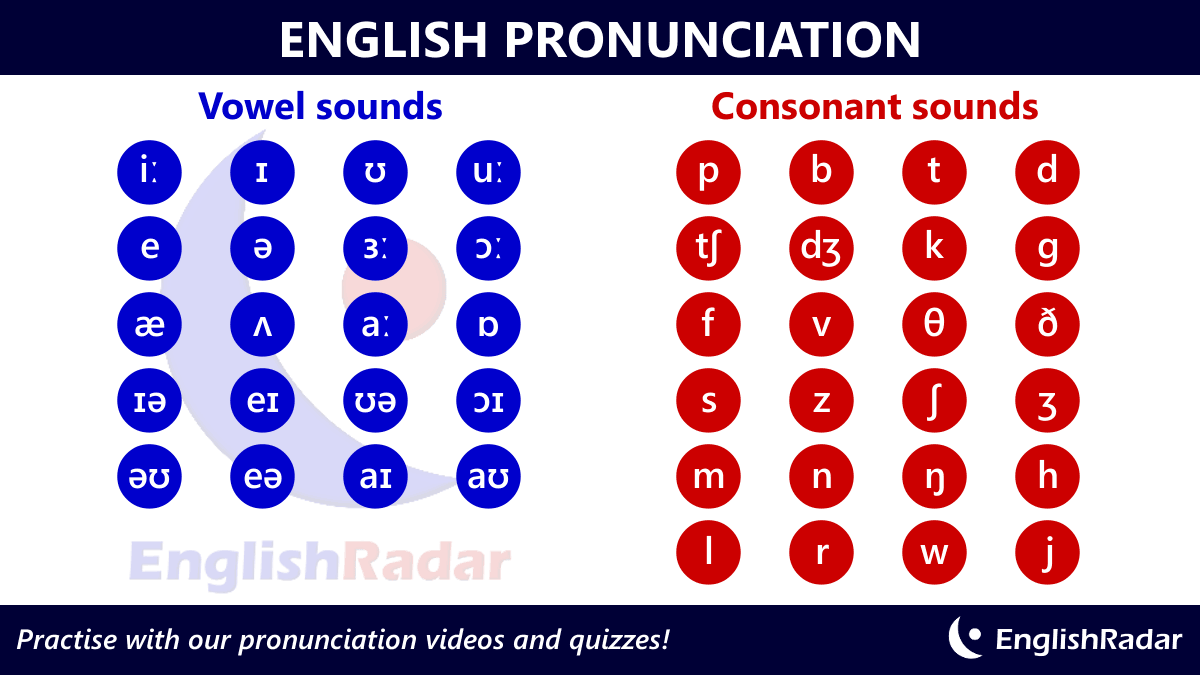
As you can see, there are more sounds than there are letters in the alphabet. This is why we will eventually use the IPA symbols shown here to talk about pronunciation accurately.
For now, let's break down these categories further.
Vowels: Single Sounds (Monophthongs) and Gliding Sounds (Diphthongs)
Vowel sounds themselves can be split into two types. This is where we introduce our third category: diphthongs.
-
Monophthongs (from Greek mono, "single" + phthongos, "sound"): These are pure, single vowel sounds. Your mouth and tongue hold a steady position throughout the sound. Examples include the /ɪ/ in "sit" or the /æ/ in "cat".
-
Diphthongs (from Greek di, "two" + phthongos, "sound"): These are special vowels where your tongue glides from one position to another within the same syllable, creating a two-part sound. Think of the sound in "oy" in the word "boy" or "ay" in "say".
To understand this distinction better, let's look at an article that explains how vowels are produced.
The difference between consonants and vowels - Spelfabet
The article 'The difference between consonants and vowels' from Spelfabet provides clear definitions for these sound categories.
Please read the section titled 'How vowels are produced'. Focus on the explanation of monophthongs (mouth in the same position) and diphthongs (mouth moves from one position to another).
A Note for Hindi Speakers
The concept of diphthongs is particularly important for you. In Hindi, vowel sounds are generally monophthongs. As a result, Hindi speakers sometimes simplify English diphthongs by only pronouncing the first part of the sound. For example, the word "go" /gəʊ/ might be pronounced closer to "go" /goː/, without the gliding 'w' quality at the end.
Recognizing that a diphthong involves a movement is a key step to mastering these sounds. For more on this, you can read the following section.
English for Urdu and Hindi Speakers: 10 Pronunciation ...
The article 'English for Urdu and Hindi Speakers' by pronunciation coach Hadar Shemesh specifically discusses this challenge.
Please read the section 'The next challenge is simplifying diphthongs.' Notice the explanation of how words like 'go' and 'way' should include a transition or glide.
Visualizing Vowel Production
Since you're interested in the physical mechanics of speech, the image below is an excellent resource. It shows the position of the tongue and jaw for various English vowels and diphthongs. This can be especially helpful as you adapt to speaking with braces.
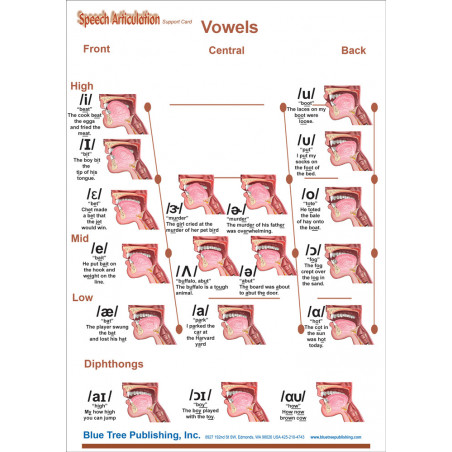
Take a moment to look at the diagrams for a high front vowel like /iː/ ("eat") and a low back vowel like /ɑː/ ("father"). You can see a clear difference in both tongue height and how far forward or back it is. For a diphthong like /aɪ/ ("ice"), imagine the tongue moving from a position for /a/ towards the position for /ɪ/.
A Tour of the Sound Categories
Now that we have our definitions, let's take a quick tour through all the sound categories with a video guide. This will help you hear examples of each type.
BASIC Phonetics | Understanding The International Phonetic Alphabet
The video 'BASIC Phonetics' from English with Greg gives a great overview of the 44 sounds, breaking them down into consonants and vowels (including diphthongs).
Please watch the following two segments: Consonants (01:23 - 05:41): Don't worry about memorizing every symbol. Just listen for the variety of sounds and notice that they all involve some kind of air blockage or friction. Vowels & Diphthongs (05:41 - 11:33): Listen to the distinction between the single vowel sounds (monophthongs) and the gliding vowel sounds (diphthongs).
Activity: Categorize the Sounds
Let's test your understanding. For each word below, identify the sound made by the bolded letter(s). Is it a consonant, a monophthong (single vowel), or a diphthong (gliding vowel)?
- bed - The /b/ sound.
- go - The /əʊ/ sound.
- heat - The /iː/ sound.
- she - The /ʃ/ sound.
- fight - The /aɪ/ sound.
- cup - The /ʌ/ sound.
Click here for the answers
- bed: Consonant. Your lips press together to block the air.
- go: Diphthong. Your mouth moves from a relaxed central position /ə/ to a rounded one /ʊ/.
- heat: Monophthong. Your tongue stays in a high, forward position for the long /iː/ sound.
- she: Consonant. Your tongue raises to create friction, but it doesn't fully block the air.
- fight: Diphthong. Your tongue glides from a low position /a/ to a high one /ɪ/.
- cup: Monophthong. Your tongue stays in a steady, central position for the /ʌ/ sound.
Conclusion
Great job today! You've now learned how the entire English sound system is organized, a critical step toward improving your pronunciation with precision.
Key Takeaways:
- Sounds are categorized based on airflow: consonants involve blocked or constricted air, while vowels have free-flowing air.
- Vowels can be monophthongs (a single, steady sound) or diphthongs (a glide between two vowel positions in one syllable).
- For you as a Hindi speaker, paying special attention to the gliding movement in diphthongs is key to sounding more natural in English.
In our next lesson, we will learn how to recognize and read the International Phonetic Alphabet (IPA) symbols for common English sounds. This will unlock a powerful tool, enabling you to use online dictionaries to check the exact pronunciation of any new word you encounter.