Hello! Welcome to your fourth lesson in our journey to improve your English pronunciation.
In our last lesson, we categorized English sounds into three families: consonants, monophthongs (single vowels), and diphthongs (gliding vowels). We learned that this grouping is based on how air flows through your mouth.
Today, we will learn the system that linguists use to write down these sounds accurately: the International Phonetic Alphabet (IPA). The goal is for you to recognize the IPA symbols for common English sounds. Think of this as learning the "alphabet of pronunciation." Mastering this will give you the power to look up any word in a dictionary and know exactly how it should sound, which is a massive step toward your goal of speaking with clarity and confidence in professional settings.
Why Spelling Isn't Enough: The Need for IPA
As you know, English spelling can be very confusing. The same letters can represent different sounds, and the same sound can be spelled in different ways.
Consider the letters "ough":
- though (/ðəʊ/)
- through (/θruː/)
- tough (/tʌf/)
Trying to guess the pronunciation from spelling alone is unreliable. The IPA solves this problem by having one unique symbol for every single sound.
To start, let's watch a video that explains what the IPA is and why it's so important for learning English pronunciation.
Learn All English Sounds & Pronounce Words Perfectly with the IPA!
The video 'Learn All English Sounds & Pronounce Words Perfectly with the IPA!' from the mmmEnglish channel provides an excellent introduction to this topic.
Please watch from the beginning until 03:10. The presenter, Emma, will explain why the 26 letters of the English alphabet are not enough to represent the 44+ sounds of English.
The English Phonemic Chart
Here is a chart that shows the approximately 44 sounds of English using their IPA symbols. It might look intimidating at first, but we will break it down. You can see it is divided into vowels and consonants, just as we discussed.
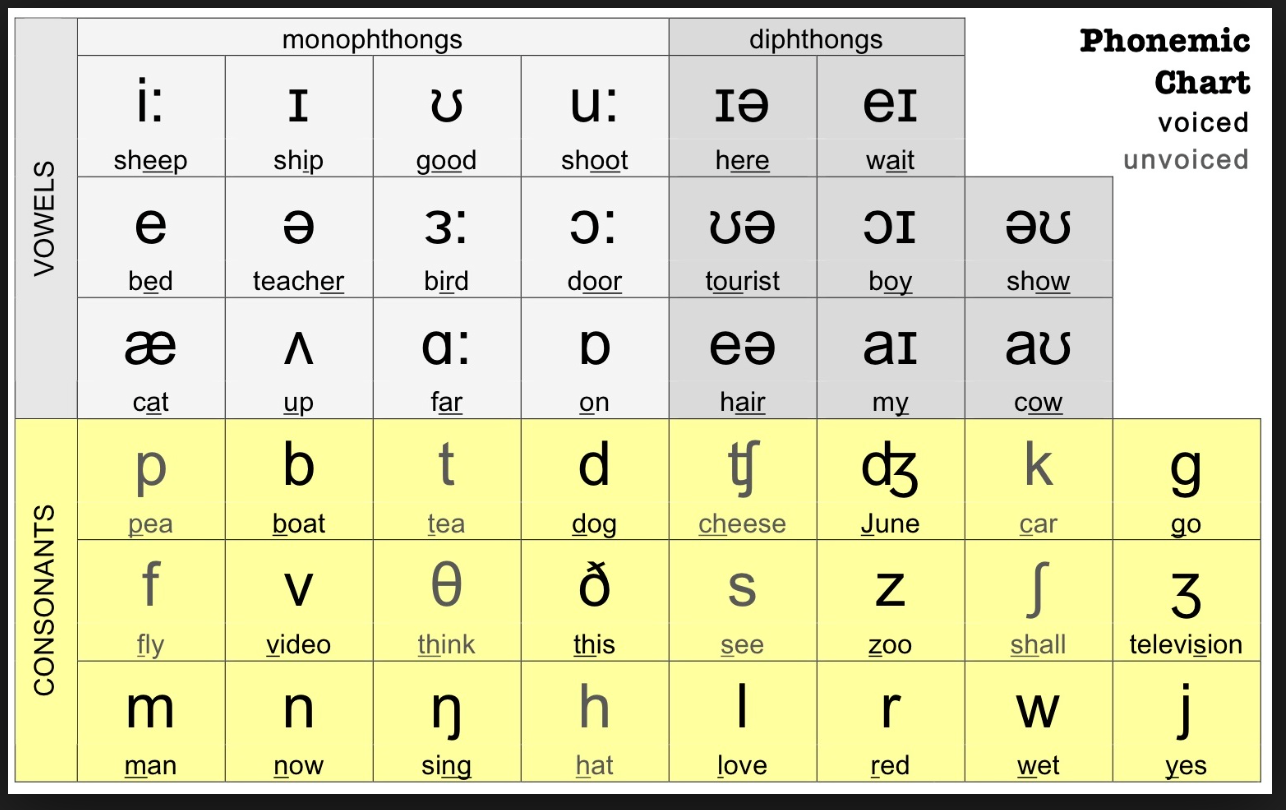
Let's continue with the mmmEnglish video to get a quick tour of these sections.
Learn All English Sounds & Pronounce Words Perfectly with the IPA!
Now, let's get a brief overview of how the IPA chart is structured.
Watch from 03:10 to 04:08. Notice how the chart is split into vowel sounds (top) and consonant sounds (bottom).
Decoding the Vowel Symbols
Vowels are often the trickiest part of pronunciation. As you are a native Hindi speaker, connecting these new sounds to sounds you already know can be very helpful.
Let's watch a few clips from a video where the instructor explains some English vowel sounds with Hindi comparisons. This will help you build a bridge from what you know to what you're learning.
INTERNATIONAL PHONETIC ALPHABET l PART 1 l सारे VOWEL SOUNDS सीखें l IPA l PHONETICS IN ENGLISH l
The video 'INTERNATIONAL PHONETIC ALPHABET l PART 1' from Learn English Online with Krishna is taught in Hindi and will help connect IPA symbols to familiar sounds.
Please watch the following short segments: Short 'i' /ɪ/ vs. Long 'i' /iː/ (04:30 - 07:37): Pay close attention to how he compares these to the Hindi 'छोटी इ' and 'बड़ी ई'. Notice the two dots /ː/ which signify a long sound. Short 'e' /e/ and /æ/ (07:37 - 10:10): This covers the sounds in 'set' and 'cat', which can be challenging to distinguish.
Visualizing Vowel Production
You mentioned you're interested in the physical mechanics of sound production. The chart below, called a vowel quadrilateral, maps vowel sounds based on your tongue's position (front-to-back) and height (high-to-low). This can be especially useful for you to understand how to form sounds correctly, particularly with your new braces.

Now, let's watch a comprehensive overview of all the vowel and diphthong symbols in English. As you watch, try to hear the sounds and connect them to the symbols on the chart above.
Learn All English Sounds & Pronounce Words Perfectly with the IPA!
Let's return to the mmmEnglish video for a full tour of the English vowel symbols.
Watch from 04:08 to 07:52. This covers all the monophthongs (pure vowels) and diphthongs (gliding vowels). Don't worry about memorizing them all now; just focus on associating the symbol with the sound you hear.
Decoding the Consonant Symbols
Many consonant symbols look just like the English letters they represent (e.g., /p/, /b/, /m/, /t/), which makes them easy to learn. However, some sounds have unique symbols.
The following resource provides a clear table of these unique symbols.
The Ultimate Guide to IPA: Read Phonetic ... - Pronounce
Let's review the key consonant symbols using 'The Ultimate Guide to IPA'.
Please find the section titled 'Decoding the English IPA Chart: The Key Symbols' and review the table under the subheading 'Consonants: The Familiar and the Foreign'. This table lists symbols like /θ/ (think), /ð/ (this), and /ʃ/ (shoe).
Now, let's watch the video explanation of the consonant sounds. Pay attention to the distinction between unvoiced (air only) and voiced (vocal cord vibration) sounds, which we covered in a previous lesson.
Learn All English Sounds & Pronounce Words Perfectly with the IPA!
This segment from the mmmEnglish video will walk you through the consonant sounds.
Watch from 07:52 to 11:08. Try placing your hand in front of your mouth for unvoiced sounds like /p/ and on your throat for voiced sounds like /b/ to feel the difference.
Let's Practice!
Knowledge of the IPA is only useful if you can apply it. The next part of the video is an interactive practice session. This is the most important part of the lesson. Please say the sounds and words out loud. This will train your eyes, ears, and mouth to work together.
Learn All English Sounds & Pronounce Words Perfectly with the IPA!
Now it's time to actively practice recognizing the symbols and making the sounds.
Complete the two practice sections: Symbol to Sound (11:22 - 18:15): You will see a symbol and an example word. Say the sound out loud. This helps build the connection between the symbol and the mouth movement. Transcription to Word (18:15 - 22:19): You will see a word written in IPA. Try to read the symbols and say the word before the answer is revealed. This is excellent practice for using a dictionary.
Conclusion
Excellent work today. You've taken your first step into a much larger world of precise pronunciation. Learning to read IPA is like learning to read a map—it ensures you'll never be lost when it comes to pronouncing a new word.
Key Takeaways:
- The International Phonetic Alphabet (IPA) uses one symbol for one sound, removing the confusion of English spelling.
- The IPA chart is divided into vowels (monophthongs and diphthongs) and consonants.
- Special symbols like /θ/ (th), /ʃ/ (sh), and /ə/ (schwa) represent common sounds that don't have a single, consistent letter in the alphabet.
- Active practice—saying the sounds out loud as you see the symbols—is the best way to make them stick.
In our next module, we will begin to target specific sounds that are crucial for clear English. We'll start with the most common vowel sound in the entire language: the schwa /ə/, which is key to mastering the natural rhythm of English.