Hello! Welcome to your second lesson.
In our first session, we explored the organs of speech—the lips, tongue, teeth, and palate—which shape the sounds you make. Today, we're going to investigate the source of the sound itself: the vocal cords.
This lesson directly addresses your interest in the physical production of speech. We will explore the fundamental difference between voiced and voiceless sounds. By the end of our 60 minutes, you'll be able to feel and hear this distinction, a crucial skill that separates many pairs of English words and is a cornerstone of clear pronunciation.
The Voice "On/Off" Switch
At the heart of our topic is a simple but powerful mechanism in your throat. Think of your voice box (larynx) as having an "on/off" switch for vibration.
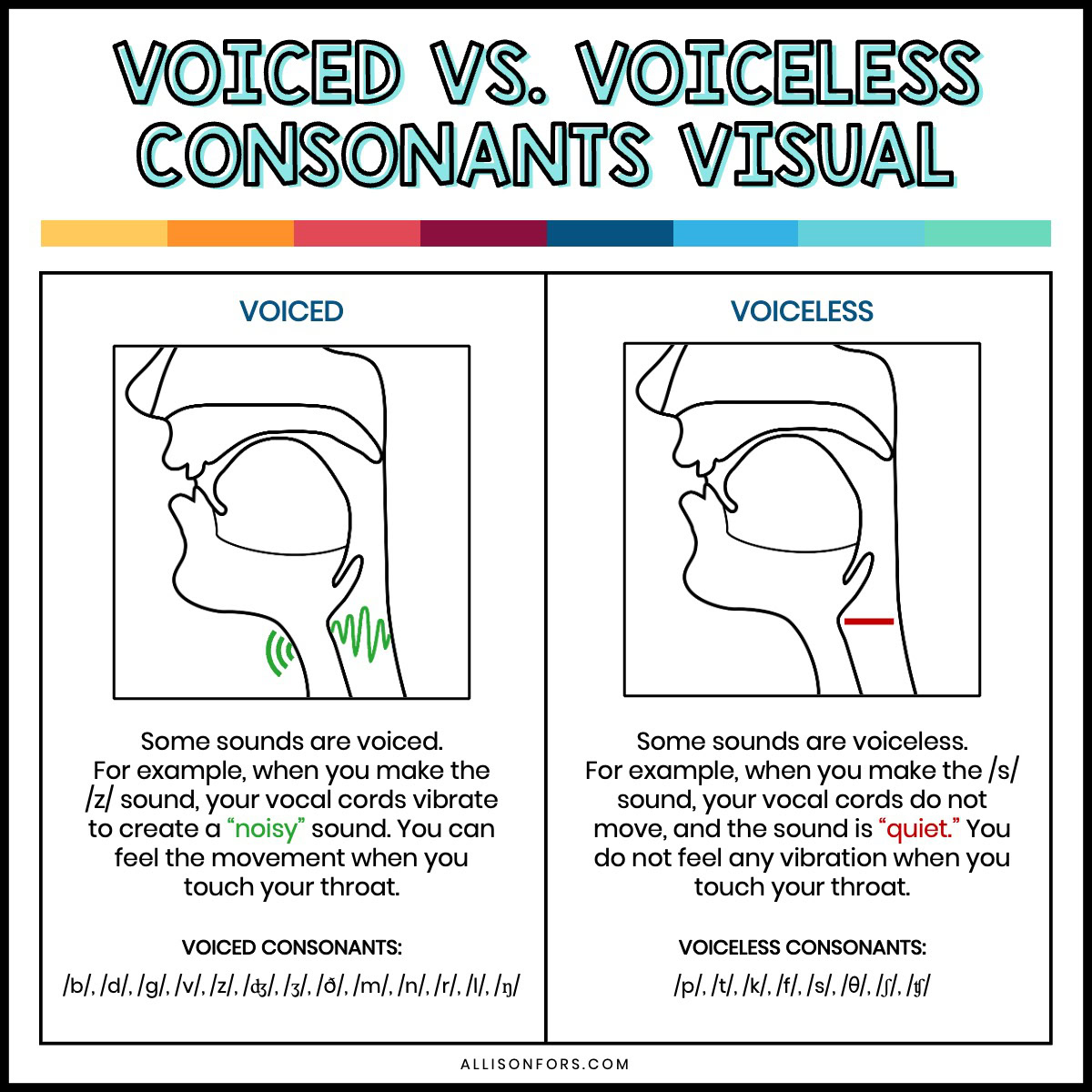
- When a sound is voiced, the switch is "on." Your vocal cords come together and vibrate as air from your lungs pushes through them. This creates a buzzing sound.
- When a sound is voiceless, the switch is "off." Your vocal cords are relaxed and apart, so air passes through freely without any vibration. The sound is made purely of air.
This image provides a clear visual of what's happening inside your throat.
Activity 1: Feel the Vibration
The best way to understand this concept is to feel it yourself. This is a simple exercise you can do anytime to check a sound.
- Gently place two fingers on the front of your throat, over your Adam's apple.
- Now, make a long, continuous "zzzzzz" sound, like a buzzing bee. You should feel a distinct vibration or buzzing under your fingers. This is a voiced sound.
- Keeping your fingers in the same spot, now make a long "ssssss" sound, like a hissing snake. The vibration should stop completely. You're now making a voiceless sound.
This physical feedback is your most reliable tool. To explore this concept further and hear more examples, please watch the first part of the following video.
Voiced vs. Unvoiced Sounds | English Pronunciation | Phonology
This video from Billie English clearly explains and demonstrates the difference between voiced and unvoiced (voiceless) sounds, reinforcing what you just felt.
Please watch from the beginning until 01:56. The presenter will guide you through feeling the vibration in your throat for several sounds.
Applying the Concept: Vowels and Consonants
Now that you can feel the difference, let's see how it applies to the sounds of English.
Vowel Sounds
This one is simple: All vowel sounds in English are voiced. Every time you say a vowel like a, e, i, o, u, your vocal cords are vibrating. Go ahead and try it—say "ahhh" or "eeee" with your fingers on your throat. You will always feel the buzz.
Consonant Sounds
Consonants are where it gets interesting. They can be either voiced or voiceless. Many consonants come in pairs, where the only difference is this voicing. Your mouth, tongue, and lips are in the exact same position for both sounds in the pair.
This is where minimal pairs become a useful practice tool. These are pairs of words that differ by only one sound, in this case, the voicing. Mistaking one for the other can completely change the meaning of a sentence.
To learn more about minimal pairs and see a list of common examples, please read the following sections from this guide.
A Guide to Voiced and Unvoiced Sound for Clear Speech - Intonetic
The article 'A Guide to Voiced and Unvoiced Sound' from Intonetic explains the concept of minimal pairs and provides excellent, practical tests you can use.
Please read two sections: Start with 'Mastering Pronunciation With Minimal Pairs'. Focus on the explanation and the table of common pairs (e.g., pat/bat, fan/van). Continue to 'Simple Tests to Hear and Feel the Difference'. Pay close attention to the 'Whisper Test' and the 'Paper Test', as these are excellent hands-on exercises.
Here is a summary of the most common consonant pairs. The symbols like /p/ are from the International Phonetic Alphabet (IPA), which we will study in more detail later.
| Voiceless (No vibration) | Voiced (Vibration) | Minimal Pair Example |
|---|---|---|
| /p/ | /b/ | pat / bat |
| /t/ | /d/ | ten / den |
| /k/ | /g/ | coat / goat |
| /f/ | /v/ | fan / van |
| /s/ | /z/ | sue / zoo |
| /θ/ ('th' in think) | /ð/ ('th'in this) | thigh / thy |
| /ʃ/ ('sh' in shoe) | /ʒ/ ('s' in measure) | pressure / pleasure |
| /tʃ/ ('ch' in chin) | /dʒ/ ('j' in gin) | chin / jin |
Activity 2: Practice and Self-Correction
Let's put your new knowledge and the tests from the article into practice.
1. The Paper Test
As the article explained, this test helps you feel the puff of air (aspiration) that often comes with voiceless sounds like /p/, /t/, and /k/.
- Hold a small piece of paper or your hand in front of your mouth.
- Say "pin". You should feel a strong puff of air.
- Now say "bin". The puff of air is much weaker or absent.
- Try this with "tin" vs. "din" and "coat" vs. "goat".
2. Minimal Pair Practice
Read the following sentences aloud. Pay close attention to the bolded words. Use your fingers on your throat to confirm you are switching the "voice" on and off correctly.
- I saw a big bat. / He gave the ball a gentle pat.
- Could you get me the fan? / He is driving a large van.
- We need to buy a new coat. / I saw a goat on the farm.
- She went to the zoo. / My sister's name is Sue.
3. Contextual Practice
Since you are a native Hindi speaker, distinguishing these pairs is a very effective way to improve clarity. The resource "Pronunciation Practice for Indian speakers of English" (LINK) highlights this. Let's use an exercise inspired by it. Choose the correct word to complete the sentence and say it aloud.
- I need a new (pin / bin) for the trash.
- The dog lives in a (ten / den).
- She wrote with a (pen / Ben). (Ben is a name)
Conclusion
Excellent work today! You've learned one of the most fundamental principles of English phonetics and have practical, physical ways to check your own speech.
Key Takeaways:
- Voiced sounds are made with vocal cord vibration (voice "on").
- Voiceless sounds are made with no vibration, just air (voice "off").
- All English vowel sounds are voiced.
- Consonants come in voiced/voiceless pairs (e.g., /b/ and /p/).
- You can use physical tests—feeling your throat, the whisper test, and the paper test—to distinguish between them.
In our next lesson, we will use this knowledge to formally categorize the sounds of English. We will learn to differentiate between the three main sound types: vowels, diphthongs, and consonants. This will give us a complete map of the English sound system before we start practicing each sound individually.