Hello! Welcome to the first lesson of your English pronunciation course.
Today, we're going to build the foundation for everything that follows. We'll explore the "tools" your body uses to create speech sounds. You've mentioned that you're interested in the theory of how sounds are made, and this lesson is designed to give you exactly that fundamental knowledge.
By the end of this lesson, you will be able to identify the key organs of speech—like the tongue, lips, and teeth—and understand their specific jobs in producing the sounds of English. Understanding this physical process is the first and most important step to mastering clear and accurate pronunciation.
How Speech is Made: The Big Picture
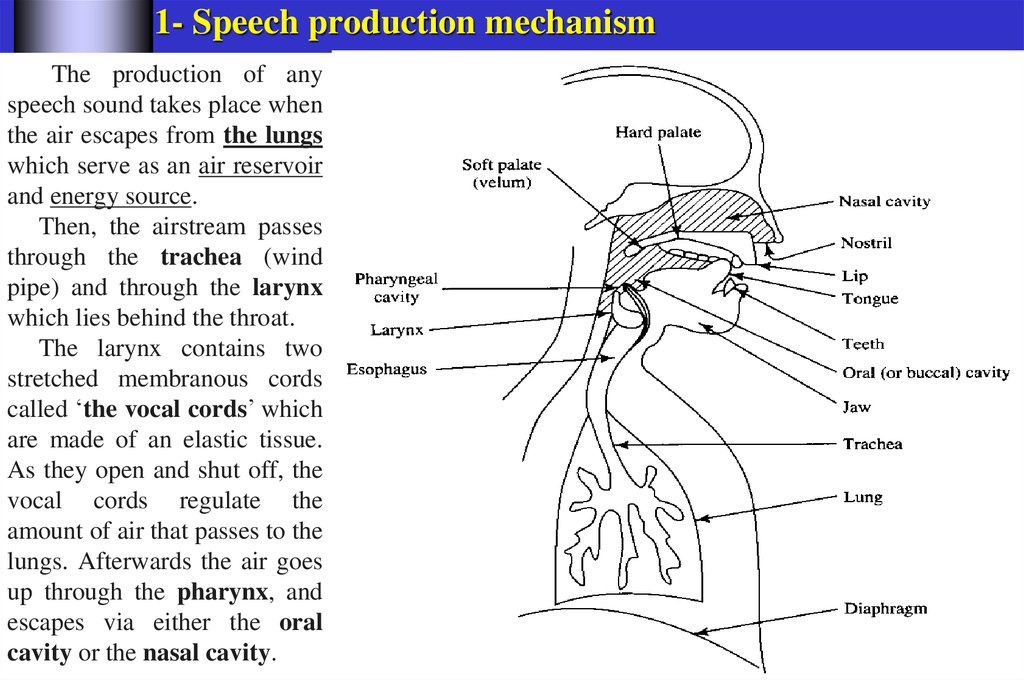
Think of speaking like playing a wind instrument. The process starts with air from your lungs, which acts as the power source. This air travels up your windpipe (trachea) and through your voice box (larynx), where your vocal cords are.
But this is just a stream of air. To turn it into recognisable speech, we need to shape it. This shaping is done by the organs of speech, also known as articulators.
Take a look at this diagram to see the entire system at work.
Your Speech Toolkit: The Articulators
Now, let's focus on the articulators in the mouth and throat. These are the parts we actively use to pronounce different sounds. Some are fixed in place (passive articulators), while others are movable (active articulators).
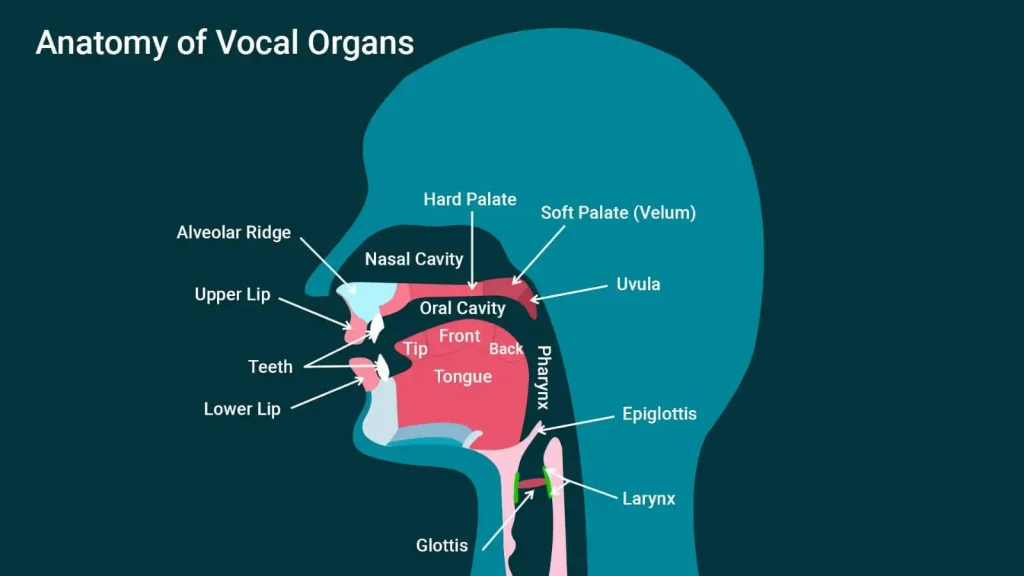
To get a comprehensive overview of these parts and their names, please read the following section from the provided educational material. It includes a diagram very similar to the one above and explains the role of each part.
[PDF] Section I - The Sound System of English - DEI
This document, 'The Sound System of English' from the Dayalbagh Educational Institute, provides a clear introduction to the organs of speech. We will focus on the section that identifies each part and its function.
Please read the section titled '(iii) Organs of speech', which starts on page 8. Pay close attention to the diagram (Figure 1.2) and the list of movable and fixed organs.
As you just read, our main articulators are the lips, teeth, tongue, the roof of the mouth (palate), and jaw. Let's break down their specific roles.
1. The Fixed (Passive) Articulators
These parts don't move, but they provide a crucial surface for the movable articulators to touch or move towards.
- Teeth: Primarily the upper front teeth. They work with the tongue for sounds like the 'th' in "think" and with the lower lip for sounds like /f/ in "fan" and /v/ in "van".
- Alveolar Ridge (or Teeth Ridge): This is the firm, bumpy ridge just behind your upper front teeth. It's a very important contact point. The tip of your tongue touches it to make sounds like /t/ (top), /d/ (dog), /n/ (no), /s/ (sit), and /l/ (lip).
- Hard Palate: This is the hard, bony roof of your mouth behind the alveolar ridge. The body of the tongue moves towards it for sounds like the 'y' in "yes".
2. The Movable (Active) Articulators
These are the parts that do most of the moving to shape the sound.
- Lips: They are very flexible. They can be pressed together (for /p/ as in "pet", /b/ as in "bat"), rounded (for /w/ as in "wet"), or can touch the teeth (for /f/ as in "fan").
- Tongue: This is the most important and agile articulator. It can move in many ways and can be divided into different parts, each responsible for making different sounds:
- Tip & Blade: The very front of the tongue, used for the alveolar ridge sounds mentioned above (/t/, /d/, /s/).
- Front: The part of the tongue that lies under the hard palate.
- Back: The part that lies under the soft palate, used for sounds like /k/ (cat) and /g/ (go).
- Soft Palate (or Velum): This is the soft, muscular part at the back of the roof of your mouth. It acts like a switch.
- When it is raised, it closes the passage to the nose, and air escapes only through the mouth. These are oral sounds (most sounds in English).
- When it is lowered, it opens the passage to the nose, and air escapes through the nasal cavity. These are nasal sounds: /m/, /n/, and /ŋ/ (the 'ng' sound in "sing").
- Lower Jaw: The jaw helps the tongue and lips move to their correct positions by changing the size of the mouth opening.
Hands-On Exploration
Theory is useful, but feeling the movements yourself is the best way to learn.
Activity 1: A Tour of Your Mouth
Take a moment to become more familiar with your articulators. This is a great way to build awareness, especially as you get used to the feeling of your new braces.
- Use the tip of your tongue to feel the back of your upper teeth.
- Slide your tongue tip backwards from your teeth onto the bumpy alveolar ridge.
- Continue sliding your tongue back along the smooth, bony hard palate.
- Keep going until you feel the roof of your mouth become soft and fleshy. That's your soft palate.
Activity 2: Feel the Sound
Now, let's connect these places to a few sounds. Say each sound slowly and notice which articulators are making contact.
- Say "ta-ta-ta". Notice how the tip of your tongue taps against your alveolar ridge.
- Say "pa-pa-pa". Feel your lips pressing together and releasing a puff of air.
- Say "ka-ka-ka". Try to feel the back of your tongue rising to touch your soft palate.
- Say "la-la-la". Again, feel the tongue tip on the alveolar ridge, but notice how the air flows around the sides of the tongue.
Practicing these simple movements will help you develop the muscle control needed for clear pronunciation.
Optional Resource
The following video explains these same concepts. The speaker uses a mix of Hindi and English, which you might find helpful for clarifying any points.
Organs of Speech | Speech Mechanism | Phonetics | organs of speech in english
This video from 'Learn English With Ram' provides a great overview of the organs of speech, using some Hindi explanations which can be helpful for reinforcement.
You can watch from the beginning, but the key parts for this lesson are: The Palate (roof of the mouth): from 04:55 to 08:33 The Tongue: from 08:33 to 09:32 The Lips: from 09:32 to 10:22
Conclusion
Great work on your first lesson! You've taken a significant step toward understanding the mechanics of English pronunciation.
Key Takeaways:
- Speech is produced by shaping air that comes from the lungs.
- The organs of speech (articulators) are the tools we use to shape that air.
- The main articulators include the lips, teeth, alveolar ridge, hard palate, soft palate (velum), and tongue.
- Some articulators are fixed (teeth, alveolar ridge, hard palate), while others are movable (lips, tongue, soft palate).
- Different sounds are made by moving an active articulator to touch or get close to a passive one.
In our next lesson, we will go a bit deeper into the system to explore the source of vibration: the vocal cords. We'll learn the crucial difference between voiced and voiceless sounds, a fundamental concept for mastering English pronunciation.