Welcome back. In our last lesson, we analyzed the battles of Badr and Uhud, drawing lessons on strategic foresight, the power of morale, and the critical importance of discipline. We saw how the Prophet (PBUH) led with both tactical brilliance and deep ethical conviction, whether in the face of improbable victory or costly setback.
Today, we continue our exploration of his military leadership by examining two more defining events: the Battle of the Trench (Khandaq) and the Conquest of Makkah. This lesson will fulfill the learning outcome: Analyze the strategic and ethical principles of the Prophet (PBUH) as a Military Leader with reference to the Ghazwa of Khandaq and the Conquest of Makkah. These two events showcase a different spectrum of leadership. Khandaq demonstrates defensive genius and the art of unconventional warfare, while the Conquest of Makkah is a masterclass in achieving total victory through psychological superiority and strategic magnanimity. For your CSS exam, understanding these events as sophisticated applications of political and military strategy is key to providing a nuanced analysis.
The Prophetic Code of Conduct in Warfare
Before we dissect the battles, let's reinforce the ethical framework that governed the Prophet's (PBUH) military actions. As we've established, his philosophy was a radical departure from the perpetual raids and vendettas of pre-Islamic Arabia. It was warfare bound by divine law, with the ultimate aim of establishing peace and justice.
[PDF] The Life of the Prophet Muhammad in Terms of Battles ... - DergiPark
This research paper provides a succinct summary of the rules and moral principles that the Prophet (PBUH) established for warfare. It offers a clear, structured overview that is highly relevant for exam questions on Islamic ethics of war.
Please read the section titled "C. Orders, Directives, Motives and Goals." Focus on the specific directives laid out, particularly the list of prohibitions and commands. Note the strict protection afforded to non-combatants and the emphasis on avoiding revenge. Also, pay attention to the discussion on motivation and long-term goals, which highlights how the Prophet (PBUH) used glad tidings of future success to sustain morale during difficult times, a tactic we will see in action at Khandaq.
These principles were not abstract ideals; they were operational commands that shaped every strategic and tactical decision, ensuring that even in conflict, the door to reconciliation was never fully closed.
1. Case Study III: The Battle of the Trench (Khandaq), 5 A.H.
Two years after the setback at Uhud, the Quraysh made a final, grand attempt to annihilate the Muslim state. Instigated by the exiled leaders of the Banu Nadir tribe, they assembled a massive confederation (Ahzab) of various tribes, including the powerful Ghatafan. Numbering around 10,000 men, this was the largest army ever seen in Arabia, and it marched on Madinah with the sole purpose of wiping Islam off the map.
Strategic Innovation: Defense-in-Depth
Facing an existential threat and being outnumbered more than three to one, the Prophet (PBUH) convened his war council (shura). A direct confrontation in the open field, as at Uhud, was suicidal. It was here that Salman al-Farsi, a companion of Persian origin, proposed a strategy completely foreign to Arab warfare: digging a trench (khandaq).
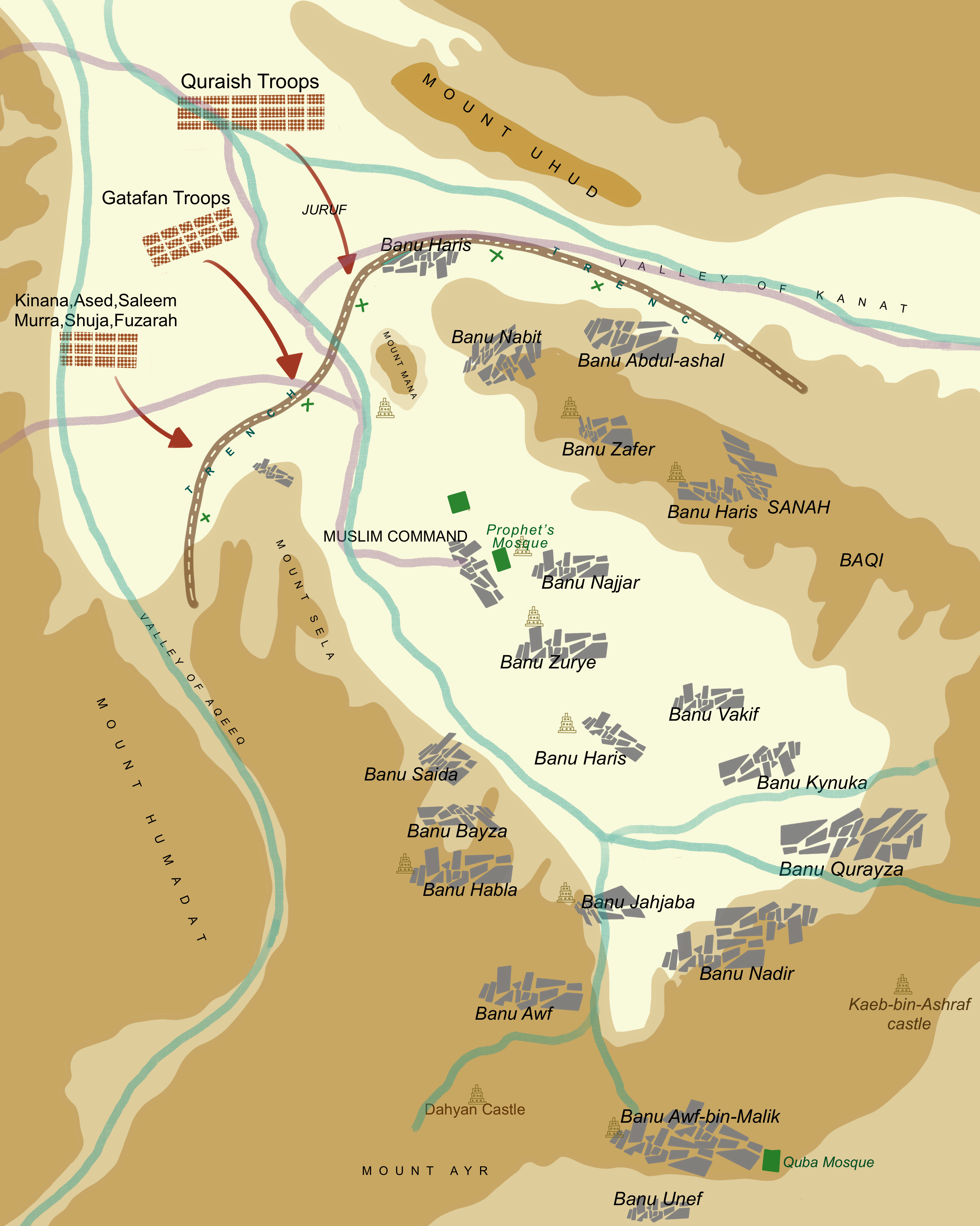
The decision to adopt this "foreign" tactic demonstrates a key aspect of the Prophet's leadership: pragmatism and the willingness to learn and innovate, regardless of the source of the idea. He personally led the effort, working alongside his companions to dig the five-and-a-half-kilometer trench in just six days. This act of leading from the front, sharing in the hardship, was a powerful motivator for the beleaguered Muslims. It was during this grueling work that the Prophet (PBUH), striking a rock that was impeding progress, received and shared visions of the future conquests of Yemen, Persia, and Rome—a profound act of bolstering morale against overwhelming odds.
Leadership During the Siege
The trench completely baffled the confederate army. Their cavalry was useless, and the month-long siege that ensued became a battle of wills, resources, and psychology.
Seerah of Prophet Muhammad 57 - The Battle of Khandaq/Ahzab - Dr. Yasir Qadhi | 17th April 2013
This detailed lecture by Dr. Yasir Qadhi provides a compelling narrative of the battle, rich with the kind of analytical detail you need.
Please watch the following segments: The Trench Strategy: Watch from 10:30 to 23:45 to understand the context of Salman al-Farsi's suggestion, the specifics of the trench, and the Prophet's (PBUH) personal involvement and motivational prophecies during its construction. The Siege and Hardship: Continue from 30:15 to 43:00. This section details the state of the siege, the immense psychological pressure, and the hardships faced by the Muslims, which are vividly described in Surah Al-Ahzab.
Counter-Intelligence and Psychological Warfare
The greatest danger during the siege came not from the front, but from within. The Banu Qurayza, a Jewish tribe bound by the Charter of Madinah to defend the city, committed treason by entering into negotiations with the enemy to attack the Muslims from the rear.
This is where the Prophet's (PBUH) genius for counter-intelligence shone. He employed a new convert, Nu'aym ibn Mas'ud, whose conversion was unknown to the confederates. Playing on the existing mistrust between the pagan tribes and the Banu Qurayza, Nu'aym skillfully shuttled between the camps, feeding each side information that made them doubt the other's intentions. This act of psychological warfare, rooted in the principle that "war is deception" (al-harbu khid'ah), completely shattered the enemy's fragile alliance.
[PDF] Is Mohammed a Strategic Leader? - DTIC
This analysis from a US military perspective provides an excellent summary of the strategic moves during the battle.
Read the section describing the Battle of the Trench, which begins on page 16. Focus on the analysis of how the Prophet (PBUH) showed strategic foresight by degrading the coalition's unity and managing the internal threat posed by the Qurayzah.
The combination of the trench, the crumbling alliance, dwindling supplies, and a fierce, divinely-sent storm broke the confederates' will. They retreated in disarray. The Battle of the Trench was a decisive strategic victory won without a major battle. It marked a turning point, after which the Prophet (PBUH) declared, "From now on, we will attack them, and they will not attack us." The strategic initiative had permanently shifted to the Muslims.
2. Case Study IV: The Conquest of Makkah (Fath Makkah), 8 A.H.
The Conquest of Makkah is perhaps the ultimate expression of the Prophet's (PBUH) military philosophy: the use of overwhelming power to achieve a political and moral victory with minimal bloodshed.
Context and Casus Belli
The campaign was triggered when the Quraysh violated the Treaty of Hudaibiya by assisting their allies in an attack on a tribe allied with the Muslims. In response, the Prophet (PBUH) mobilized an army of 10,000—a force so large and assembled in such secrecy that it was designed to induce psychological shock rather than engage in combat.
The Strategy of Overwhelming Force
The plan was to make resistance appear so futile that Makkah would surrender without a fight.
Seerah of Prophet Muhammad 78 - The Conquest of Makkah Part 3 ~ Dr. Yasir Qadhi | 5th March 2014
This lecture meticulously details the events immediately preceding the entry into Makkah. It is a masterclass in psychological strategy and the use of magnanimity as a political tool.
Please watch these two crucial segments: Psychological Warfare and the Conversion of Abu Sufyan: Watch from 37:13 to 59:49. This part covers the Prophet's order to light 10,000 campfires to create an awesome spectacle. It then details the capture of Abu Sufyan, the Quraysh leader, and the subsequent conversation in the Prophet's tent. Pay close attention to how the Prophet (PBUH) not only spares Abu Sufyan but strategically grants his house the status of a sanctuary, turning the leader of the opposition into an agent for a peaceful surrender. Demonstration of Power: Continue from 59:50 to 1:03:13. This segment describes how the Prophet (PBUH) instructs his uncle, Al-Abbas, to have Abu Sufyan witness the disciplined march-past of the entire Muslim army. This was a deliberate demonstration of force designed to ensure Abu Sufyan returned to Makkah fully convinced of the futility of resistance.
The conversion of Abu Sufyan was the strategic linchpin. By pardoning the leader of the enemy and bestowing honor upon him, the Prophet (PBUH) decapitated the opposition's leadership and turned him into a messenger of peace. Abu Sufyan rushed back to Makkah and warned the Quraysh that the approaching force was irresistible, advising them to seek safety in their homes, the Ka'bah, or his own house. The will to fight collapsed.
Ethical Principles in Absolute Victory
The entry into Makkah was largely bloodless. The Prophet's (PBUH) strict orders were to avoid fighting. When he finally stood before the defeated Quraysh, the very people who had persecuted him, tortured his followers, and driven him from his home, he did not seek revenge. He asked his famous question: "O people of Quraysh, what do you think I will do to you?"
They replied, "We expect nothing but good from you, O noble brother, son of a noble brother."
His response has echoed through history: "I say to you what Yusuf said to his brothers: 'There is no blame on you today.' (Quran 12:92). Go, for you are free."
This general amnesty was not a sign of weakness but of supreme strength and strategic wisdom. It instantly transformed a city of enemies into a community of followers, ensuring a lasting and stable peace that could never have been achieved through force. He then proceeded to purify the Ka'bah, destroying the 360 idols, symbolizing an ideological victory over a military one.
Conclusion
The battles of Khandaq and Makkah reveal the remarkable breadth and depth of the Prophet Muhammad's (PBUH) leadership. He was not a general of a single doctrine but a master strategist who adapted his methods to the situation while holding firm to his ethical principles.
Key Takeaways:
- Strategic Flexibility: At Khandaq, facing overwhelming numbers, he adopted a radical defensive innovation (the trench). At Makkah, holding overwhelming power, he opted for a strategy of psychological shock and awe to prevent bloodshed.
- Integrated Strategy: He seamlessly blended military force with diplomacy, intelligence, and psychological warfare. The use of Nu'aym ibn Mas'ud at Khandaq and the co-opting of Abu Sufyan at Makkah are prime examples.
- Leadership and Morale: He led from the front, sharing in his people's hardship (digging the trench) and inspiring them with a vision of a greater purpose, even in the darkest hours.
- Ethics as Strategy: His ultimate weapon was his moral authority. The prohibition against harming non-combatants, the fulfillment of treaties, and, most profoundly, the general amnesty at Makkah were not just "ethical" add-ons; they were integral components of a long-term strategy to win hearts and minds and build a lasting peace.
The bloodless conquest of Makkah and the unification of much of Arabia under his leadership set the stage for the final phase of his mission. In our next lesson, we will analyze the Khutba Hajjatul Wida (The Last Sermon), where, during his farewell pilgrimage, he laid out the comprehensive social, ethical, and legal charter for the society he had built—a document often compared to a universal declaration of human rights.