Greetings. In our previous session, we examined the Prophet's (PBUH) leadership during the strategic siege of Khandaq and the momentous, bloodless Conquest of Makkah. We saw how he combined military strategy, psychological insight, and unwavering ethical principles to achieve not just victory, but a lasting and just peace. The unification of Arabia under his leadership was now nearly complete, setting the stage for the consolidation of the society he had spent over two decades building.
This brings us to a pivotal moment in Islamic history and the subject of today's lesson: the Khutba Hajjatul Wida (The Last Sermon). Delivered in 10 A.H. during his farewell pilgrimage, this sermon was his final, comprehensive address to the nascent Muslim nation. It wasn't a victory speech, but a foundational charter outlining the core principles of social justice, human rights, and moral conduct that would define the Ummah for all time.
Our learning objective is to analyze the Khutba Hajjatul Wida as a universal charter of human rights and social justice, comparing its principles with the Universal Declaration of Human Rights (UDHR). For your CSS exam, this comparative analysis is critical. It moves beyond mere description, requiring you to evaluate historical religious texts through the lens of modern political and legal frameworks—a hallmark of the analytical approach you aim to master.
1. The Final Address: Context and Significance
To fully appreciate the weight of the sermon, we must first understand its setting. In the 10th year after the Hijra, the Prophet (PBUH) announced he would lead the Hajj (pilgrimage). An immense multitude, estimated at over 100,000 people from across the Arabian Peninsula, gathered in Makkah to perform the rites with him. This was the largest assembly he would ever address, and he knew it would be his last.
Seerah of Prophet Muhammad 100 - The farewell Hajj - Sh. Dr. Yasir Qadhi 1/21/15
The lecture "The Farewell Hajj" by Dr. Yasir Qadhi provides a vivid account of this historic event. Watching these segments will help you grasp the profound atmosphere and the core messages delivered at Arafat.
Please watch the following parts of the video: Setting the Scene: Begin by watching the introduction from 3:55 to 8:08. This section describes the huge gathering of people and explains why this event came to be known as the "Farewell Hajj," highlighting the Prophet's (PBUH) own premonition that his mission was nearing its end. The Sermon at Arafat: Watch the detailed breakdown of the first part of the sermon from 49:02 to 59:19. Pay close attention to the foundational principles he laid down concerning the sanctity of life and property, the abolition of pre-Islamic blood feuds and interest (riba), and the crucial segment on the rights and treatment of women.
The Prophet's (PBUH) words were not just a sermon; they were a declaration of the new world order of Islam. He systematically dismantled the pillars of the old tribal system (Jahiliyyah) and cemented the foundations of a new society based on divine guidance, justice, and human dignity.
2. Deconstructing the Charter: Core Principles of the Sermon
The Last Sermon is a rich, multi-faceted document. For analytical clarity, let's distill its key principles, which can be viewed as the articles of this unwritten charter.
[PDF] Finding An Analytical Issue of the Last Sermon of the Prophet ...
This research paper provides a consolidated text of the sermon, compiled from various authentic sources. Reading it will give you a clear reference for the principles we are about to discuss.
Please read the section titled "II. Muhammad’s (pbuh) Last or Farewell Sermon". You can find the main text starting from the line "Hey, mankind..." Focus on identifying the key commandments as you read.
Drawing from the video and the text, we can identify several foundational principles:
-
1. The Sanctity of Life, Property, and Honor:
"Verily your blood, your property is as sacred and inviolable as the sacredness of this day of yours, in this month of yours, in this town of yours."
This statement establishes the fundamental rights to life and property as sacrosanct. By comparing their inviolability to the most sacred time and place known to his audience, the Prophet (PBUH) elevated these individual rights to the level of divine commandments. Later, in his sermon at Mina, he added "your honor," extending protection against slander and defamation. -
2. The Abolition of Institutionalized Injustice:
"Behold! Everything pertaining to the ‘Days of Ignorance’ is under my feet completely abolished. Abolished are also the blood-revenges of the ‘Days of Ignorance’... And the usury of the pre-Islamic period is abolished..."
Here, the Prophet (PBUH) actively dismantles the structures of pre-Islamic tribalism. By abolishing blood feuds, he replaced the cycle of vengeance with the rule of law. By abolishing Riba (usury), he struck at the heart of economic exploitation. To show his absolute commitment, he forgave a blood-debt owed to his own family and cancelled the interest due to his own uncle, Al-Abbas. This is leadership by example, ensuring the law applies to all, starting from the top. -
3. Radical Equality and Anti-Racism:
"All mankind is from Adam and Eve, an Arab has no superiority over a non-Arab nor a non-Arab has any superiority over an Arab; also a white has no superiority over a black nor a black has any superiority over a white - except by piety and good action."
This is one of the most revolutionary declarations in human history. In a world defined by tribal lineage, class, and race, this statement established human equality as a core principle of faith. The only differentiating factor in the eyes of God is not birth or color, but moral character (Taqwa). -
4. The Rights and Status of Women:
"O people, Fear Allah concerning women! Verily you have taken them on the security of Allah... Their rights upon you are that you should provide them with food and clothing suitably."
In a patriarchal society where women were often treated as chattel, the Prophet (PBUH) dedicated a significant portion of his final address to their rights. He framed the marital bond as a sacred trust from God and established the husband's firm responsibility for the wife's economic maintenance. He regulated the methods of discipline, moving away from the prevailing abusive norms toward a system that, while reflecting its time, aimed to protect women from harm. -
5. The Primacy of the Rule of Law:
"I have left among you the ‘Book of Allah’ (Quran) and if you hold fast to it, you would never go astray."
The sermon establishes a clear constitutional framework. The ultimate source of law and guidance is the Quran, which stands above any ruler or personal desire. This principle establishes a society based on divine law, not the whims of men.
3. A Comparative Analysis: The Last Sermon and the UDHR
Now we arrive at the central task for your exam preparation: comparing the Prophet's sermon with the Universal Declaration of Human Rights (UDHR). The UDHR was adopted by the UN in 1948, over 13 centuries later, and is considered the foundational document of modern international human rights law.
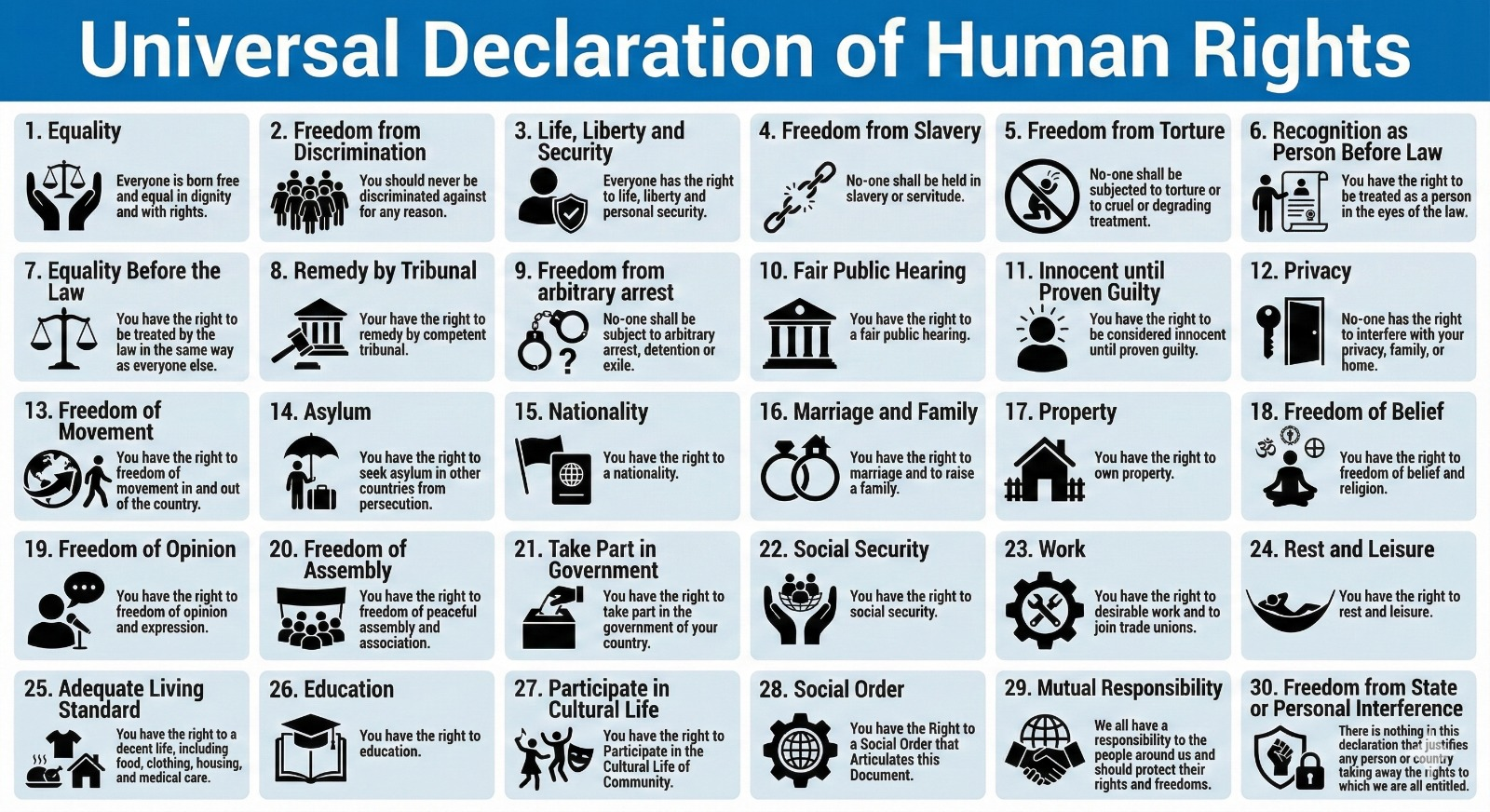
At first glance, the parallels are striking. Let's explore the points of convergence and divergence, which are key for a high-level analysis.
[PDF] The Islamic And Western Concepts Of Human Rights
This paper provides an excellent comparative overview. It directly contrasts the philosophical foundations of Islamic and Western human rights frameworks.
Please read the section titled "DIFFERENCES BETWEEN ISLAMIC AND WESTERN RIGHTS" (starting on page 1667). Pay special attention to the discussion on the source of rights and the claim that the UDHR is an update of rights already present in Islam. This perspective is crucial for your analysis.
Points of Convergence
Many principles from the Last Sermon resonate directly with articles of the UDHR.
| Principle from Last Sermon | Corresponding UDHR Article (Illustrative) |
|---|---|
| Sanctity of Life ("your blood is sacred") | Article 3: Everyone has the right to life, liberty and security of person. |
| Right to Property ("your property is sacred") | Article 17: Everyone has the right to own property. |
| Equality & Non-Discrimination ("no superiority... except by piety") | Article 1 & 2: All human beings are born free and equal in dignity and rights, without distinction of race, colour, etc. |
| Rights of Women & Family (marital trust, maintenance) | Article 16: Men and women... are entitled to equal rights as to marriage... The family is the natural and fundamental group unit of society. |
| Justice & Rule of Law (abolition of blood feuds) | Article 7 & 10: All are equal before the law and are entitled without any discrimination to equal protection of the law. |
Points of Divergence and Analytical Nuance
A sophisticated analysis, of the kind required for CSS, must also explore the differences. The most fundamental distinction lies in their philosophical origin.
-
Source of Rights:
- Islamic Framework: Rights are divinely granted by God (Allah). They are part of a sacred covenant. This makes them immutable and not subject to the vote of a legislative assembly or the will of a ruler. As the paper The Islamic and Western Concepts of Human Rights notes, they are bestowed by the Almighty, not by a human institution.
- UDHR Framework: Rights are considered inherent to human beings, stemming from the "dignity of the human family." It is a secular, human-centric framework. While powerful, this also means the interpretation and even the existence of these rights can be debated and amended by human bodies.
-
Rights vs. Duties:
- The Last Sermon presents rights within an integrated framework of responsibilities and duties. The right to be treated well by your spouse is linked to your duty to be faithful. The right to property is linked to the duty to avoid exploitative practices like Riba. The entire system is oriented towards pleasing God and maintaining social harmony.
- The UDHR, particularly in its popular interpretation, often focuses more on individual entitlements and freedoms with less explicit emphasis on corresponding duties, although Article 29 does mention duties to the community.
-
Scope and Universality:
- The Last Sermon's principles were declared as universal for all mankind ("O People..."). However, their legal application was historically situated within an Islamic polity.
- The UDHR was designed from the outset as a "common standard of achievement for all peoples and all nations," though its Western philosophical origins are a subject of ongoing academic debate.
[PDF] Finding An Analytical Issue of the Last Sermon of the Prophet ...
To finalize the comparison, this section of the paper explicitly connects the sermon to the UN charter.
Please read the section titled "V. Relation with UN-Human Right Charter." It argues that the UDHR is almost a repetition of the rights declared in the sermon, providing a strong concluding point for your comparative essay.
Conclusion
The Khutba Hajjatul Wida stands as a monumental declaration in the history of human rights and social justice. Delivered in the 7th century, it laid down principles of human equality, economic justice, rule of law, and gender rights that were radically advanced for their time and find strong echoes in modern international law.
Key Takeaways:
- A Comprehensive Charter: The Last Sermon was not merely a spiritual address but a socio-political and legal blueprint for the Muslim Ummah, emphasizing the sanctity of life, property, and honor.
- Foundations of Justice: It dismantled the unjust structures of Jahiliyyah, such as blood feuds and usury, and replaced them with a system based on equality and the rule of law.
- Precursor to Modern Rights: Many of its principles (non-discrimination, right to life, property rights) directly converge with articles of the 20th-century UDHR.
- Distinct Philosophical Roots: The crucial difference lies in the source of rights—divine in Islam versus secular-humanist in the UDHR—which has profound implications for their authority, scope, and relationship with individual and communal duties.
For your CSS exam, being able to articulate this nuanced comparison—celebrating the convergences while analytically explaining the divergences—will demonstrate a deep and sophisticated understanding of both Islamic principles and modern political thought.
In our next lesson, we will transition from the life of the Prophet (PBUH) to the era that immediately followed his death. We will begin Module 4 by analyzing the political challenges during the caliphate of Hazrat Abu Bakr (RA), focusing on the critical issues of succession and his leadership during the crisis of the Ridda wars.