In our previous lesson, we examined the Prophet Muhammad's (PBUH) role as a master diplomat and statesman, culminating in our analysis of the Treaty of Hudaibiya. We saw how strategic patience and a long-term vision for peace could achieve what force of arms could not. This lesson shifts our focus from the negotiation table to the battlefield, continuing our exploration of the Prophet's (PBUH) leadership in the context of the Madinan state.
The learning outcome for this session is to: Analyze the strategic and ethical principles of the Prophet (PBUH) as a Military Leader with reference to the Ghazwat of Badr and Uhud. These two battles represent pivotal moments in the early history of Islam. Badr was the improbable victory that established the nascent Muslim state as a force to be reckoned with, while Uhud was the near-disaster that provided profound lessons in discipline, faith, and leadership in crisis. For your CSS exam, analyzing these events not as mere historical episodes but as case studies in military strategy and ethics is a crucial skill.
1. The Prophetic Philosophy of Warfare
Before dissecting the battles themselves, it is essential to understand the ethical framework that guided the Prophet's (PBUH) military conduct. His approach was a fundamental departure from the pre-Islamic Arabian tradition of ghazwa (raiding) for plunder, pride, or perpetual blood feuds. He re-conceptualized warfare, grounding it in a strict ethical code with clear objectives and rules of engagement.
[PDF] PROPHET MUHAMMAD (PBUH) AS A MILITARY STRATEGIST
This research paper, "Prophet Muhammad (PBUH) as a Military Strategist," provides a concise yet comprehensive overview of the principles underpinning Islamic warfare. It is an excellent resource for framing your analysis.
Please read the following sections to grasp the foundational concepts: First, review the five objectives of war in Islam. Note that they are primarily defensive or corrective, not expansionist for the sake of conquest. This is a critical point for any CSS question on the nature of Jihad. Next, study the list of qualities he possessed as a military strategist, such as his consultative approach (shura) and mercy (rahmah). These personal attributes directly influenced his military doctrine. Read the section on "Strategic Innovations," which includes a crucial Hadith outlining the rules of engagement: the protection of non-combatants (the old, children, women) and infrastructure. Finally, examine the table and discussion under "Comparison of Modern Warfare". This comparative analysis between the ethical constraints of Islamic law and the "total war" approach of many modern conflicts is precisely the kind of high-level analysis expected in the CSS exam.
As the paper highlights, the Prophet (PBUH) fought not for personal glory or material gain, but for the defense of the community, the protection of the oppressed, and the establishment of justice. His objective was always to achieve peace with minimal bloodshed, a principle that guided his strategies in both victory and defeat.
2. Case Study I: The Battle of Badr (2 A.H.) – The Criterion
The Battle of Badr was the first major military encounter between the Muslims of Madinah and the Quraysh of Makkah. It was a battle the Muslims appeared destined to lose, being outnumbered by a factor of more than three to one. Yet, it became a decisive victory that the Quran calls Yawm al-Furqan—the Day of Criterion, which distinguished truth from falsehood.
Context: A Confluence of Factors
The battle was not a random skirmish. It was the culmination of rising political, economic, and religious tensions. A deep understanding of this context is vital.
[PDF] The Confluence of Politics, Religion, and Culture in the Battle of Badr
This paper from the US Air Command and Staff College provides an exceptional military and political analysis of Badr, exploring the underlying causes and strategic decisions.
Focus on the following sections to build a multi-layered understanding: Read the section "Culture & Badr" to understand how the Prophet (PBUH) re-framed pre-Islamic concepts like honor, revenge, and tribal solidarity within the new, unifying framework of the ummah. Next, study the section "Politics & Badr" to see how the Pledges of Aqaba and the Constitution of Madina created the political-military alliance necessary for such an engagement. Finally, read the detailed narrative in "The Battle of Badr". Pay close attention to the intelligence gathering, the decision-making process, and the strategic positioning before the first clash.
As the paper explains, Badr was not merely an attempt to raid a caravan. It was a deliberate strategic move to challenge the economic and political hegemony of the Quraysh.
Strategic Principles in Action
Badr is a masterclass in how superior strategy and morale can overcome numerical inferiority.
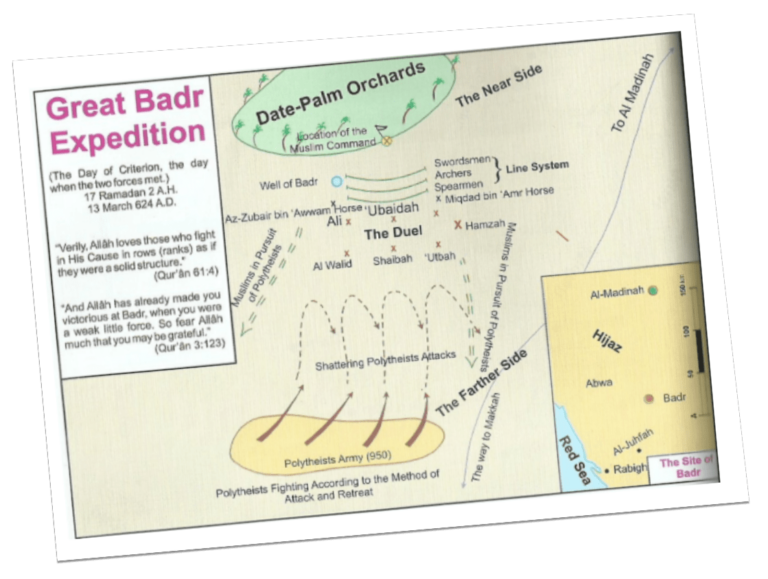
- Intelligence and Deception: The Prophet (PBUH) dispatched reconnaissance parties to gather intelligence. The capture and interrogation of the Quraysh's water-bearers provided crucial information on the enemy's strength and leadership, allowing for precise planning.
- Strategic Use of Terrain: Upon the advice of his companion Hubab ibn al-Mundhir (an example of shura in military planning), the Prophet (PBUH) moved the Muslim camp to control the wells of Badr. This gave his army access to water while denying it to the enemy—a critical factor in the desert heat.
- Morale and Divine Aid: The Prophet's (PBUH) intense prayer before the battle, his promise of Paradise for those who fought steadfastly, and the Quran's description of divine intervention (Quran 8:9-12) served as powerful force multipliers. They instilled a level of conviction and courage in the Muslim ranks that the Quraysh, fighting for tribe and pride, could not match.
- Discipline and Formation: The Muslims fought as a disciplined phalanx—a solid, structured block of spearmen and archers. This was in stark contrast to the Quraysh's more chaotic, individualistic style of fighting, reflecting the pre-Islamic "attack and retreat" method shown on the map.
Ethical Principles and Aftermath
The ethics displayed at Badr were as significant as the strategy.
- Just Cause: The war was defensive, initiated only after years of persecution and the expulsion of Muslims from Makkah, and after Allah granted permission to fight (Quran 22:39).
- Treatment of Prisoners: After the victory, a debate ensued on how to treat the 70 prisoners. While some advised execution, the Prophet (PBUH) favored the counsel of Hazrat Abu Bakr (RA) to ransom them. The educated among them were allowed to earn their freedom by teaching ten Muslim children to read and write—an unprecedented act that prioritized knowledge even in the aftermath of war.
The victory at Badr consolidated the Prophet's (PBUH) authority and led to critical political shifts, such as the expulsion of the treacherous Banu Qaynuqa tribe from Madinah, which we will now explore.
The First Test of the Madinan Constitution: Expulsion of Banu Qaynuqa
The victory at Badr emboldened some and angered others. The Banu Qaynuqa, one of the three main Jewish tribes in Madinah and signatories to the Constitution, began to show open hostility.
2012-12-05 Seerah pt.42 - Events between battle of Badr and Uhud pt1 - Yasir Qadhi
This lecture by Dr. Yasir Qadhi details the events that transpired between the battles of Badr and Uhud. It provides a nuanced look at a politically sensitive event, the expulsion of the Banu Qaynuqa, which is essential for a comprehensive analysis.
Please watch the segment from 21:04 to 54:51. As you watch, focus on these points: The lecturer's initial framing, which refutes the simplistic charge of anti-Semitism by placing the conflict in its political, not racial, context. The specific provocations by the Banu Qaynuqa: their open mockery after Badr and the gross public misconduct in their marketplace that led to bloodshed. The Prophet's (PBUH) response: a formal declaration that the treaty was broken, followed by a siege, not an immediate attack. The role of Abdullah ibn Ubayy, the leader of the hypocrites, in interceding for them and the Prophet's (PBUH) handling of this politically charged intervention.
This incident demonstrates a key principle of the Prophet's (PBUH) statecraft: treaties are sacred, but they are not a suicide pact. When an allied group engaged in open hostility, broke the terms of the mutual-defense pact, and committed acts of violence, a firm response was necessary to ensure the security of the state. Even then, the Prophet's (PBUH) decision was tempered by political considerations, ultimately choosing expulsion over execution.
3. Case Study II: The Battle of Uhud (3 A.H.) – The Strategic Lesson
If Badr was a lesson in faith and strategy, Uhud was a lesson in discipline and the consequences of disobedience. A year after their humiliating defeat, the Quraysh returned with a larger, better-equipped army of 3,000 men, determined to exact revenge.

Strategic Principles
- Initial Tactical Success: The Prophet's (PBUH) placement of the archers was a masterful tactical decision. It completely neutralized the Quraysh's main advantage—their cavalry. For the first phase of the battle, the strategy worked perfectly. The smaller Muslim force routed the Makkans, who began to flee, leaving their camp and its spoils behind.
- The Critical Error: Seeing the Quraysh flee, about 40 of the 50 archers, believing the battle was over, disobeyed the Prophet's (PBUH) strict orders not to leave their post for any reason. They rushed down the hill to claim the spoils of war.
- Leadership in Crisis: This single act of indiscipline exposed the Muslim flank. Khalid ibn al-Waleed seized the opportunity, wheeling his cavalry around the hill and attacking the Muslim army from the rear. Chaos ensued. Amidst the confusion and rumors of his death, the Prophet (PBUH) remained steadfast. He rallied his companions, organized a fighting retreat to the slopes of Mount Uhud, and prevented a total collapse. His personal courage, despite being seriously wounded, was instrumental in turning a potential rout into a costly but survivable setback.
Ethical and Spiritual Lessons
Uhud is arguably more significant for its lessons than its military outcome.
- The Peril of Materialism: The archers' desire for booty (ghanimah) was the direct cause of the reversal. It stands as a powerful Quranic and historical lesson on the dangers of allowing material desires to override strategic imperatives and obedience to leadership.
- A Test of Faith: The Quran frames the defeat at Uhud not as a punishment, but as a test from Allah to distinguish the true believers from the wavering and the hypocrites (Quran 3:140-142). It was a trial by fire that ultimately strengthened the core of the Muslim community.
- The Importance of Discipline: Uhud is the quintessential military case study on the absolute necessity of chain of command and discipline. It shows that a brilliant strategy is worthless if it is not executed with unwavering obedience.
Conclusion
The battles of Badr and Uhud, when analyzed together, provide a complete picture of the Prophet Muhammad's (PBUH) military leadership. He was not just a spiritual guide; he was a brilliant strategist, a master of terrain and timing, and an inspirational commander who led from the front. More importantly, his military philosophy was inextricably linked to an ethical core that prioritized justice, minimized harm, and always kept the door open for peace.
Key Takeaways:
- War with a Purpose: The Prophet's (PBUH) military campaigns were governed by clear ethical objectives, primarily the defense of the faith and the establishment of justice, not plunder or conquest.
- Strategic Genius: At Badr, he demonstrated how intelligence, terrain, and morale could defeat a superior force. At Uhud, his initial strategy was flawless and foiled only by indiscipline.
- Leadership in Victory and Crisis: He was magnanimous in victory (Badr's prisoners) and unshakable in crisis (Uhud's retreat). His leadership was the constant factor that ensured the survival and ultimate success of the community.
- Lessons over Victories: The setback at Uhud provided strategic and spiritual lessons in discipline and faith that were arguably more valuable for the long-term health of the ummah than an easy victory would have been.
In our next lesson, we will continue this analysis by examining two more landmark military events: the defensive masterpiece of the Battle of the Trench (Khandaq) and the bloodless triumph of the Conquest of Makkah.