Hello! Welcome to the first lesson of Module 2.
In our last lesson, you successfully set up your Shopify Partner account and created a development store. This store is your personal sandbox, but it's also a "tenant" living inside Shopify's massive global infrastructure. Your store coexists with millions of others on the same platform.
This raises a fundamental question, especially for someone with your background in IT infrastructure and full-stack development: how does Shopify manage this? How can it serve millions of unique businesses from a single platform, ensuring each one is secure, performant, and isolated?
The answer lies in its architecture. Today, we'll explore that foundation. Our learning outcome is to describe Shopify's multi-tenant SaaS architecture and its implications for customization. We'll look "under the hood" to understand the architectural model that makes Shopify possible and see how it directly shapes what we, as developers, can and cannot do.
1. Understanding Multi-Tenant Architecture
At its core, Shopify is a Software as a Service (SaaS) platform. You don't own the software or the servers; you subscribe to a service. The architectural model that enables this for millions of users is called multi-tenancy.
Think of it like an apartment building versus a row of single-family houses.
- Single-tenancy is like building a separate house for each family. Each has its own foundation, plumbing, and electrical systems. It's completely isolated but expensive and inefficient to build and maintain at scale.
- Multi-tenancy is like an apartment building. Many families (tenants) live in a single structure, sharing the foundation, plumbing, and utilities. Each apartment is a private, secure space, but the underlying infrastructure is shared. This is far more cost-effective and scalable.
In this analogy, each Shopify merchant is a tenant in the same massive "building." They share the core application, databases, and servers, but their data (products, orders, customers) is logically isolated and kept private.
To get a concise overview from a backend engineering perspective, watch the first few minutes of the following video.
What is a Multitenancy Architecture and Why Is it becoming popular?
This video from Hussein Nasser, a popular software engineering channel, provides a clear and direct definition of multi-tenancy and even uses Shopify as a prime example.
Watch from the beginning until timestamp 02:48. Focus on the core definition of a multi-tenant application and how it contrasts with a completely isolated, single-instance approach.
As the video highlights, this shared model has significant benefits, such as cost efficiency and resource optimization, but it also introduces major challenges, primarily around security and data isolation. An error in the architecture could lead to one tenant seeing another's data, which would be catastrophic.
2. The Layers of Multi-Tenancy and Its Challenges
To prevent such issues, a multi-tenant system is carefully layered to enforce isolation. Given your full-stack background, you'll recognize these layers, but here they have a "tenant-aware" characteristic.
- Application Layer: A single codebase serves all tenants. When a request comes in (e.g., to view a product page), the application must first identify which tenant it's for (e.g., via the store's domain) to fetch the correct data and apply the correct theme.
- Database Layer: This is where the most critical isolation happens. Shopify could give each store its own database (costly) or have all stores share a database. In a shared model, every database query must be filtered by a
tenant_id(e.g.,SELECT * FROM products WHERE shop_id = 123;) to ensure it only returns data for the correct store. - Infrastructure Layer: The underlying servers, load balancers, and caching systems are all shared. This introduces the "noisy neighbor" problem: what if one store's viral flash sale consumes all the server resources, slowing down every other store on that server?
The next video provides a more structured breakdown of these layers and challenges.
Why Multi-Tenant Architecture is the Future of SaaS
This video from 'The Coding Gopher' channel dives deeper into the specific layers of a multi-tenant system and the strategies used to manage them.
Watch the sections from 00:00 to 03:00 and 03:27 to 04:21. Pay attention to the breakdown of the application, middleware, and database layers, and the discussion of challenges like the 'Noisy Neighbor' anti-pattern.
3. Shopify's Specific Implementation: The Modular Monolith and Pods
Now let's move from the general theory to Shopify's specific implementation. With your experience in modern web development, you might assume a platform of Shopify's scale would be built on a distributed microservices architecture. However, Shopify's core is a large, modular monolith built on Ruby on Rails.
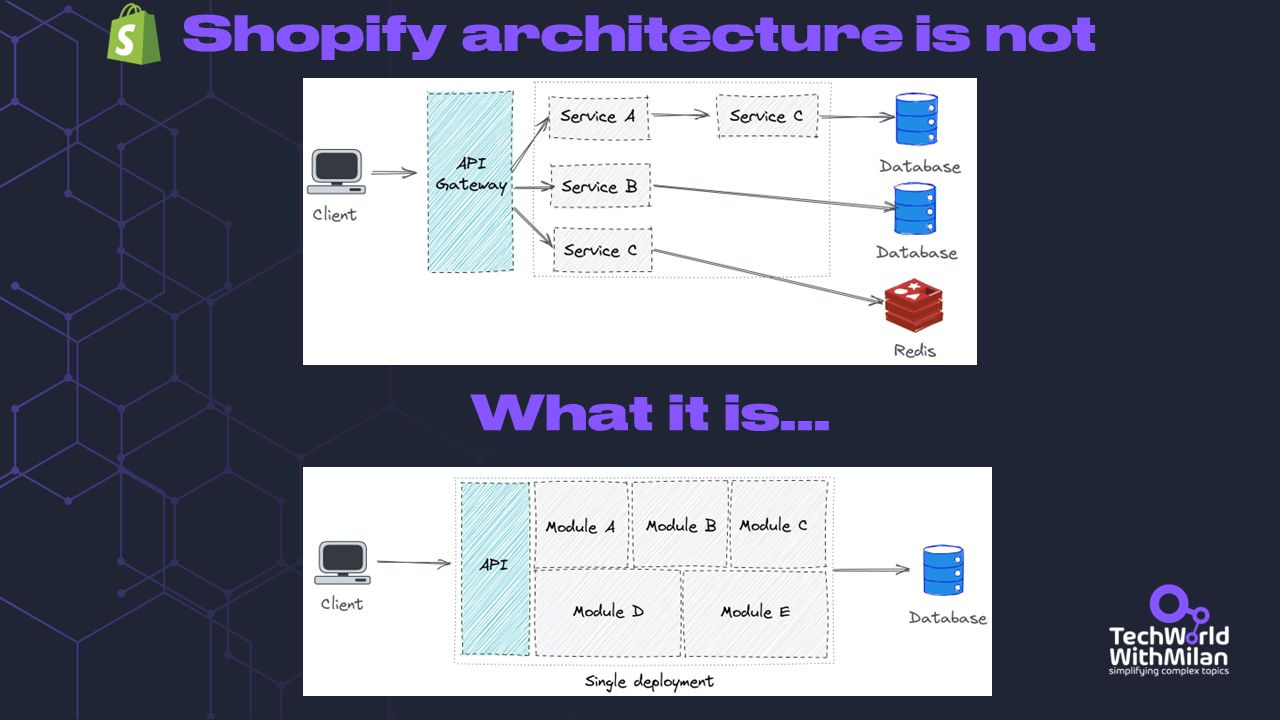
This diagram clarifies a common misconception. While Shopify has many services, its core remains a powerful, modular monolith, not a collection of independent microservices.
Instead of breaking the application into tiny, separate services, Shopify organizes its code into Rails Engines—mini-applications within the larger monolith. This provides a degree of isolation and ownership without the operational complexity of a full microservices architecture.
But how does a monolith scale to handle millions of stores? This is where Shopify's key innovation comes in: Pods.
Initially, Shopify ran on a single large database. As they grew, they introduced sharding (splitting the database into smaller pieces). The next evolution of this idea was the Pod.
A Pod is a fully independent, self-contained slice of Shopify's infrastructure. Each Pod has its own database cluster, Redis cache, and application servers. Your development store, and every other Shopify store, lives on one of these Pods.
The 'Shopify Tech Stack' article from ByteByteGo, written in collaboration with the Shopify engineering team, gives us an inside look at this architecture. It details the evolution from a single database to the Pod-based system.
Read the section 'Databases, Caching, and Queuing', focusing on the part about the 'Primary Database: MySQL'. This will explain the concept of Pods and why Shopify moved to this model.
The Pod architecture is a brilliant solution. It allows Shopify to scale horizontally by simply adding more Pods. More importantly, it contains failures. If a database issue or a "noisy neighbor" affects one Pod, it doesn't take down the entire Shopify platform; only the stores on that specific Pod are impacted.
4. Implications for Customization
Understanding this architecture isn't just an academic exercise. It directly explains the "rules of the road" for Shopify development. The multi-tenant, Pod-based model has profound implications for how we customize the platform.
-
No Direct Access to the Core: Because the infrastructure is shared, you can never directly access the core application code or the MySQL database. You can't SSH into a server or run a raw SQL query. Allowing this would be an unacceptable security risk in a multi-tenant environment.
-
Customization via APIs: All customization happens through well-defined, controlled interfaces—the APIs. Shopify's architecture is API-first. These APIs act as a secure gateway, allowing your app or theme to interact with a store's data without ever touching the shared infrastructure directly.

*This diagram visualizes the implication. As a developer, you live on the outside, interacting with the Shopify core through its APIs (REST and GraphQL). This is the boundary created by the multi-tenant architecture.*
3. Sandboxed Environments: To allow for safe customization of the storefront, Shopify created Liquid, a sandboxed templating language. It has a limited set of tags and filters and cannot execute arbitrary server-side code. This ensures a theme's code can't break out of its sandbox and interfere with the core platform or other tenants. We'll dive deep into Liquid in the next module.
- Resource Limits and Throttling: To prevent the "noisy neighbor" problem, Shopify enforces API rate limits. Your app can only make a certain number of API calls per second. This ensures that one misbehaving app can't overwhelm the system for all tenants on a Pod. Writing efficient, considerate code is a requirement, not just a best practice.
Test your understanding!
A client asks you to build a feature that requires a highly complex, real-time report that joins data from their store's orders, products, and customers. They suggest you could just connect directly to their store's database to run the complex SQL queries needed. Based on what you've learned, how would you explain why this is not possible and propose an alternative approach?
Show answer
You would explain that due to Shopify's multi-tenant architecture, there is no direct access to the underlying database. Their store's data co-exists with thousands of others on a shared infrastructure (a "Pod"), and direct database access is blocked for security and stability.
The correct approach would be to build an external application. This app would use Shopify's Admin API to fetch the necessary order, product, and customer data. It would then store this data in its own database, where you have full control to run complex queries and generate the real-time report. You could also use webhooks to keep your app's database synchronized with the Shopify store.
Conclusion
Today, we peeled back the curtain on Shopify's architecture. We've seen that it's a sophisticated multi-tenant SaaS platform designed for massive scale, reliability, and security.
Key Takeaways:
- Multi-tenancy is the core concept: Shopify serves millions of merchants from a shared infrastructure, like tenants in an apartment building.
- Shopify's solution is the "Pod": Shopify scales and isolates tenants using Pods, which are self-contained slices of the entire application stack.
- The architecture dictates the development model: The multi-tenant nature is precisely why we must work through APIs and sandboxed environments like Liquid. We are building extensions that plug into the platform, not modifying the core product itself.
This high-level architectural understanding provides the "why" for the tools and techniques we'll be using throughout this course.
In our next lesson, we'll begin our deep dive into the data model that this architecture serves. We'll explore the fundamental building blocks of any e-commerce store: Products, Variants, and Collections, and see how they are structured within your development store.