Hello! Welcome back to your affiliate marketing training.
In our last lesson, you learned how to navigate the ClickBank marketplace using categories and keyword searches to find lists of products. You now know how to find the "aisles" of this digital store. Today, we're going to learn how to read the price tags and nutritional labels.
This lesson focuses on a critical skill: interpreting key ClickBank product metrics. Specifically, we'll decode the meaning of the Gravity Score, Avg $/conversion, and Initial $/conversion. Understanding these numbers is what separates beginners who pick products randomly from strategic affiliates who make data-informed decisions. This knowledge is your first major step toward identifying products that have a real potential to be profitable.
Your Guide to a Product Listing
When you search for products in the marketplace, each result is displayed with a set of statistics. These stats are your first clue to a product's performance and potential earnings.
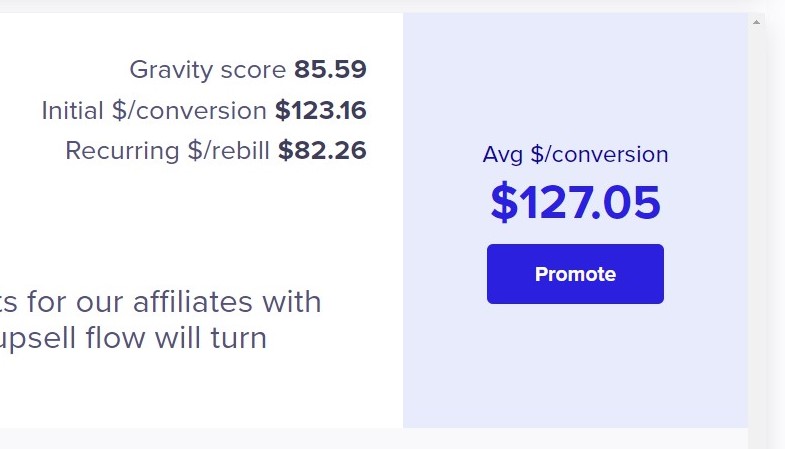
Let's look at each of these metrics one by one.
1. The Earnings Metrics: Initial and Average $/Conversion
The most direct measures of your potential income are the conversion metrics. ClickBank provides a few different numbers that tell a story about how you get paid.
First, let's watch a short video from ClickBank's official channel that defines the most important earnings metric.
ClickBank Marketplace Tutorial 2021 (Step by Step): ClickBank Tutorial
This clip from the 'ClickBank Marketplace Tutorial' clearly explains what 'Avg $/conversion' means and breaks it down further into the initial sale and potential recurring income.
Please watch from 03:12 to 05:09. Pay close attention to the distinction the presenter makes between 'Avg $/conversion' and 'Initial $/conversion'.
As you just saw, there are a few related numbers to understand:
-
Initial $/conversion: This is the average commission you earn from a customer's first purchase only. It does not include any subsequent purchases they might make, like upsells or monthly subscriptions. This number tells you how much money you can expect to make upfront from a single sale.
-
Avg $/conversion: This is the total average commission you earn from a single customer over the lifetime of their purchases related to that initial sale. It is calculated by taking the
Initial $/conversionand adding the average earnings from any upsells (one-time additional products offered after the initial purchase) and rebills (recurring subscription payments). -
Recurring $/rebill: If a product has a subscription component (e.g., monthly access or a supplement that ships every month), this metric shows the average commission you earn from each of those recurring payments.
Why This Matters
The difference between Initial and Avg $/conversion reveals the structure of the product's sales funnel.
- If Initial $/conversion is close to Avg $/conversion, it means the product makes most of its money from the first sale. There are few, if any, upsells.
- If Avg $/conversion is much higher than Initial $/conversion, it indicates a strong sales funnel with valuable upsells. This can be great for maximizing your earnings per customer, though the income comes in over a longer period.
As a beginner, a strong Initial $/conversion is often desirable because it provides clear, immediate feedback on your marketing efforts.
2. The Validation Metric: Gravity Score
Now for the most famous—and often misunderstood—ClickBank metric: the Gravity Score. While the conversion stats tell you how much you could earn, Gravity tells you if other affiliates are actually earning that money.
Let's get the official definition first, then discuss the strategy behind it.
ClickBank for Beginners: A 7-Step Affiliate Starter's Guide
The official ClickBank blog provides the clearest definition of the Gravity Score. This article will explain exactly what it measures.
Please read the section titled 'What is Gravity Score?'. It's short but very important for understanding this core concept.
To summarize, the Gravity Score tells you how many distinct affiliates have earned a commission from a specific product over the last 12 weeks. A higher number means more affiliates are successfully making sales.
Think of it this way:
- A high Gravity Score is proof of conversion. It validates that the product's sales page works and that people are buying it.
- However, a high Gravity Score also indicates high competition. Many other affiliates are promoting that product.
Finding the "Sweet Spot"
As a new affiliate, jumping into a product with a Gravity score of 300+ can be difficult because you'll be competing with experienced marketers with big budgets. Conversely, a product with a Gravity of 0 has no proof that it sells at all.
Many experts suggest a "sweet spot" for beginners.
ClickBank for Beginners: A 7-Step Affiliate Starter's Guide
Let's return to the 'ClickBank for Beginners' article. The author gives a practical recommendation for a target Gravity range when you're just starting out.
Re-read the final paragraph in the 'What is Gravity Score?' section, starting with 'A high Gravity score proves that the product can convert...'. Note the recommended range.
As the article suggests, a Gravity score in the 20-100 range can be a great place to start. These products are proven to sell but aren't as saturated with competition as the top-tier offers.
Putting It All Together: A Practical Approach
You should never choose a product based on a single metric. The key is to look at all the numbers together to build a complete picture. The SmartBlogger guide you see below offers a very insightful perspective on this.
ClickBank: The Brutally Honest, Must-Read Guide for 2024
This article, 'ClickBank: The Brutally Honest, Must-Read Guide', provides excellent strategic advice on how to balance these metrics instead of just chasing the highest numbers.
Read the short section titled '1. Don’t Be Obsessed With High Gravity and $/Sale'. This provides a crucial piece of strategic wisdom.
Your Turn: Using Filters to Find Products
Now let's apply this knowledge. You can use the filters in the ClickBank marketplace to search for products that meet your specific criteria for these metrics. The following video demonstrates how this is done.
ClickBank Marketplace Tutorial 2021 (Step by Step): ClickBank Tutorial
Returning to the 'ClickBank Marketplace Tutorial', this clip shows you how to use the marketplace filters to set minimum or maximum values for Gravity, Initial $/conversion, and more.
Watch from 06:42 to 08:48. Follow along as the presenter filters products based on a specific Gravity range and minimum earnings per sale. This is a powerful technique for narrowing down your options.
Now, try it yourself:
- Go to the ClickBank Affiliate Marketplace.
- Choose a broad category, like "Health & Fitness."
- Use the filters on the left (you may need to scroll down) to set the following criteria:
- Gravity: Set a Min value of 20.
- Initial $/conversion: Set a Min value of $40.
- Browse the results. You are now looking at a curated list of products that are proven to sell (Gravity > 20) and offer a solid upfront commission (at least $40).
This filtering process is how you move from aimless browsing to targeted product research.
Conclusion
You've made a significant leap forward today. You're no longer just looking at a list of products; you're analyzing them and starting to think like a professional marketer.
Here are your key takeaways:
- Avg $/conversion is the total average you earn per customer, while Initial $/conversion is what you make upfront. The difference between them reveals the product's sales funnel strategy.
- Gravity Score is your best indicator that a product actually sells, as it tracks the number of unique affiliates making commissions.
- The best strategy isn't to chase the highest numbers, but to find a balance: a product with a reasonable Gravity score that proves it converts, and an
Initial $/conversionthat meets your income goals without being in a hyper-competitive market.
Preview of the next lesson:
Knowing the numbers is half the battle. But what if two products have similar metrics? How do you decide? In our next lesson, we will build on today's skills to compare two ClickBank product listings and select the stronger offer based on metrics and sales page quality. You'll learn how to evaluate the actual sales material that your customers will see, which is a crucial factor in determining if a product will truly convert for you.