Introduction
Welcome to the next step in our journey into paid advertising. In the last lesson, we focused on the "who" by defining a target audience in Facebook Ads Manager using demographics and interests. You now have the skills to tell Facebook who you want to see your ads.
Today, we shift our focus to the "what." What message will you put in front of that audience to capture their attention and persuade them to act? This is the art and science of copywriting.
By the end of this 60-minute lesson, you will be able to write the copy for a simple Facebook ad, including a headline, primary text, and a clear call to action. We'll break down the components of an ad, explore proven frameworks for writing persuasive copy, and put it all into practice.
1. The Anatomy of a Facebook Ad
Before we start writing, it's essential to understand where our words will appear. A Facebook ad has several distinct text components.

Here's a quick breakdown:
- Primary Text: This is the main body of your ad copy, appearing above the ad creative (the image or video). It's where you'll tell your story and make your case.
- Headline: A short, punchy line of text that appears directly below the ad creative. Its job is to grab attention and state your core promise.
- Description: An optional line of text below the headline, often used to add context, social proof, or a sense of urgency.
- Call to Action (CTA) Button: The button that tells people what action to take (e.g., "Learn More," "Shop Now," "Sign Up").
These fields are what you'll fill out in the Facebook Ads Manager, and the platform assembles them into the final ad your audience sees.
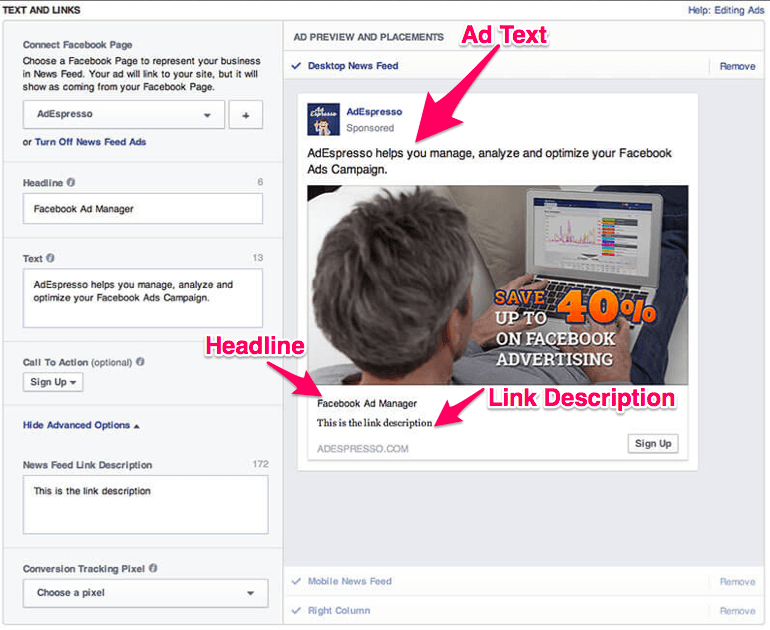
While these parts are separate, they should all work together toward a single goal: getting the right person to click.
2. The Three Pillars of Ad Copy
Effective ad copy, regardless of the platform, generally follows a simple three-part structure. Thinking in these terms will help you organize your message.
- The Hook: The first sentence of your Primary Text. Its only job is to stop the user from scrolling and make them curious enough to read more.
- The Body: The rest of the Primary Text. Here, you build on the hook by explaining the offer, addressing the audience's problems, and showing how your promoted product is the solution.
- The Call to Action (CTA): The closing part of your text that explicitly tells the reader what to do next and why they should do it.
Let's dive into how to write each of these effectively.
3. Writing Compelling Primary Text
The Primary Text is where you have the most space to persuade your audience. We'll use proven copywriting formulas to structure this section, which removes the guesswork and helps you write more effectively.
The All-Important Hook
You have a tiny window to capture someone's attention in a busy news feed. The first line of your ad is the most critical piece of copy you'll write.
How To Write Facebook Ad Copy (With Examples & Notes)
To understand the power of the hook, let's watch a brief clip from marketing expert Alex Cattoni. She explains why those first few characters are so crucial.
Watch from 03:26 to 04:30. Pay close attention to the '125 characters' rule and how the Mindvalley example creates an 'open loop' that makes you want to know the answer.
A great hook might:
- Ask a provocative question.
- State a surprising fact.
- Empathize with a specific pain point.
- Make a bold promise.
Structuring the Body with Copywriting Formulas
Once you have their attention, you need a logical flow to guide them from interest to desire. Copywriting formulas are templates for persuasion that have been tested for decades.
Complete Guide to Writing Facebook Ad Copy That Sells
This guide from Easy Ads provides an excellent breakdown of the most effective copywriting formulas. We'll focus on a few key ones that are perfect for affiliate marketing.
Read the section titled 'How to write Primary Ad Text'. Focus on understanding the formulas for AIDA, BAB, and PAS. Notice how each one provides a different angle to structure your ad.
Let's quickly review the three most useful formulas from that reading:
-
PAS (Problem, Agitate, Solve): This is arguably the most powerful formula for affiliate marketing.
- Problem: State the pain point your audience experiences. (e.g., "Struggling to lose weight with keto?")
- Agitate: Describe why that problem is so frustrating. (e.g., "The cravings are unbearable and you're not seeing the results you were promised.")
- Solve: Introduce the affiliate product as the solution. (e.g., "This 28-day meal plan makes keto easy and delicious...")
-
BAB (Before, After, Bridge): This formula paints a picture of transformation.
- Before: Describe the audience's current, undesirable state.
- After: Describe the ideal state they want to be in.
- Bridge: Position the product as the bridge to get them there.
-
AIDA (Attention, Interest, Desire, Action): A classic marketing framework.
- Attention: Your hook.
- Interest: Share interesting details and benefits.
- Desire: Help them imagine the positive outcome.
- Action: Tell them what to do.
By starting with one of these formulas, you transform a blank page into a fill-in-the-blanks exercise, making the writing process much more manageable.
4. Crafting the Headline and Description
While the Primary Text tells the story, the Headline and Description deliver a quick, powerful punch.
The Headline
According to research mentioned in the article "Facebook ad copy" from Copyhackers, the most effective headlines are often just 5 words long. Your goal is clarity and impact. Here are some tips drawn from experts:
- Focus on one clear benefit: Don't try to say everything. What is the single most important outcome?
- Use numbers: "3 Simple Steps to..." is more powerful than "A Simple Way to..."
- Ask a question: "Ready to Finally Master Keto?"
- State the offer directly: "Get Your Free Keto Cookbook".
A powerful concept is to test 5-foot benefits vs. 5-mile benefits.
- A 5-foot benefit is immediate and tangible (e.g., "Cook a Keto Meal in 15 Mins").
- A 5-mile benefit is a long-term, aspirational outcome (e.g., "Achieve Your Dream Body").
Testing both can reveal what resonates most with your audience.
The Description
Use the Description field (below the headline) to complement the headline, not repeat it. This is a great place for:
- Adding social proof: "Join 10,000+ Happy Customers"
- Creating urgency: "50% Off Ends Tonight"
- Overcoming an objection: "Works for Complete Beginners"
5. The All-Important Call to Action (CTA)
You've hooked them, built desire, and made a promise in the headline. Now you must tell them exactly what to do next. Don't be subtle.
Your ad has two CTAs:
- The CTA Button you select in Ads Manager ("Learn More" is a safe, low-commitment choice for beginners).
- The CTA in your Primary Text. This is a final sentence that reinforces the action.
How To Write Facebook Ad Copy (With Examples & Notes)
Alex Cattoni calls this final sentence the 'stinger'. Let's watch her explain how to use this to drive the click.
Watch from 09:57 to 10:44. Notice how the example recaps the pain point and presents the free training as the clear next step.
A strong text CTA is clear and compelling. For example:
- "➡️ Click 'Learn More' to get instant access to the 28-day meal plan and start your transformation today."
- "👇 Tap below to watch the free video presentation that reveals the #1 mistake people make on keto."
Practical Exercise
Let's put this all together. Imagine you are promoting a ClickBank product called "Keto Quickstart", a digital guide and meal plan for beginners. Your target audience is women aged 30-50 in the US who are interested in weight loss.
Your Task (5-10 minutes):
Using the PAS (Problem, Agitate, Solve) formula, write the copy for a simple Facebook ad.
-
Write the Primary Text:
- Problem: Start with a hook that identifies their struggle.
- Agitate: Briefly touch on why it's so frustrating.
- Solve: Introduce "Keto Quickstart" as the solution.
- End with a clear Call to Action.
-
Write one Headline: Keep it short and benefit-driven.
Here is an example to get you started:
-
Primary Text (Example):
(Problem) Tired of trying keto diets that are complicated and leave you feeling hungry?
(Agitate) It's frustrating when you put in the effort but don't see the scale move because the rules are too hard to follow.
(Solve) Keto Quickstart was designed for busy women like you. It gives you simple, delicious recipes and a step-by-step plan that takes the guesswork out of keto.
(CTA) ➡️ Click "Learn More" to see how you can start losing weight with keto... the easy way! -
Headline (Example):
Your Simple 28-Day Keto Plan
Now, try writing your own version. There's no single right answer; the goal is to practice applying the framework.
Conclusion
Congratulations! You've just learned the fundamental building blocks of writing persuasive ad copy. This skill is a powerful combination of understanding your audience's psychology and applying structured, proven frameworks.
Key Takeaways:
- A Facebook ad consists of distinct copy components: Primary Text, Headline, Description, and a CTA button.
- Effective ad copy follows a Hook, Body, CTA structure to guide the reader from awareness to action.
- Copywriting formulas like PAS, BAB, and AIDA provide a roadmap, making it easier to write persuasive copy.
- Your Headline should be short and punchy, while your Primary Text tells the full story.
- Always end with a clear and direct Call to Action that tells your audience exactly what to do next.
Preview of the next lesson:
Once your ad is written and running, how do you know if it's working? In our next lesson, we will explore the numbers behind the ads. You will learn to define foundational ad metrics (Reach, Clicks, CTR, CPC) and locate them in Ads Manager. This will empower you to analyze your ad's performance and make data-driven decisions.