Hello! Welcome to the next module of your affiliate marketing journey.
In the previous module, we focused on building a direct line of communication with your audience by setting up your email list and welcome sequence. You now have a system to capture leads and build relationships.
But how do people find your website and join your list in the first place? One of the most powerful and sustainable ways is through search engines like Google. This brings us to a new, exciting topic: Search Engine Optimization (SEO).
This lesson marks the beginning of our SEO module. We'll start with the fundamentals. Your learning outcome for today is to explain the difference between on-page, off-page, and technical SEO. Understanding these three core pillars is essential before you can start implementing any specific strategies to drive free, targeted traffic to your affiliate site.
1. What is SEO? A Quick Introduction
At its core, SEO is the practice of improving your website to increase its visibility when people search for products or information related to your business in search engines. The better visibility your pages have, the more likely you are to attract new visitors.
To give you a dynamic overview of what SEO is and introduce its main components, let's start with a short video.
SEO In 10 Minutes | What Is SEO(Search Engine Optimization)? | SEO Explained 2020 | Simplilearn
The video 'SEO In 10 Minutes' from Simplilearn provides a great high-level summary of the key areas of search engine optimization. It will introduce you to the three concepts we're focusing on today.
Watch the following segments to get a feel for each area: On-Page SEO (01:39 - 03:35): Pay attention to the elements mentioned, like content, keywords, and headings. These are things you'll directly control on your website's pages. Technical SEO (03:35 - 07:32): Notice how this section talks about behind-the-scenes factors like site speed, mobile-friendliness, and site structure. Off-Page SEO (07:32 - 09:03): Focus on the concept of 'backlinks' and how they act as a 'vote of confidence' from other websites.
2. The Three Pillars of SEO
As you saw in the video, SEO isn't just one single activity. It’s a combination of efforts that can be grouped into three main categories, often called the "pillars" of SEO:
- On-Page SEO
- Technical SEO
- Off-Page SEO
A helpful analogy is to think of your website as a physical store:
- On-Page SEO is about the quality and organization of what's inside your store—the products on the shelves, the helpful signs, and the knowledgeable staff. It's everything the customer directly interacts with.
- Technical SEO is the store's foundation and infrastructure—the electrical wiring, plumbing, and physical accessibility. Customers don't usually notice it unless something is broken, but it's essential for the store to function.
- Off-Page SEO is your store's reputation around town—the word-of-mouth referrals, positive reviews in local papers, and recommendations from other trusted business owners.
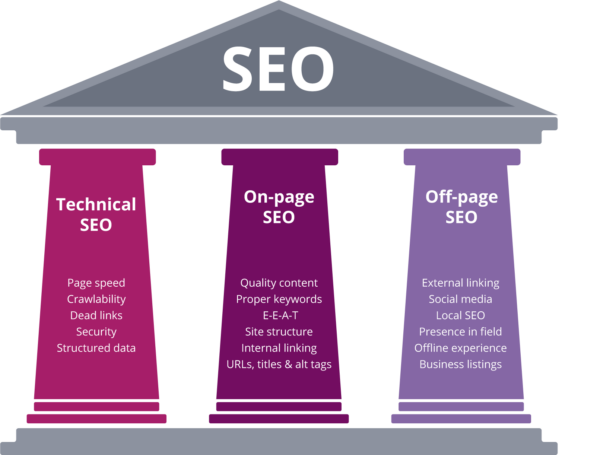
Now, let's dive deeper into what each of these pillars entails. The following article provides a comprehensive breakdown.
On-Page vs Off-Page SEO vs Technical: What's the Difference
The article 'On-Page vs Off-Page SEO vs Technical: What's the Difference' from Zero Gravity Marketing offers clear definitions and lists the key components of each SEO category.
Please read the following sections to get a detailed understanding of each pillar: 'What Is On-Page SEO': Read this section and the list under 'Aspects Of On-Page SEO'. 'What Is Off-Page SEO': Read this section and the descriptions of Backlinks, Social Media Marketing, and Brand Mentions. 'What Is Technical SEO': Read this section and the list under 'Aspects Of Technical SEO'. Focus on understanding the definition of each type of SEO and the examples provided.
3. Breaking Down the Differences
Based on the video and the reading, let's solidify your understanding of these three distinct but interconnected areas.
On-Page SEO: What's on Your Page
This refers to all the optimizations you perform directly on your website's individual pages. You have 100% control over these elements. The goal is to make your content valuable for human readers and easy for search engines to understand.
Key Components:
- Content Quality: Creating in-depth, helpful articles that answer your audience's questions (like the product reviews you'll be writing).
- Keywords: The search terms your audience uses, which you'll strategically include in your content.
- Title Tags & Meta Descriptions: The title and summary that appear in Google search results.
- Headings (H1, H2, H3): Structuring your articles for readability.
- Internal Linking: Linking from one page on your site to another relevant page.
- Image Optimization: Using descriptive filenames and "alt text" for your images.
Technical SEO: Your Website's Foundation
This refers to optimizations on the backend of your website that help search engines crawl and index your site more effectively. While it sounds complex, modern tools like WordPress and certain plugins handle much of this for you.
Key Components:
- Site Speed: How fast your pages load.
- Mobile-Friendliness: Ensuring your site looks and works great on smartphones.
- Security (HTTPS): Having a secure connection, indicated by the padlock in the browser bar.
- XML Sitemap: A file that lists all your site's pages, making it easier for Google to find them.
- Crawlability: Ensuring there are no broken links or errors that prevent search engines from accessing your content.
Off-Page SEO: Your Website's Reputation
This refers to all the actions taken outside of your own website to build its authority, credibility, and reputation. It's essentially about showing search engines that other people on the internet trust and value your content.
Key Components:
- Backlinks: These are the most critical part of off-page SEO. A backlink is a link from another website to yours. High-quality backlinks from reputable sites act as a strong "vote of confidence."
- Brand Mentions: When your brand or website is mentioned on other sites, even without a link.
- Social Media Marketing: Sharing your content and engaging with your audience on social platforms can lead to more visibility and backlinks.
4. A Side-by-Side Comparison
To help you clearly distinguish between the three pillars, here is a helpful summary table.

The most important thing to remember is that you need all three. You could have the most amazing content (On-Page), but if your site is slow and broken (Technical), no one will see it. Similarly, a technically perfect site with a great reputation (Off-Page) won't rank if it has no valuable content.
Conclusion
Great work today! You've just learned the foundational theory behind all search engine optimization efforts. By understanding the distinction between what happens on your site, behind the scenes, and out on the web, you're prepared to build a holistic SEO strategy.
Key Takeaways:
- On-Page SEO is about the content and structure of your web pages. You control it directly.
- Technical SEO is about your site's infrastructure and health, ensuring it's accessible to search engines and users.
- Off-Page SEO is about building your website's authority and reputation across the web, primarily through backlinks.
- A successful affiliate marketing website requires a balanced approach that addresses all three pillars of SEO.
Preview of the next lesson:
Now that you understand the "what," it's time to start with the "how." Our next lesson will be your first practical step in On-Page SEO: conducting basic keyword research. You will learn how to use free tools to find the exact phrases your target audience is searching for, which will become the foundation for all the content you create.