Hello! Welcome back to our module on Search Engine Optimization.
In our last lesson, you learned about the three pillars of SEO: on-page, off-page, and technical. This foundational knowledge is crucial because it helps you understand that driving traffic from Google is a multi-faceted process.
Today, we're diving into one of the most important activities in on-page SEO. The goal of this lesson is to learn how to conduct basic keyword research using free tools to find low-competition, long-tail keywords. This skill is the starting point for all content you'll create. By finding the right keywords, you'll know exactly what to write about to attract people who are actively looking for the solutions your affiliate products provide.
1. What Are We Looking For? Keywords and Intent
Before we start using any tools, we need to be clear on what we're searching for. Keyword research isn't just about finding popular words; it's about understanding the people behind the searches.
Long-Tail Keywords: Your Secret Weapon
As a new affiliate marketer, you won't be able to compete with huge, established websites for broad, popular keywords like "laptops" or "weight loss". These are often called "head keywords."
Instead, your focus will be on long-tail keywords. These are longer, more specific search phrases that people use when they're closer to making a decision.
Keyword Research for SEO: The Beginner's Guide [2025] - Mangools
To understand the difference between broad 'head' keywords and specific 'long-tail' keywords, let's turn to the 'Keyword Research for SEO' guide from Mangools.
Please read the section titled 'How to find keywords' down to (but not including) the 'Google Keyword Planner' subheading. Focus on the definitions of 'fat head keywords' and 'long-tail keywords' and their properties.
As the article explains, long-tail keywords have:
- Lower search volume (fewer people search for them each month).
- Lower competition (making it easier for a new site to rank).
- Higher specificity and engagement (the searcher knows exactly what they want).
This image provides a great visual summary of the concept:
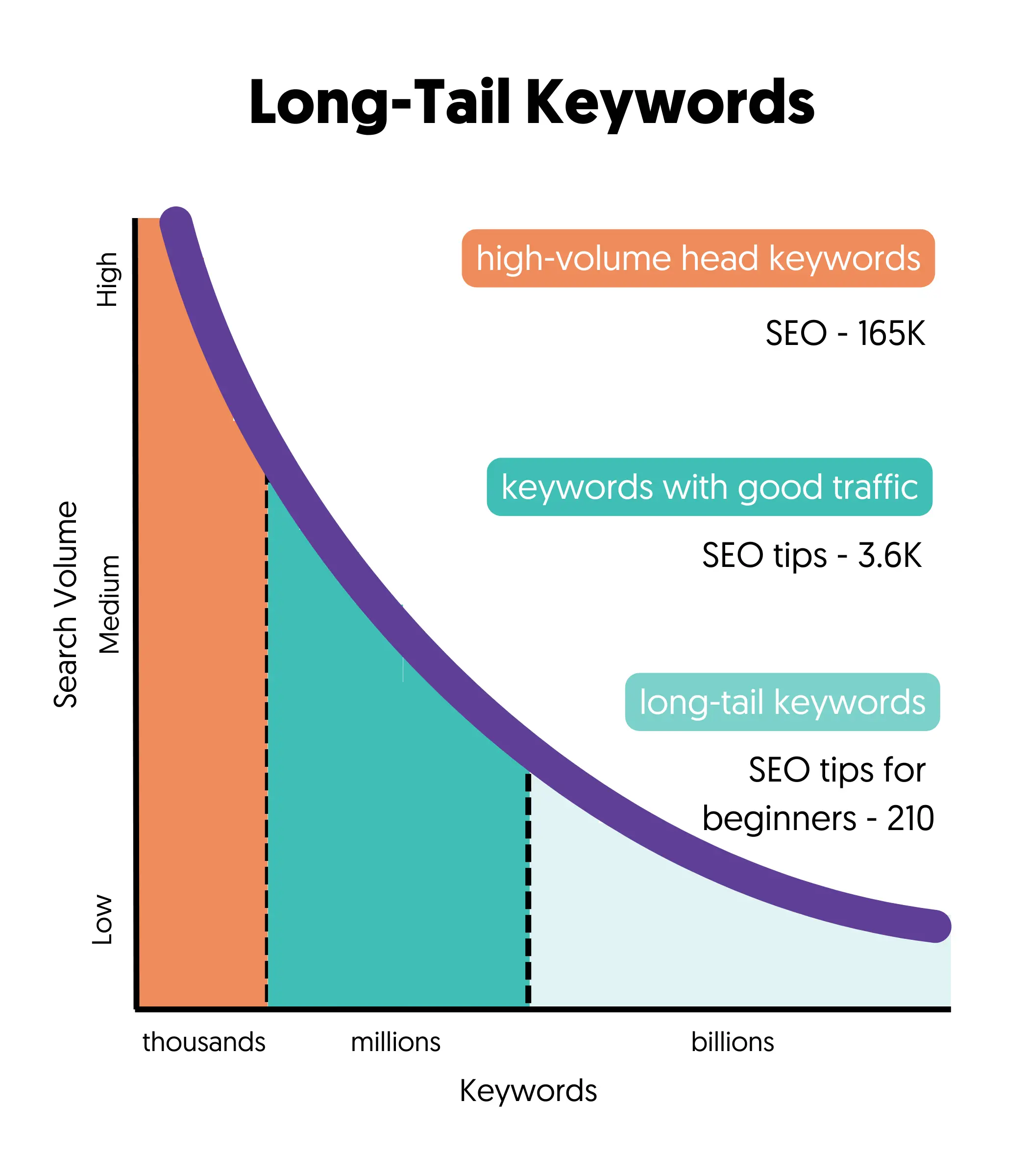
For an affiliate marketer, a search for "best drip coffee maker under $100" is far more valuable than a search for "coffee". The first person is ready to buy; the second is just browsing.
Search Intent: The "Why" Behind the Search
Understanding why someone is searching for a particular keyword is critical. This is called search intent. Are they looking for information, or are they looking to buy something?
To explore this foundational concept, let's watch a segment from a video by Ahrefs, a leading company in the SEO industry.
Keyword Research for Affiliate Marketing Sites [3.2]
This video, 'Keyword Research for Affiliate Marketing Sites,' clearly explains search intent and why it's so important for choosing topics that can naturally lead to product sales.
Watch the beginning of the video from 00:00 to 01:53. Pay close attention to the examples given for 'best protein powder' versus 'what is protein powder'.
As you just saw, keywords with commercial or transactional intent (like "best..." or "...review") are perfect for affiliate content because the searcher is already in a buying mindset. Keywords with informational intent ("how to...", "what is...") are great for building trust and authority.
2. A Framework for Affiliate Keywords
For an affiliate site, not all keywords are created equal. The Ahrefs video introduces a helpful framework of four main types of keywords to look for.
Keyword Research for Affiliate Marketing Sites [3.2]
Let's continue with the same Ahrefs video to learn about the four main types of keywords that are perfect for affiliate marketing sites.
Watch the segment from 01:53 to 03:06. This will introduce you to the four categories we will be looking for: general comparisons, branded comparisons, product reviews, and T&A (Trust and Authority) keywords.
To summarize, these are the keyword types you will be hunting for:
- General Comparisons: "best [product category] for [use case]" (e.g., best wireless earbuds for running)
- Branded Comparisons: "[brand A] vs [brand B]" (e.g., Sony WH-1000XM5 vs Bose QC Ultra)
- Product Reviews: "[product name] review" (e.g., Technivorm Moccamaster KBGV Select review)
- Informational (T&A): "how to [solve a problem]" or "what is [a concept]" (e.g., how to clean a coffee maker with vinegar)
3. The Process: Finding Keywords with Free Tools
Now for the practical part. We'll follow a simple three-step process: Brainstorm -> Generate -> Assess.
Step 1: Brainstorm Seed Keywords
Start by thinking of broad, one or two-word topics related to your niche. These are your "seed" keywords. If your niche is home fitness, your seed keywords might be:
- dumbbells
- yoga mats
- kettlebell
- home workout
Step 2: Generate Long-Tail Keyword Ideas
Next, you'll use free tools to expand your seed keywords into hundreds of long-tail ideas. Here are a couple of excellent, genuinely free options.
Tool 1: Ahrefs Free Keyword Generator
This tool will give you keyword ideas and their search volume. It's a simplified version of the powerful tool used in the video we watched.
Tool 2: Answer Socrates
This tool is fantastic for finding question-based keywords. It scrapes Google's "People Also Ask" sections and autocomplete suggestions to find what real people are asking about your topic.
The following video from Rank Math SEO demonstrates several free tools. We'll focus on the ones that are most useful for our purpose.
7 Best Free Keyword Research Tools (With No Limits)
This video, '7 Best Free Keyword Research Tools,' walks through several options. We'll look at two specific examples to see how these tools work in practice.
Please watch these two short segments: Ahrefs Keyword Generator (07:10 - 08:30): This will show you how to use your seed keyword to find related phrases and questions. Answer Socrates (17:48 - 19:30): This demonstrates how you can generate a huge list of question-based keywords from a single topic.
Step 3: Assess Competition and Search Volume
Once you have a list of ideas, you need to figure out which ones are worth pursuing. You're looking for the sweet spot:
- Decent Search Volume: There's no magic number, but for a new site, a keyword with 50-500 monthly searches can be a great target.
- Low Competition: The tool shows a low "Keyword Difficulty" (KD) score, or a manual Google search shows other small blogs, forums, or Quora/Reddit posts on the first page.
Many free tools provide a competition metric. For example, the Ahrefs Keyword Generator provides a "KD" (Keyword Difficulty) score from 0-100. As a beginner, you should target keywords with a KD of 20 or less.

4. Practical Exercise: Your First Keyword Hunt
It's time to put this into practice. This exercise will help you get comfortable with the process of finding valuable keywords for your future content.
- Choose a niche or sub-niche you find interesting (e.g., "vegan baking," "budget travel," "gaming headsets").
- Brainstorm 3-5 seed keywords for that niche.
- Use the free tools we discussed (Ahrefs Keyword Generator, Answer Socrates) to find one example for each of the four affiliate keyword types.
- Create a simple list or spreadsheet and for each keyword you find, note its approximate monthly search volume and your assessment of its competition (e.g., "KD 12" or "Low competition - forums are ranking").
Here is the list you need to fill out:
- General Comparison Keyword: (e.g., best vegan protein powder for beginners)
- Branded Comparison Keyword: (e.g., Vitamix vs Blendtec for smoothies)
- Product Review Keyword: (e.g., Oura Ring Gen 3 review)
- Informational Keyword: (e.g., how to make a sourdough starter)
Take your time with this. The goal is not to find perfect keywords right away, but to get familiar with the process and the tools.
Conclusion
Excellent work! You've just completed your first dive into the world of keyword research. This is a skill you will use constantly as an affiliate marketer to create content that attracts free, targeted traffic from search engines.
Key Takeaways:
- Long-tail keywords are specific, lower-competition phrases that are ideal for new affiliate sites.
- Search intent helps you understand why a person is searching, allowing you to create content that matches their needs.
- Affiliate marketers should focus on four key keyword types: general comparisons, branded comparisons, product reviews, and informational (T&A) keywords.
- A simple and effective keyword research process is Brainstorm -> Generate -> Assess using free tools.
Preview of the next lesson:
Finding a great keyword is the first step. The next step is using it effectively. In our upcoming lesson, you will learn how to identify the key on-page SEO elements, such as the title tag, meta description, and headings. We'll take a keyword like one you found today and discover exactly where and how to place it within a blog post to signal its relevance to Google.