Hello! Welcome to the next lesson in our journey to build a successful affiliate marketing business.
In the last lesson, we did some important detective work. You learned how to identify your audience's "pain points" and map them to the solutions offered by a ClickBank product. We also looked at the Pain-Agitate-Solve (PAS) formula as a way to frame your message.
This lesson builds directly on that foundation. Now that you know what to say (the solution to their pain), we'll focus on how to structure that message to guide a reader from being a curious visitor to a motivated buyer.
Today's lesson is about applying a classic and powerful marketing framework. We will be covering the learning outcome: Apply the AIDA (Attention, Interest, Desire, Action) framework to structure persuasive content.
1. What is the AIDA Framework?
AIDA is an acronym that stands for:
- Attention
- Interest
- Desire
- Action
It describes the four stages a person goes through when making a purchasing decision. As a marketer, your job is to create content that moves your reader through each of these stages smoothly. Think of it as a roadmap for your reader's mind.
To get a clear overview of the model, let's watch a short video.
The AIDA Model Explained with Examples
This video from EPM gives a great introduction to the AIDA model, its history, and a breakdown of what each stage represents.
Please watch from the beginning until 02:07. Focus on understanding the purpose of each of the four stages.
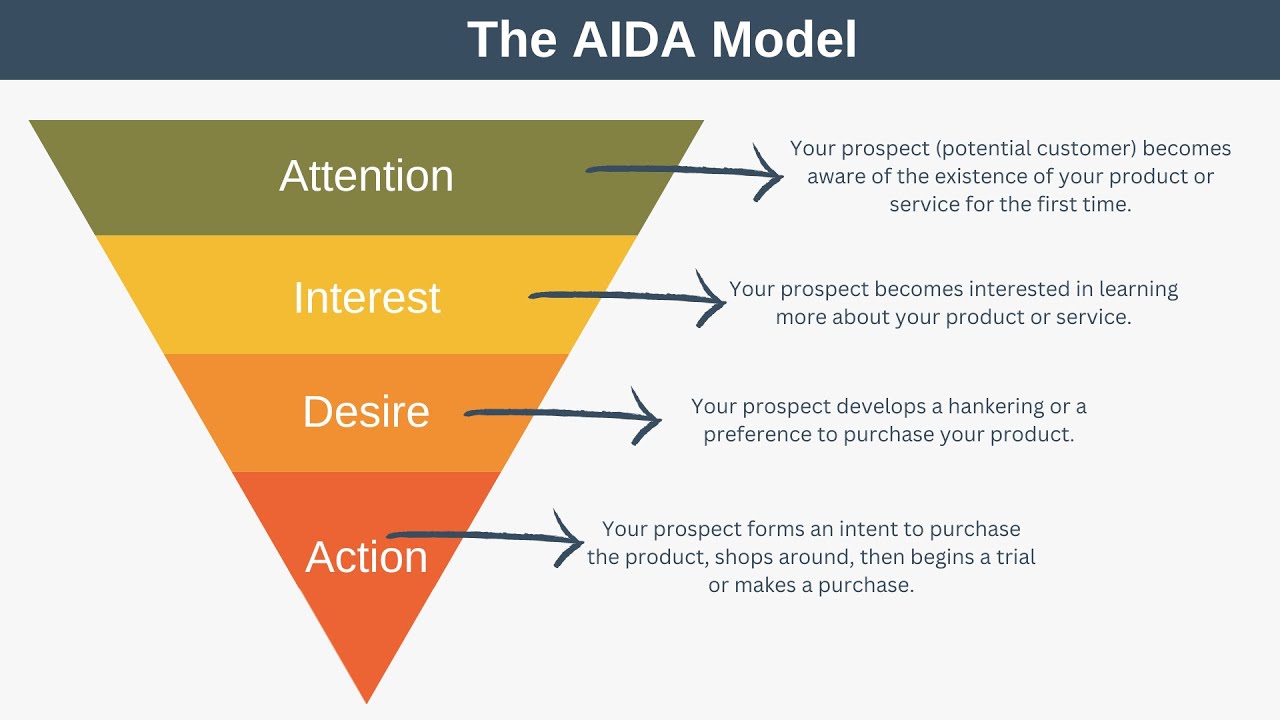
As the video explained, AIDA functions like a funnel. You start by capturing the attention of a broad audience and then guide the most interested individuals down toward the final action.
This next image breaks down the goals and actions for both the customer and the business at each stage. It provides a more detailed look at what you should be trying to achieve.

2. Applying AIDA to Your Content, Stage by Stage
Now, let's get practical. How do you actually use this framework when writing an article, a product review, or even an email for your affiliate business? We'll break it down using insights from some of the best marketing resources.
The HubSpot article, "The AIDA Model: A Proven Framework," provides excellent strategic advice for each stage. We'll use it as a guide.
The AIDA Model: A Proven Framework for Converting Strangers Into ...
This article from HubSpot offers practical, modern advice on applying each step of the AIDA model. We will refer to its sections as we go through each stage.
For now, just get familiar with the article's structure. Skim the headings under 'How to Apply the AIDA Model to Your Marketing.' We'll dive into each one next.
Stage 1: Attention
Your first job is to stop the scroll. In a world of infinite content, you have seconds to grab your reader's attention.
- Goal: Make them ask, "What is this?"
- How to do it:
- A powerful headline: This is your most important tool. It should be specific, create curiosity, or speak directly to a pain point.
- An intriguing question: "Are you making these common mistakes when trying to lose weight?"
- A surprising statistic: "Did you know that 80% of people give up on their New Year's resolutions by February?"
In the last lesson, you identified your audience's pain points. Leading with that pain is one of the most effective ways to grab attention.
Let's watch a short clip that gives some concrete examples of attention-grabbing phrases.
How to use the AIDA formula in copywriting.
The Kopywriting Kourse channel provides clear, simple examples of how to write for each stage of AIDA. This first clip focuses on grabbing attention.
Watch from 01:07 to 01:50 to see examples of how to open your content with a relevant and catchy hook.
Stage 2: Interest
You have their attention. Now you need to hold it and start building a connection.
- Goal: Make them think, "I like this. This is relevant to me."
- How to do it:
- Tell a relatable story: Share a personal or hypothetical story about the problem.
- Provide useful information: Share interesting facts or details that educate the reader about their problem.
- Show empathy: Use the language your audience uses (which you found in your research) to show you genuinely understand their struggle.
This is the stage where you elaborate on the "Pain" and begin to "Agitate" it, as we discussed in the PAS framework. You're confirming to the reader that they are in the right place.
How to use the AIDA formula in copywriting.
Let's continue with the Kopywriting Kourse video to see how to build interest after you've captured their attention.
Watch from 01:50 to 02:59. Notice how the examples provide interesting facts and multiple use-cases to keep the audience engaged.
Stage 3: Desire
This is the most crucial transition. You need to shift the reader's mindset from "This is an interesting problem" to "I need this solution."
- Goal: Make them feel, "I want it."
- How to do it:
- Focus on benefits, not features: Don't just list what the product has. Explain what the product does for the customer.
- Feature: "This guide includes a 7-day meal plan."
- Benefit: "You can start your diet with confidence, knowing exactly what to eat for an entire week, without any stressful guesswork."
- Show the transformation: Paint a "before and after" picture. Describe their current frustrating reality (the "Agitate" part of PAS) and contrast it with the easier, happier future the product enables (the "Solve").
- Use social proof: Include testimonials, success stories, or positive reviews to build trust. As the HubSpot article mentions, people trust what others are already using and loving.
- Focus on benefits, not features: Don't just list what the product has. Explain what the product does for the customer.
How to use the AIDA formula in copywriting.
This stage is often the trickiest. This clip clearly explains how to make your audience personally desire the outcome your product provides.
Watch from 02:59 to 04:40. Pay close attention to how the examples focus on the end result and how the customer's life will be better.
Stage 4: Action
You've built a strong case. Now you must make it incredibly easy for the reader to take the next step. Don't be shy—tell them exactly what to do.
- Goal: Get them to say, "I'm getting it."
- How to do it:
- Be clear and direct: Use a strong command verb. "Click here," "Get started today," "Find out more."
- Create a sense of urgency (optional): "Limited-time offer," "Get it now before the price goes up."
- Reduce friction: The link should take them exactly where they need to go, with no confusion. A button often works better than a simple text link.
A vague call-to-action (CTA) like "Let us know what you think" will kill your conversion rate. Be specific.
How to use the AIDA formula in copywriting.
Finally, let's look at how to craft an effective call to action that gets results.
Watch from 04:40 to 05:57. The key takeaway here is to tell people to take a single, specific action.
3. Putting It All Together: An AIDA Blog Post Outline
The AIDA framework is the perfect blueprint for structuring an affiliate product review or a helpful article.
Here's a great resource that shows you exactly how to use AIDA to outline a blog post.
What Is the AIDA Model? How It Works + Examples
This article from Siege Media provides a simple, actionable template for using AIDA to structure your blog content. This is a perfect summary to tie everything together.
Read the section titled 'Outline Blog Articles Using AIDA.' This gives you a clear, four-bullet-point blueprint for your next piece of content.
Let's use that blueprint with our hypothetical "Keto Diet for Beginners" guide:
- Attention: Headline: 5 Reasons Your Last Diet Failed (And How to Guarantee Keto Works)
- Interest: Introduction: Start by empathizing with the frustration of yo-yo dieting. "It's a familiar story: you start a new diet with high hopes, only to fall off the wagon a few weeks later..." Explain why this happens (it's often due to lack of a clear plan).
- Desire: Body Paragraphs: Create a section for each of the "5 reasons." In each one, you'll:
- Describe the problem (e.g., "Reason #2: You Got Bored of the Food").
- Show how the ClickBank product solves it (e.g., "But with the Keto for Beginners guide, you get over 100 delicious recipes... Imagine enjoying pizza and chocolate mousse while still losing weight!").
- Include a testimonial if available.
- Action: Conclusion: Summarize the main benefits and provide a very clear call to action. "Ready to finally achieve your weight loss goals without feeling deprived? Click here to learn more about the Keto for Beginners guide and get started today!"
Your Turn: Create a Mini-AIDA Outline
Let's put this into practice. Take the "Pain Point Map" you created in the last lesson. Choose one of the pain points you identified.
In a document or notebook, write a short AIDA sequence for it:
- Attention: Write one attention-grabbing headline or question related to that pain point.
- Interest: Write 1-2 sentences that show you understand the reader's frustration with this problem.
- Desire: Write 1-2 sentences that describe the transformation or benefit of solving this problem with your product.
- Action: Write one clear, specific call to action.
This exercise will help you get comfortable with thinking in the AIDA structure and will be a valuable building block for your future content.
Conclusion
You now have two essential frameworks in your affiliate marketing toolkit. The PAS framework (Pain-Agitate-Solve) helps you formulate the core message, and the AIDA framework (Attention-Interest-Desire-Action) gives you the structure to deliver that message persuasively.
Key takeaways from this lesson:
- AIDA is a four-stage model that maps the psychological journey of a potential customer.
- Attention: Grab them with a powerful headline that addresses their pain.
- Interest: Hold them by showing empathy and providing useful context.
- Desire: Make them want the solution by focusing on benefits and transformation.
- Action: Tell them exactly what to do next with a clear and compelling CTA.
- You can use AIDA as a direct blueprint for outlining your affiliate articles.
Preview of the next lesson:
We've seen today how critical the "Attention" stage is. If you can't grab your reader's attention, the rest of your message doesn't matter. In our next lesson, we will do a deep dive into that first crucial step: "Write a compelling headline that grabs attention and addresses a specific audience problem."