Introduction
Welcome to the final module of the course! You've come a long way, from understanding the basics of affiliate marketing to building, promoting, and optimizing your own affiliate website. In our last lesson, you learned how to develop a testing plan to systematically improve the performance of your content, which is crucial for maximizing the revenue from your existing traffic.
Now, we're going to shift our focus from optimizing your current operations to strategic growth. This lesson addresses a key step in scaling your affiliate project from a side income into a full-time business: learning how to evaluate a complementary niche to potentially expand your business into.
We will explore why expanding into a related niche is often more effective than starting something new from scratch. You'll learn how to identify these opportunities and use a structured framework to evaluate their potential, ensuring your next move is a strategic one.
1. Why Expand? The Power of Complementary Niches
Once your first niche website is established and generating consistent traffic and income, you might wonder, "What's next?" While you can continue to go deeper into your current niche, one of the most powerful growth strategies is to expand into a complementary niche.
A complementary niche is a topic that is closely related to your current one and appeals to a similar audience. For example:
- If your niche is dog training, a complementary niche could be dog food reviews or pet grooming supplies.
- If your niche is learning to play guitar, a complementary niche could be home recording equipment or music theory courses.
This strategy is powerful because it allows you to leverage the authority, audience, and content you've already built. You're not starting from zero; you're expanding your territory.
Let's start with a short video that perfectly illustrates this concept of "niching out."
Keys to Choosing the Right Affiliate Marketing Niche [2.1]
The video 'Keys to Choosing the Right Affiliate Marketing Niche' from Ahrefs explains how a well-chosen starting niche gives you room to grow. This section specifically discusses the strategy of expanding into related topics.
Watch from 03:40 to 05:20. Pay close attention to the example of starting with 'bed frames' and naturally expanding to 'mattresses,' 'pillows,' and the broader topic of 'sleep.' This is the core idea of expanding into a complementary niche.
As the video explains, starting with a focused niche allows you to establish yourself, but its connection to a larger industry provides the pathway for growth. Now, let's look at a framework for thinking about this strategically.
2. A Strategic Framework for Your Niche Portfolio
When you start thinking about multiple niches, it's helpful to use a business framework to categorize them. The BCG Matrix is a classic tool for managing a portfolio, and we can adapt it for affiliate marketing.
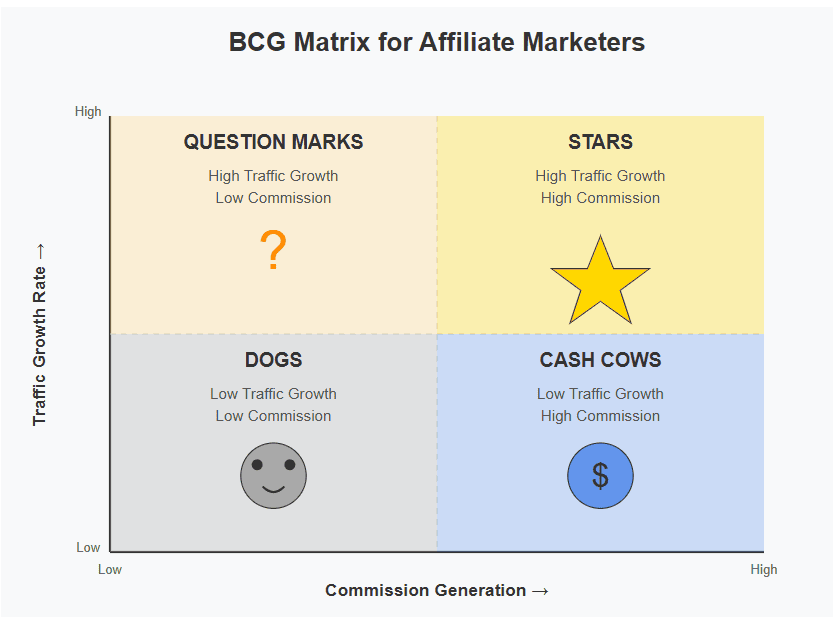
Let's break down the four quadrants in an affiliate context:
- Dogs (Low Growth, Low Commission): These are underperforming niches or products. They don't get much traffic and don't earn much. You should generally avoid or divest from these.
- Question Marks (High Growth, Low Commission): This is often where a new, complementary niche starts. It's in a growing market, and you see high traffic potential, but you haven't yet figured out how to monetize it effectively. It requires investment (your time and content) to turn it into a Star.
- Stars (High Growth, High Commission): The ideal scenario. These are popular topics in a growing market that you've successfully monetized. You should continue to invest heavily here.
- Cash Cows (Low Growth, High Commission): This might be your initial, established niche. The market growth has slowed, but it's a stable, reliable earner. It generates the "cash" (and authority) that you can reinvest into your "Question Marks."
Your goal is to use the profits from your Cash Cows to fund your Question Marks, turning them into the next Stars and, eventually, new Cash Cows. This is the engine of scaling.
3. How to Identify and Evaluate a Complementary Niche
The process of evaluating a complementary niche is very similar to the research you did when you chose your first niche. However, you now have an existing audience and business to consider.
Best Affiliate Niches | 10 Top Affiliate Marketing Niches
The article 'How to Pick the Right Affiliate Niches for Your Business?' from Trackier outlines a clear, strategic process for niche selection. We will use this framework to guide our evaluation.
First, read the section 'How to Pick the Right Affiliate Niches for Your Business?' to understand the three core pillars: Audience, Market Demand, and Profitability. Then, skim the next section, 'What Are the 10 Most Profitable Affiliate Niches,' to see examples of broad, profitable areas that you might find adjacent to your own.
Based on that reading and other best practices, here is a five-step evaluation process for any potential new niche.
Step 1: Brainstorm and Check for Audience Fit
Start by listing potential niches that are related to your current one. Think about other problems or interests your current audience has.
- If you're in the home workout niche, your audience also cares about nutrition, workout apparel, and mental wellness.
- If you're in the SaaS software review niche, your audience is also interested in project management techniques, productivity hacks, and online business strategies.
The key question is: Would my existing audience be interested in this new topic? A strong overlap is the foundation of a successful expansion.
Step 2: Analyze Market Demand and Growth
Just like with your first niche, you need to validate that people are actually searching for this topic and that interest is stable or growing.
- Tool: Google Trends
- Action: Compare your potential new niche against your existing one. Look at the trend line over the past 5 years. Is it growing, stable, or declining? A stable or growing trend is a positive signal.
Step 3: Investigate Profitability
You need to know if you can make money in this new niche.
- Tool: The ClickBank Marketplace.
- Action: Search the ClickBank marketplace for high-quality products related to the complementary niche. Look for offers with a healthy Gravity Score and Avg $/conversion. The presence of good products to promote is a non-negotiable requirement.
Step 4: Assess the Competition
How difficult will it be to gain a foothold in this new area?
- Tool: SEO tools (like the free versions of Ahrefs or Ubersuggest) or simply a Google search.
- Action: Search for the main keywords in the potential niche (e.g., "best meal prep containers," "review of [project management tool]"). Look at the top-ranking sites. Are they massive, authoritative brands, or are there smaller blogs and niche sites like yours? The presence of other niche sites can actually be a good sign that the niche is viable for independent affiliates.
Step 5: Consider Your Expertise and Brand Alignment
Finally, does this new niche fit you and your brand?
- Authenticity: Can you genuinely create helpful, authoritative content on this topic? Your audience trusts you in your current niche; you need to maintain that trust.
- Brand Cohesion: Does it make sense for your brand to talk about this? If your site is "The Ultimate Guide to Vegan Bodybuilding," expanding into "Sustainable Fashion" might be a stretch. Expanding into "Vegan Meal Delivery Services" is a perfect fit.
The article "How to Choose the Best Niche for Affiliate Marketing" provides more detail on these considerations.
How to Choose the Best Niche for Affiliate Marketing (Top 12 Niches)
This article reinforces the core factors to consider when selecting any niche, which are directly applicable to evaluating an expansion.
Read the section 'What Should I Consider When Choosing The Best Niche For Affiliate Marketing?' to review the importance of interest, demand, and profitability. Then, read the section 'Must I stick to Only One Best Niche for Affiliate Marketing?' which directly confirms our expansion strategy.
A Practical Walkthrough: Scoring Your Options
To make this process more concrete and data-driven, you can use a structured method to score your potential niches. The following video details a 5-step process (with a free spreadsheet) for finding a new niche, but we can adapt its excellent methodology to evaluate our expansion ideas.
How to Find the Best Niche for Affiliate Marketing (5 Simple Steps)
The video 'How to Find the Best Niche for Affiliate Marketing' by Metics Media offers a very detailed, step-by-step process for analyzing a niche with real data. We will borrow this methodology to evaluate the complementary niches you brainstormed.
You don't need to follow every single step with the spreadsheet right now, but watch through the video to understand the process. Focus on how he uses data to answer key questions: Step 1 (01:37): Brainstorming ideas. Step 2 (02:21): Using Google Trends to check demand. Step 3 (06:52): Using an SEO tool to check traffic and competition. Step 4 (11:39): Researching affiliate programs and earning potential. Step 5 (15:14): Using a scorecard to make a final decision. This process is the practical application of the five evaluation steps we just discussed.
By putting your top 2-3 complementary niche ideas through a process like this, you move from a gut feeling to a data-informed strategic decision.
Conclusion
You are now equipped with a strategic mindset for long-term growth. Instead of seeing your affiliate business as a single website, you can view it as a portfolio of assets that you can develop over time.
Key Takeaways:
- Scaling your business often involves expanding into complementary niches that appeal to your existing audience.
- This strategy allows you to leverage your existing authority, audience, and content.
- The BCG Matrix provides a useful framework for managing your niche portfolio, using your established "Cash Cows" to fund new "Question Marks."
- To evaluate a new niche, you must analyze audience fit, market demand, profitability, competition, and brand alignment.
- Using a structured, data-driven process with tools like Google Trends and the ClickBank Marketplace is critical for making an informed decision.
Preview of the next lesson:
Choosing a complementary niche is a major strategic decision for growth. But how do you fund this expansion and other growth activities? In our final lesson, you will learn how to outline a strategy for reinvesting affiliate earnings to grow from a side income to a full-time business. This will tie everything together, providing a roadmap for turning your initial success into a sustainable and scalable enterprise.