Hello! Welcome back.
In our last lesson, we implemented Redis caching for our Django API. We saw a dramatic performance improvement using the @cache_page decorator but also encountered the challenge of stale data. We created a basic solution using Django signals to invalidate the cache whenever a product was changed.
Today, we will delve deeper into this critical topic. This lesson is designed to meet the learning outcome: Apply cache invalidation strategies to ensure data consistency between the cache and database.
We'll move beyond our initial simple approach to explore a spectrum of more robust and granular invalidation strategies. You'll learn about the inherent trade-offs between data consistency, application performance, and implementation complexity. Given your interest in the "under the hood" aspects of systems, we'll start by examining why this problem is considered one of the harder challenges in computer science before implementing more refined solutions in Django.
1. The Hard Problem of Cache Invalidation
You may have heard the famous aphorism by Phil Karlton: "There are only two hard things in Computer Science: cache invalidation and naming things." While partly a joke, it highlights a genuine difficulty. The moment you introduce a cache, you create a second, temporary source of truth for your data, and keeping it synchronized with the primary source (the database) is fraught with challenges.
To understand these challenges from a system design perspective, let's explore a great article that breaks down the problem.
Cache Invalidation | System Design
This article, 'Cache Invalidation' from Algomaster, explains why maintaining cache consistency is so difficult. It will introduce you to concepts like race conditions and dependency chains, which are fundamental to understanding the problem.
Please read the sections 'What is Cache Invalidation?' and 'Why is Cache Invalidation Hard?'. As you read, think about how these issues might manifest in a real-world application, like the e-commerce API we are building.
As the article points out, in a simple, single-threaded application, invalidation is trivial. But in real-world backend systems with multiple concurrent users and potentially distributed servers (which you'll encounter later in this course), ensuring an invalidation action happens correctly and at the right time becomes very complex. This is analogous to challenges in distributed machine learning, where ensuring all nodes are working with a consistent model state is crucial for successful training.
2. A Spectrum of Invalidation Strategies
There is no one-size-fits-all solution for cache invalidation. The right approach depends on your specific needs, such as how critical up-to-the-minute data is for your users versus how much load your database can handle.
Let's review the most common strategies and their trade-offs. The same article provides an excellent overview.
Cache Invalidation | System Design
Now, let's explore the different strategies you can employ. This section details several key patterns and includes a helpful comparison table.
Read the section 'Invalidation Strategies'. Focus on understanding the following four main types: Time-To-Live (TTL): The simplest strategy, where data expires after a set time. Event-Driven Invalidation (Delete on Write): Explicitly deleting cache entries when data changes. This is the pattern our signal-based solution from the last lesson follows. Write-Through: Writing to the cache and then the database in a single operation. Write-Behind (Write-Back): Writing to the cache immediately and to the database later, asynchronously. Pay close attention to the 'Strategy Comparison' table at the end of the section.
Here are some visuals to help solidify these concepts.

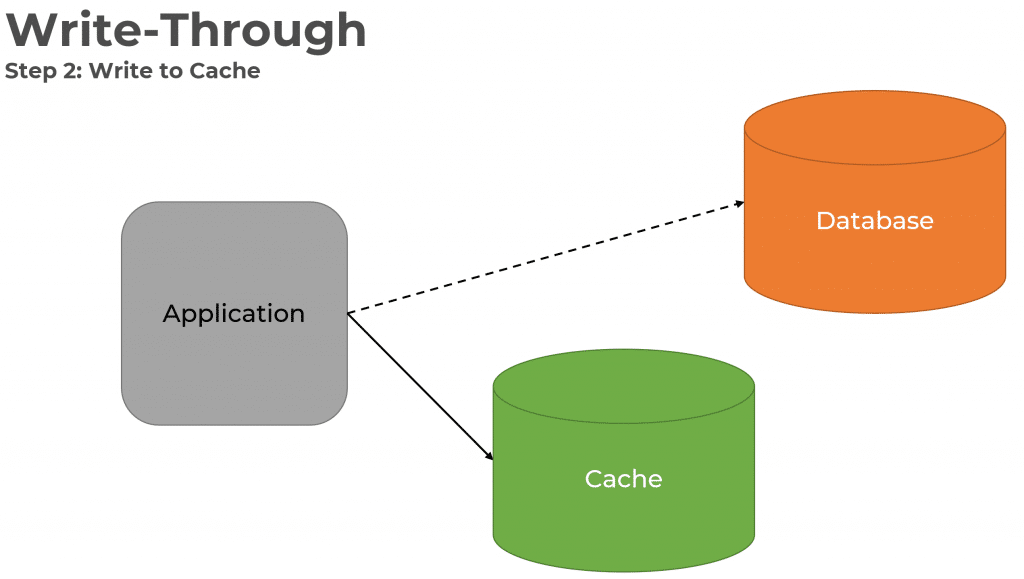
To hear these concepts explained from another perspective, the following video provides a concise overview focused on consistency in distributed systems.
What are Distributed CACHES and how do they manage DATA CONSISTENCY?
This video from Gaurav Sen discusses data consistency in the context of distributed caches, offering a great high-level view on write-through and write-back strategies.
Please watch the video from 05:54 to 06:30 and from 09:38 to 13:10. The first short segment frames the consistency problem, and the second part details the write-through and write-back strategies and when you might choose one over the other.
For most web applications, a combination of TTL and Event-Driven Invalidation (Delete on Write) offers a good balance of performance and consistency, and this is what we'll focus on implementing in Django.
3. Refining Our Invalidation Logic in Django
In the last lesson, we used a Django signal to call cache.delete_pattern('*product_list*'). This works, but it's a bit of a sledgehammer. It deletes all cached versions of our product list (e.g., page 1, page 2, different orderings) every time any product is changed.
A more refined strategy is to be as specific as possible. When a single product is updated, we should definitely invalidate the cache for that specific product's detail view, in addition to the list view.
Let's see how to implement this more granular approach. We will expand on the signal receiver we wrote previously.
The "Delete on Write" Pattern in Django
The guide we used in the previous lesson contains a perfect example of this more granular invalidation.
Django + Redis: The Complete Caching Guide That ...
This article section demonstrates a refined signal receiver that invalidates both a specific item's cache and a general list cache.
Review the code under 'Pattern 2: Cache with Automatic Invalidation'. Notice how it deletes two different keys: one specific to the instance (f'product:{instance.id}') and one for the general list.
Let's adapt this pattern for our own project. Assume we have two types of cached data:
- The product list view, cached with a
key_prefixof'product_list'. - A product detail view, which we might cache using a key like
'product_detail_{id}'.
Our signals.py file would look like this:
# products/signals.py

from django.db.models.signals import post_save, post_delete
from django.dispatch import receiver
from django.core.cache import cache
from .models import Product

@receiver([post_save, post_delete], sender=Product)
def invalidate_product_cache(sender, instance, **kwargs):
    """
    Invalidates cache when a Product instance is saved or deleted.
    """
    # 1. Invalidate the specific product's detail view cache
    detail_key = f"product_detail_{instance.pk}"
    cache.delete(detail_key)
    print(f"Deleted cache for key: {detail_key}")

    # 2. Invalidate the list view cache.
    # The cache key for views using @cache_page is complex.
    # It includes the view's prefix, headers, and URL.
    # Using delete_pattern is a practical way to clear all variations
    # (pagination, ordering) of the list view.
    # The pattern should match the key_prefix used in the @cache_page decorator.
    list_key_prefix = "product_list"
    cache.delete_pattern(f"*:{list_key_prefix}:*")
    print(f"Deleted cache pattern for prefix: {list_key_prefix}")
This implementation is more robust. We precisely target the cache for the specific object that changed, while still ensuring that any lists containing that object are also refreshed. The django-redis delete_pattern function remains very useful for clearing view caches that have many variations due to query parameters.
4. Best Practices and Race Conditions
Even with our refined logic, subtle bugs can occur due to the concurrent nature of web servers. It's important to be aware of these pitfalls.
Prefer Delete Over Update
When a write occurs, it's almost always better to delete the cache entry rather than trying to update it with the new data. Deleting is an idempotent operation: deleting the same key multiple times has the same result as deleting it once. In contrast, if two concurrent processes try to update the same key, the last one to run wins, and it might not be the newest data. This "delete-on-write, read-to-repopulate" model is simpler and safer.
Use TTL as a Safety Net
What if your signal fails to run due to a bug or a server issue? Without a TTL, the stale data could remain in your cache indefinitely. You should always set a TTL on your cached data, even when you have explicit invalidation logic. Think of it as a fallback that guarantees eventual consistency.
Test your understanding!
Imagine you have a view that is cached with a 1-hour TTL and is also invalidated by a post_save signal. A developer updates a product in the database, but a bug in the code causes the post_save signal handler to fail and not delete the cache key.
What will a user see when they request the view 10 minutes after the update? What will they see 70 minutes after the update?
Show answer
- At 10 minutes: The user will see stale data. Because the explicit invalidation failed, the old version of the view remains in the cache.
- At 70 minutes: The user will see fresh data. The 1-hour TTL has expired, forcing the cache to miss. The view will be re-rendered with fresh data from the database, which is then re-cached with a new 1-hour TTL. This demonstrates why TTL is a crucial safety net.
Conclusion
In this lesson, we moved from a basic implementation to a more nuanced understanding of cache invalidation. You now have a framework for thinking about and implementing strategies that balance the critical trade-offs between performance and data consistency.
Key Takeaways:
- Cache invalidation is a fundamentally hard problem in distributed and concurrent systems due to race conditions and the need to synchronize multiple sources of truth.
- The "Delete on Write" strategy, implemented in Django using signals, is a common and effective pattern for many web applications.
- Invalidation logic should be as granular as possible, targeting specific cache keys when possible, while still accounting for dependent caches (like lists).
- Always use a Time-To-Live (TTL) on cached data as a safety net. If your explicit invalidation fails, TTL ensures eventual consistency.
- When invalidating, prefer deleting cache entries over updating them, as deletion is idempotent and safer in concurrent environments.
Preview of the Next Lesson:
So far, all our caching has been on the server side. We've been managing our own Redis cache to speed up our server's responses. But there's another place we can cache data: the client's browser. In the next lesson, we will explore how to Use HTTP caching headers (e.g., ETag, Cache-Control) to enable client-side caching, reducing the number of requests that even need to reach our server in the first place.