Hello again! In our last lesson, we focused on making sure every sentence you write is a complete thought by fixing sentence fragments. Now that you're an expert at spotting incomplete sentences, we're going to look at the opposite problem: sentences that try to do too much.
Today, we'll dive into run-on sentences and comma splices. These happen when two or more complete thoughts are combined incorrectly, which can make your writing feel rushed or confusing. By the end of this lesson, you will be able to identify and fix run-on sentences and comma splices in short texts. Mastering this will make your creative writing clearer and more powerful.
What is a Run-On Sentence?
In our last lesson, you learned that a complete sentence, or an independent clause, needs a subject, a verb, and to express a complete thought. A run-on sentence occurs when you join two or more of these independent clauses together without the right punctuation or connecting words.
There are two main types of run-ons:
- Fused Sentence: Two independent clauses are smashed together with nothing in between.
- Example: I love this song it's my favorite.
- Comma Splice: Two independent clauses are joined with only a comma, which isn't strong enough to connect them properly.
- Example: I love this song, it's my favorite.
Take a look at this quick visual summary.
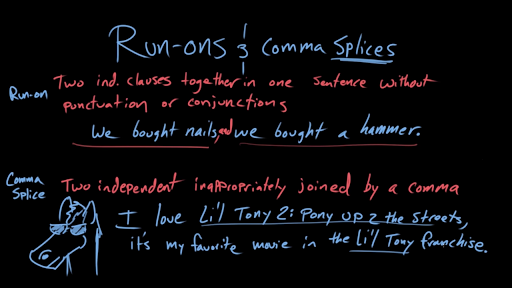
As you can see, both "We bought nails we bought a hammer" and the "Li'l Tony" example are incorrect because they are trying to contain two full sentences in one without the proper connection.
To get a more detailed look, let's watch the beginning of this video from Sparkle English.
Run-On Sentences and How To Fix Them | English Writing Essentials and Grammar
This video, "Run-On Sentences and How To Fix Them," clearly defines and gives examples of both fused sentences and comma splices.
Watch the first part of the video from the introduction to understand the two types of run-on sentences.
The key takeaway is that a comma alone is not strong enough to join two independent clauses. Think of it like trying to hold two heavy books together with a tiny piece of tape—it just won't work!
Four Ways to Fix Run-On Sentences
The good news is that there are several easy ways to fix these errors. Once you know them, you'll be able to spot and correct them in your own writing, whether you're drafting a monologue for a character or just messaging a classmate.
This infographic neatly summarizes the four main methods we're about to cover.
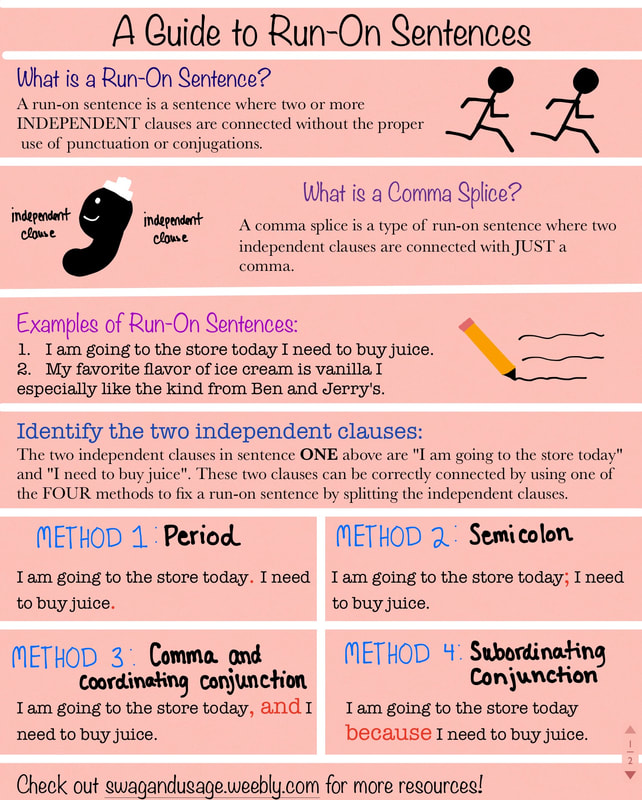
Now, let's explore each of these methods in more detail by watching the next part of the Sparkle English video.
Run-On Sentences and How To Fix Them | English Writing Essentials and Grammar
We'll continue with the "Run-On Sentences and How To Fix Them" video. It provides clear explanations and examples for each correction method.
Watch the video in four parts, focusing on each method: Method 1: Use a Period. This is the simplest fix. Just turn the two independent clauses into two separate sentences. Watch from this method. Method 2: Use a Comma and a Coordinating Conjunction. You can connect the two clauses with a comma followed by one of the "FANBOYS" (For, And, Nor, But, Or, Yet, So). Watch the explanation from this section. Method 3: Use a Semicolon. A semicolon (;) can be used to connect two closely related independent clauses. It's stronger than a comma but doesn't create a full stop like a period. See how it works from this part. Method 4: Use a Subordinating Conjunction. Words like because, although, since, and if can turn one of the independent clauses into a dependent clause, creating a correct complex sentence. Watch the final method from this explanation.
Your Turn: Practice Time
Now let's put what you've learned into practice. The best way to get comfortable with these rules is to use them.
First, try this interactive quiz.
Run-On Sentences and How To Fix Them | English Writing Essentials and Grammar
The final part of the "Run-On Sentences and How To Fix Them" video is a practice test. It's a great way to check your understanding.
Follow along with the video from the practice test. For each of the eight sentences, pause the video and decide if it's correct or if it's a run-on. If it's a run-on, think about how you would fix it before the presenter reveals the answer.
Creative Writing Task
Now, let's apply this to a creative context. Here are two sentences that might appear in a short story draft. Both contain errors. Your task is to fix them. Try to use a different method for each one.
- Comma Splice: The room was silent, she could hear her own heartbeat.
- Fused Sentence: The character felt a sudden chill he knew he wasn't alone.
Take a moment to rewrite them into correct sentences.
...
Ready to see some options?
Here are a few possible corrections:
-
Original: The room was silent, she could hear her own heartbeat.
- Fix with a period: The room was silent. She could hear her own heartbeat.
- Fix with a semicolon: The room was silent; she could hear her own heartbeat.
- Fix with a conjunction: The room was silent, and she could hear her own heartbeat.
-
Original: The character felt a sudden chill he knew he wasn't alone.
- Fix with a semicolon: The character felt a sudden chill; he knew he wasn't alone.
- Fix with a comma and conjunction: The character felt a sudden chill, for he knew he wasn't alone.
- Fix with a subordinating conjunction: The character felt a sudden chill because he knew he wasn't alone.
Your answers might be different, but as long as you've correctly joined or separated the two independent clauses, you've done an excellent job!
Conclusion
Fantastic work today! You've tackled another one of the most common errors in English writing. Being able to control how you connect your ideas is a key skill for any writer.
Here's a quick summary of what we covered:
- Run-on sentences happen when two or more independent clauses are joined incorrectly. This includes fused sentences (no punctuation) and comma splices (just a comma).
- You can fix these errors in four main ways:
- Create two separate sentences with a period.
- Use a semicolon to link two closely related ideas.
- Use a comma and a coordinating conjunction (FANBOYS).
- Use a subordinating conjunction to make one clause dependent on the other.
In our next lesson, we'll continue to build on this. We'll take a closer look at combining short, choppy sentences using coordinating conjunctions. You've already learned this as a way to fix run-ons, and next, we'll explore how to use it to make your writing flow more smoothly and sound more sophisticated.