Welcome to your first lesson! We're kicking off your journey into English writing and grammar by focusing on the most fundamental building block: the sentence. A strong house needs a solid foundation, and clear writing is built on strong, complete sentences.
In this lesson, we'll tackle a common writing error called the sentence fragment. You'll learn how to spot these incomplete sentences in your writing and, more importantly, how to fix them. Mastering this skill is the first step toward making your writing, whether it's a short story or a message to a friend, clear, confident, and easy to understand.
Our goal today is to identify and fix sentence fragments to ensure complete thoughts.
What is a Complete Sentence?
Before we can spot an incomplete sentence, we need to know what makes a sentence complete. At its core, a complete sentence has three key ingredients:
- A subject (who or what the sentence is about).
- A predicate (which includes the verb, telling us what the subject is or does).
- A complete thought (it can stand alone and make sense).
For example, in "The character walks on stage," the subject is "The character," and the predicate is "walks on stage." It expresses a complete thought.
Let's watch a short video that explains these three essential parts.
SENTENCES, FRAGMENTS, & RUN-ONS | English Lesson
Watch the beginning of this video from the Kevin Spaans channel, titled "SENTENCES, FRAGMENTS, & RUN-ONS". It provides a clear and quick definition of what makes a sentence complete.
Pay close attention to the explanation from the three requirements for a complete sentence. You can stop watching after the speaker says, "...it is called a fragment." We'll cover run-on sentences in our next lesson.
As the video explains, if any of these three elements—subject, predicate, or complete thought—is missing, you don't have a complete sentence. You have a fragment.
Types of Sentence Fragments
Sentence fragments usually happen for one of three reasons: the sentence is missing a subject, it's missing a verb, or it's a dependent clause trying to stand on its own.
Let's explore these common types of fragments and how to fix them. The following video gives excellent, clear examples.
Sentence Fragments & How to Fix Them | How to Write Complete Sentences | English Writing Essentials
The video "Sentence Fragments & How to Fix Them" from Sparkle English will be our main guide for this lesson. We'll watch it in parts.
First, watch the section that defines a fragment and shows the basic idea. Next, focus on fragments without a subject. Notice how each example feels like it's missing the "who" or "what." For example, "Went to the store" is a fragment because we don't know who went. Then, watch the segment on fragments without a verb. These often feel like a snapshot or a list, but they don't show any action or state of being. "The cat on the roof" tells us about a cat, but not what it's doing or is. Finally, pay close attention to dependent clause fragments. These are tricky because they do have a subject and a verb, but they start with words like because, although, if, or when. These words make the clause "dependent," meaning it can't stand on its own. It leaves you waiting for more information.
To summarize, a fragment is like half of a conversation. It leaves the reader with a question.
- Fragment:
Ran to catch the bus.(Who ran?) - Fragment:
My best friend from school.(What about them?) - Fragment:
Because it started to rain.(What happened because it rained?)
How to Fix Sentence Fragments
Fixing fragments is usually straightforward. As the image below shows, you can add what's missing, connect the fragment to a nearby sentence, or rewrite it.
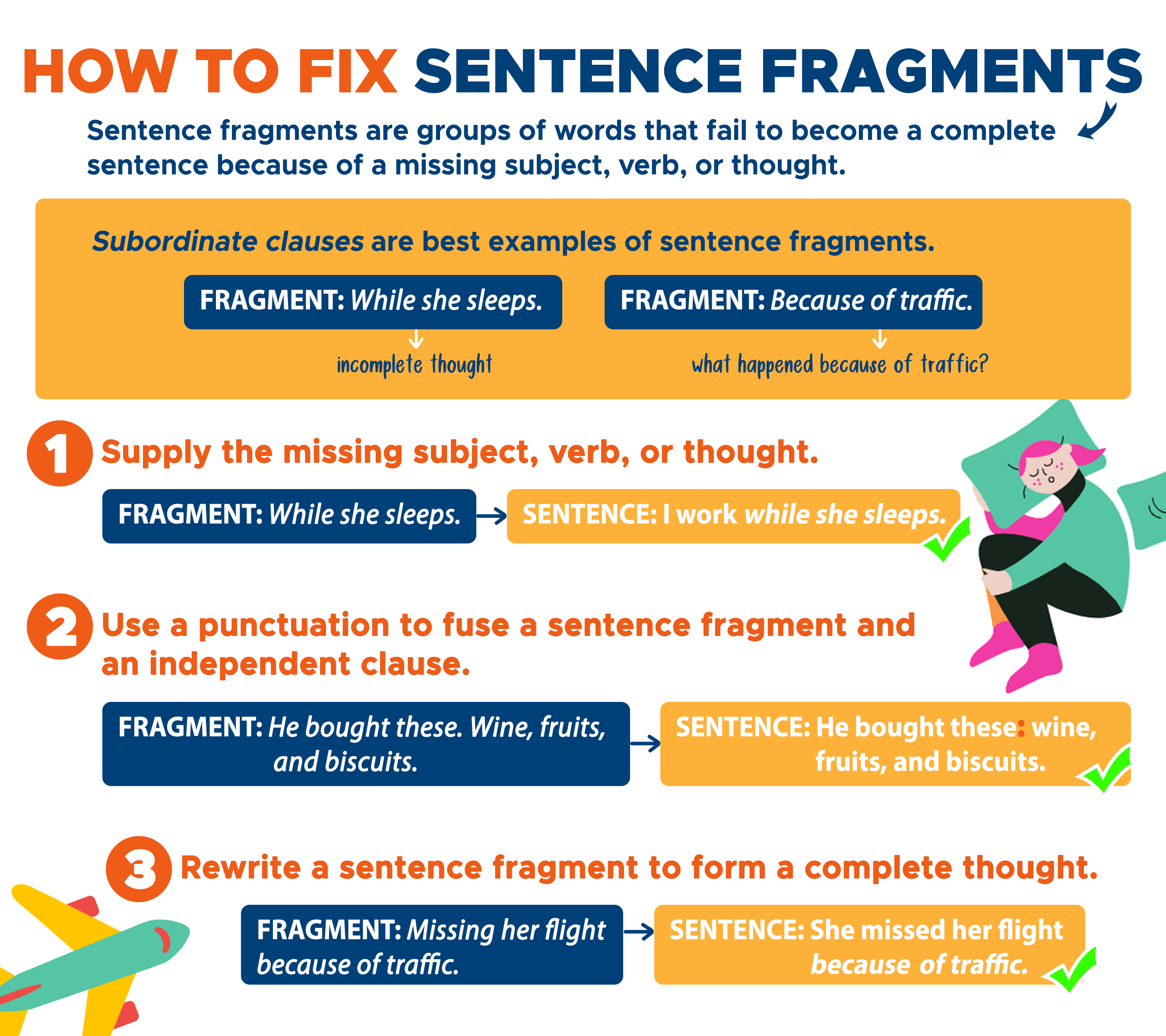
The key is to make sure your final sentence has a subject, a verb, and expresses a complete thought.
Let's try a quick practice. Look at the fragments on the left side of this image. What's missing from each one?

In "After the storm," we have a "when" but not a "what happened." In "Went to the store," we have a "what happened" but not a "who." The complete sentences on the right fix these problems by adding the missing information.
Your Turn: Practice Makes Perfect
Now it's time for you to become a fragment detective. The best way to learn is by doing.
Sentence Fragments & How to Fix Them | How to Write Complete Sentences | English Writing Essentials
Return to the "Sentence Fragments & How to Fix Them" video. The second half is an interactive quiz.
Watch the section from the practice quiz. For each of the seven examples, pause the video and try to decide if it's a fragment or a complete sentence. If it's a fragment, think about how you would fix it before the presenter gives the answer.
Creative Writing Task
Here are a few sentence fragments that might appear in a draft of a short story or monologue. Your task is to fix them. You can rewrite them in any way you like, as long as they become complete sentences.
- Fragment: Stood on the edge of the roof, looking down.
- Fragment: The old, dusty book on the table.
- Fragment: Although she knew it was a bad idea.
Take a moment to rewrite these. There are many possible correct answers!
...
Here are some possible ways to fix them:
- Correction: He stood on the edge of the roof, looking down. (Added a subject)
- Correction: The old, dusty book on the table was calling to me. (Added a verb/predicate)
- Correction: Although she knew it was a bad idea, she opened the door anyway. (Joined the dependent clause to an independent clause)
Your answers might be different, but as long as they are now complete sentences, you've successfully done the job!
Conclusion
Great work today! You've taken a big first step in strengthening your writing.
Here are the key takeaways from our lesson:
- A complete sentence must have a subject, a verb, and express a complete thought.
- A sentence fragment is an incomplete sentence because it's missing one of those key elements.
- We can fix fragments by adding the missing part (like a subject or verb) or by joining the fragment to a complete sentence.
In our next lesson, we'll look at the opposite problem: sentences that are too long because two or more ideas are mashed together without proper punctuation. These are called run-on sentences. You'll learn how to spot and fix them to give your writing even more clarity and rhythm.