Welcome back! In our last lesson, we looked at how to fix run-on sentences, and you learned that one of the best methods is to use a comma followed by a connecting word. Today, we're going to master those connecting words and use them to make your writing more powerful and engaging.
This lesson focuses on coordinating conjunctions. Instead of just using them to fix errors, you'll learn how to use them to combine short, choppy sentences into longer, more fluid ones. This skill is essential for creative writing, as it will help you control the rhythm of your sentences and make your stories and monologues sound more natural and sophisticated. By the end of our session, you'll be able to confidently combine short, choppy sentences using coordinating conjunctions.
Meet the FANBOYS
So, what are these magical connecting words? They are called coordinating conjunctions, and there are seven of them. A great way to remember them is with the mnemonic FANBOYS.
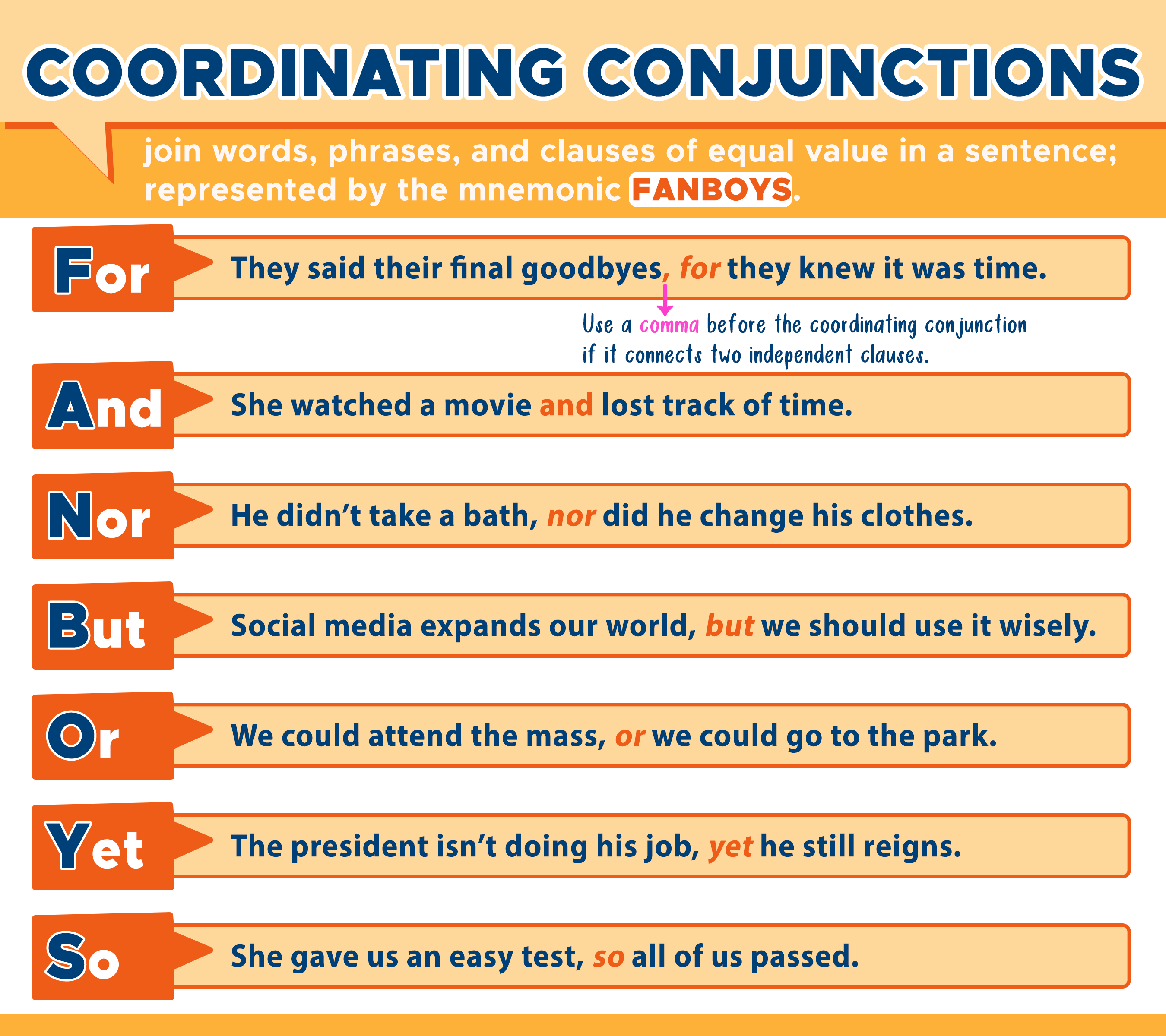
As the image shows, the FANBOYS are:
- For
- And
- Nor
- But
- Or
- Yet
- So
These conjunctions are used to join words, phrases, or clauses that are of equal importance or rank. Today, we'll focus on their most powerful use: connecting two complete sentences (independent clauses) to create a single, smooth-flowing sentence.
The Function of Each Conjunction
Each of the FANBOYS has a specific job. Understanding what each one does will help you choose the right word to connect your ideas. Let's watch a video that breaks down each one.
How to use Coordinating Conjunctions - FANBOYS - Write Better Sentences
This video, "How to use Coordinating Conjunctions - FANBOYS," gives clear explanations and examples for each of the seven conjunctions. We'll go through it step-by-step.
Watch the following segments to understand the specific role of each word: For: This shows a reason, much like the word "because". Watch the explanation from this section. (Example: I went inside, for it was starting to rain.) And: This adds one idea to another similar idea. Watch how it's used from this part. (Example: He finished his homework and went to play video games.) Nor: This adds another negative idea. It's a bit tricky because the word order changes. See the explanation from this segment. (Example: She doesn't enjoy horror movies, nor does she like thrillers.) But: This shows a contrast or a difference. Watch the examples from this part. (Example: I wanted to go to the party, but I was too tired.) Or: This presents a choice or an alternative. See how it works from this section. (Example: We could watch a movie, or we could just listen to music.) Yet: This shows a surprising contrast, similar to "but". Watch the explanation from this part. (Example: The car is old, yet it is very reliable.) So: This shows a result or consequence. Watch the final explanation from this segment. (Example: It was getting late, so we decided to go home.)
An important punctuation rule: When you use a FANBOYS conjunction to connect two complete sentences (independent clauses), you must put a comma before the conjunction.
- Correct: The sun was setting, so the sky turned orange.
- Incorrect: The sun was setting so the sky turned orange.
You can see this rule highlighted in the "Coordinating Conjunctions" image we looked at earlier.
Practice Time!
Now it's your turn to be the editor. The best way to learn is by doing. This next video is an interactive quiz. For each question, it will show you two sentences. Your job is to choose the best FANBOYS conjunction to combine them.
Practice using Coordinating Conjunctions - FANBOYS - Write Better Sentences
The video "Practice using Coordinating Conjunctions - FANBOYS" is a great way to test your understanding in a hands-on way.
For each question in the video, pause it and decide which conjunction fits best. Then, play the video to see the answer and explanation. Work your way through these exercises: First exercise: Books on a shelf Second exercise: Too much work Third exercise: Playing sports Fourth exercise: Turtles Fifth exercise: Dinner plans Sixth exercise: No fruit Seventh exercise: Picnic cut short
How did you do? Notice that sometimes, as with but and yet, more than one answer can be correct. The choice you make can subtly change the meaning of the sentence.
Creative Writing Task
Let's apply this to a creative context. Writing with only short, simple sentences can feel robotic.
- Example: I was tired. I went to bed. I couldn't sleep.
Combining them creates a much more natural flow.
- Example: I was tired, so I went to bed, but I couldn't sleep.
Your Task:
Imagine a character finding an old, dusty journal. Below are several short sentences describing the moment. Rewrite them as a single, well-flowing paragraph. Combine sentences where it feels natural, using at least three different FANBOYS conjunctions.
Choppy Sentences:
The attic was cold. It was also dark. I found the journal in a wooden chest. It was bound in leather. The pages were yellowed with age. I wanted to open it. I was afraid of what I might find.
Take a few minutes to combine these sentences into a short paragraph. Remember to use a comma before the conjunction when connecting two full sentences.
...
Sample Answer:
Here is one possible way to combine the sentences. Your version might be different, and that's perfectly fine!
The attic was cold and dark. I found the journal in a wooden chest, and it was bound in leather. The pages were yellowed with age, yet I wanted to open it. I was afraid of what I might find, but my curiosity was stronger.
See how combining sentences creates a better rhythm? This is a powerful tool for making your creative writing come alive.
Conclusion
Great work today! You've moved beyond simply fixing errors and are now learning to shape your sentences for style and impact. This is a huge step in developing your voice as a writer.
Here are the key takeaways from this lesson:
- Coordinating conjunctions (FANBOYS) connect ideas of equal importance.
- Each conjunction has a specific meaning: For (reason), And (addition), Nor (negative addition), But (contrast), Or (choice), Yet (surprising contrast), and So (result).
- Using them to combine short, choppy sentences makes your writing more fluid and sophisticated.
- Remember to use a comma before the FANBOYS when connecting two independent clauses.
In our next lesson, we will continue exploring how to connect ideas by looking at a different type of conjunction: subordinating conjunctions. These words, like although, because, and while, create more complex sentences by making one clause dependent on another.