Introduction
Welcome to the next stage of our MHT-CET preparation. In the previous lessons, we built a solid foundation in mathematical logic, learning to analyze and simplify logical statements. Now, we transition to a new, but equally important topic in this module: Matrices and Determinants. This area is fundamental to linear algebra and frequently appears in competitive exams.
Today's lesson focuses on a core concept: the determinant. A determinant is a unique number that can be calculated from any square matrix. We will explore how to compute this value using two primary methods. First, we will learn the fundamental, step-by-step process of cofactor expansion. Then, we will discover how to use the powerful properties of determinants to simplify calculations, a crucial skill for saving time in your MHT-CET exam.
What is a Determinant?
Before we can calculate a determinant, let's clarify what it is. For every square matrix (a matrix with an equal number of rows and columns), there exists a corresponding scalar value called its determinant. It's not just a random number; it encodes important information about the matrix, such as whether it's invertible and how it transforms space, which we'll explore in later lessons.
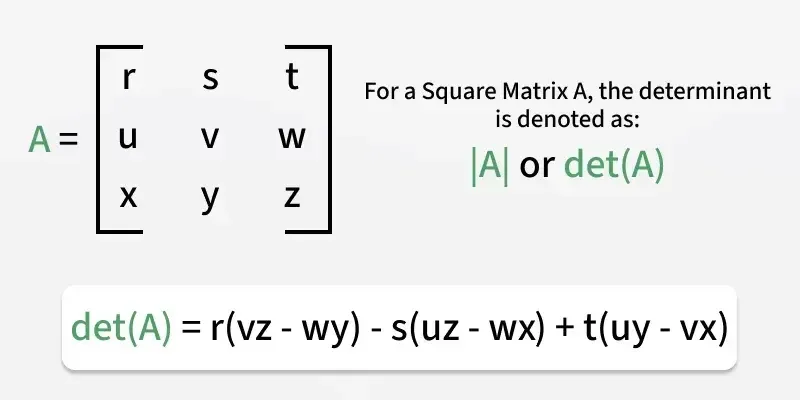
The determinant of a matrix A is denoted by det(A) or, more commonly, by placing vertical bars around the matrix, like |A|.
This article from GeeksforGeeks provides a concise introduction to the concept of a determinant.
Read the introductory section, starting from the definition and paying attention to the notation. Notice the key point that determinants are defined only for square matrices.
The image below shows the standard notation for the determinant of a 3x3 matrix and the final formula for its calculation, which we are about to derive.
Method 1: Cofactor Expansion
The most fundamental way to calculate a determinant is through a recursive process called cofactor expansion (or Laplace expansion). This method breaks down the determinant of a large matrix into smaller, more manageable ones.
The Base Case: 2x2 Determinants
The process starts with the simplest square matrix, the 2x2 matrix. Its determinant is found by a simple cross-multiplication and subtraction.
For a matrix , the determinant is:
Determinants – Notes, Topics, Formulas, Equations, Books, Question & Answers
This resource from Careers360 provides clear formulas and examples for calculating determinants.
Focus on the section Calculating the Determinant of a 2x2 Matrix. Review the formula and the worked-out numerical example to solidify your understanding.
Building Blocks: Minors and Cofactors
To handle matrices larger than 2x2, we need two key concepts: minors and cofactors.
- Minor (): The minor of an element is the determinant of the sub-matrix that remains after deleting the -th row and -th column.
- Cofactor (): The cofactor is a signed minor. It is calculated as .
The term creates a "checkerboard" pattern of signs. For a 3x3 matrix, the signs are:
This video provides an excellent visual explanation of minors, cofactors, and how they lead to the full determinant calculation.
The Cofactor Definition of Determinants (Laplace Expansion Explained) | Linear Algebra
This video from Wrath of Math, titled "The Cofactor Definition of Determinants," clearly breaks down the core concepts.
First, watch the section explaining minors and cofactors. This will help you understand the definitions with a clear example. Next, watch the segment that introduces the general definition of the determinant using cofactor expansion. Notice that you can expand along any row or any column.
The Expansion Process
With cofactors defined, the determinant of any matrix can be found by picking any single row or column, multiplying each element in it by its corresponding cofactor, and summing the results.
- Expansion along row :
- Expansion along column :
Let's see this in action for a 3x3 matrix.
The Cofactor Definition of Determinants (Laplace Expansion Explained) | Linear Algebra
Now, let's apply the theory. This part of the same video walks through a full 3x3 determinant calculation.
Watch the entire segment from this example calculation. The instructor first calculates the determinant by expanding along the first row. Then, to prove the method's flexibility, he recalculates it by expanding along the second column and gets the same result. Pay attention to the strategic choice of expanding along a row or column containing a zero to simplify the calculation.
This recursive process can be extended to any size. For example, the determinant of a 4x4 matrix is found by breaking it down into four 3x3 determinants.

Method 2: Using Properties of Determinants
While cofactor expansion always works, it can be slow. For competitive exams like the MHT-CET, using the properties of determinants is often a much faster way to solve problems. These properties allow you to simplify a determinant before you calculate it.
Here are the most important properties you need to know.
This GeeksforGeeks article provides a comprehensive list of determinant properties.
Read the section Properties of Determinants carefully. Focus on understanding each property: Reflection Property (|A| = |A^T|) Switching Property (swapping rows/columns changes the sign) Repetition/Proportionality Property (identical rows/columns make the determinant zero) Scalar Multiplication Property (|kA| = k^n|A| and how it applies to a single row/column) Sum Property (splitting a determinant) Multiplicative Property (|AB| = |A||B|)
One of the most powerful techniques is to use row or column operations (R_i → R_i + kR_j or C_i → C_i + kC_j) to introduce zeros into a row or column. These operations do not change the value of the determinant. Once you have a row or column with mostly zeros, you can use cofactor expansion on it, and most of the terms will vanish.
Let's see an example of this simplification in action.
Determinants – Notes, Topics, Formulas, Equations, Books, Question & Answers
This resource contains solved problems. We will analyze one that effectively uses properties.
Focus on Question 3, which involves a determinant with trigonometric functions. Observe how the row operations R2 -> R2 - R1 and R3 -> R3 - R1 are used. This transforms a complicated-looking determinant into one with two zeros in the first column, making the final expansion trivial. This demonstrates how properties can save a huge amount of work.
MHT-CET Problem-Solving Context
In the MHT-CET, you will often encounter questions that test your knowledge of these properties directly, rather than just asking for a brute-force calculation. Let's watch a video that solves some exam-style problems.
🚨 MHTCET 2026: Matrices PYQ's and IMPORTANT Questions for Exam #mhtcet2026
This video from PW MHT CET tackles previous year questions, showcasing exam-relevant properties.
Please watch the following two key problem explanations: First, a very common property test is shown from this segment. The instructor explains a crucial theorem: summing the product of elements of a row/column with their own cofactors gives the determinant, but summing them with cofactors from a different row/column results in zero. Memorize this rule. Next, watch the problem from this segment. It uses the property relating the determinant of a matrix to the determinant of its adjoint: |\text{adj}(A)| = |A|^{n-1}, where n is the order of the matrix. This is another high-yield formula for your exams.
Practice Problem
Now it's your turn. Use the method you find most efficient (cofactor expansion or properties) to evaluate the determinant of the following matrix:
Try to solve it, and then check your answer below.
Click for solution
Let's solve this using cofactor expansion. It's wise to expand along a row or column with a zero. Let's choose the first column.
The elements are .
The sign pattern for the first column is +, -, +.
We don't need to calculate since it's multiplied by 0.
-
Calculate :
-
Calculate :
-
Combine the results:
The determinant of matrix B is 1.
Conclusion
In this lesson, we have laid the groundwork for our study of matrices by focusing on the determinant. You've learned the fundamental mechanical skill of cofactor expansion and the more strategic, efficient approach of using properties of determinants for simplification. For the MHT-CET, both are essential: cofactor expansion is the fallback method that always works, while mastering the properties will give you the speed and insight needed to solve problems quickly.
We will continue to build on these concepts. In our next lesson, we will delve into matrix algebra, covering operations like addition, scalar multiplication, and matrix multiplication. Understanding determinants will be crucial when we later discuss matrix inverses and solving systems of linear equations.