Introduction
In our previous lesson, we explored the concept of the determinant, a unique scalar value associated with every square matrix. You learned how to calculate it using cofactor expansion and how to simplify calculations using its properties. Now, we shift our focus from finding a single value to performing algebraic operations with the matrices themselves.
This lesson addresses the core of matrix manipulation: matrix algebra. We will cover the four fundamental operations: addition (and subtraction), scalar multiplication, transposition, and the crucial operation of matrix multiplication. Mastering these procedures is essential, as they form the building blocks for solving more complex problems, such as finding matrix inverses and solving systems of linear equations, which we will tackle in the upcoming lessons. These skills are fundamental for your MHT-CET preparation.
Getting Started: Types of Matrices and Basic Operations
Before we dive into the operations, it's helpful to be familiar with the basic terminology. A matrix is defined by its order (number of rows × number of columns). We have special names for certain types, like row matrices, column matrices, and square matrices.
For a quick refresher on these basic definitions, you can review the first page of the document "Matrices Notes".
This PDF from Maths.scot provides clear, formal definitions of matrix types and operations.
Read the section "Basic Definitions" on pages 1-2. Pay attention to the definitions of order, row/column matrix, square matrix, and the identity matrix.
Matrix Addition, Subtraction, and Scalar Multiplication
The simplest matrix operations are performed element by element.
- Addition and Subtraction: To add or subtract two matrices, they must have the same order. You simply add or subtract the corresponding elements. For example, the element in the first row and first column of the resulting matrix is the sum (or difference) of the elements in the first row and first column of the original matrices.
- Scalar Multiplication: To multiply a matrix by a scalar (a single number), you multiply every single element in the matrix by that scalar.
This is a key difference from determinants. Recall from our last lesson that if you multiply a matrix of order by a scalar , the new determinant is . For matrix scalar multiplication, the scalar simply distributes to every element.
The following short video provides a clear visual demonstration of these basic operations.
Linear Algebra - Matrix Operations
This video from Postcard Professor, titled "Linear Algebra - Matrix Operations", concisely illustrates the element-wise nature of these operations.
Watch the segment explaining addition and subtraction. Notice how the matrices must have the same shape for the operation to be possible.
For formal definitions and worked examples, you can refer back to the "Matrices Notes" PDF.
This section of the PDF formally defines and illustrates these three basic operations.
Read the section Addition, Subtraction and Scalar Multiplication on pages 3-5. Follow the examples to see how these operations are applied.
The Transpose of a Matrix
Transposition is a simple but powerful operation that flips a matrix over its main diagonal. The rows of the original matrix become the columns of the transposed matrix, and vice versa. The transpose of a matrix is denoted as or .
If an matrix is transposed, the resulting matrix will have the order .
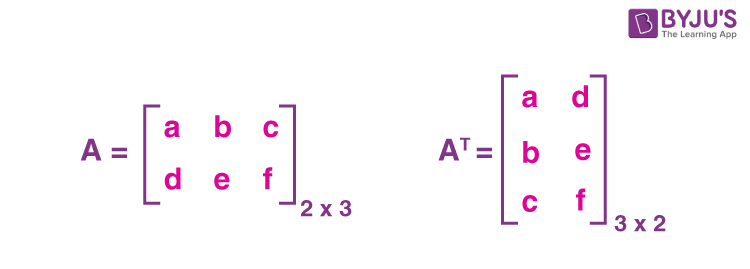
The transposition operation has some important properties that are frequently used in problems:
- (Transposing twice returns the original matrix).
- (Note the reversal of order for products, a crucial property).
Let's look at the formal definition in our notes.
Find the definition of the transpose on page 7 and review the accompanying example.
Matrix Multiplication: The Main Event
Matrix multiplication is the most complex of the fundamental operations and has rules that are very different from ordinary number multiplication.
Conditions and Dimensions
You can only multiply two matrices, say , if the number of columns in the first matrix () is equal to the number of rows in the second matrix ().
If is an matrix and is an matrix, the product is possible, and the resulting matrix will have the order .
The Process
To find the element in the -th row and -th column of the product matrix , you take the dot product of the -th row of and the -th column of . This means you multiply corresponding elements and then sum the results.
This process is best understood visually. The following video provides an excellent, step-by-step walkthrough of a matrix multiplication problem.
Linear Algebra - Matrix Operations
This segment from "Linear Algebra - Matrix Operations" breaks down the row-by-column multiplication process.
Watch the section on multiplication carefully. Pay close attention to how the instructor matches a row from the first matrix with a column from the second matrix to calculate each single element of the final matrix.
Key Properties of Matrix Multiplication
Matrix multiplication has several properties you must know for your exams. Unlike regular multiplication, it is not commutative in general, meaning .
The GanitAnk video for MHT-CET provides a great overview of these properties in a very exam-relevant context.
Matrices 01 | MHTCET 2025 | Beta 4.0#mhtcet #mhtcet2025 #livestream #live #matrices #matricesclass12
This video, made specifically for MHT-CET, explains the mechanics and properties of matrix multiplication.
Watch the segment from Multiplication of two matrices. The instructor clearly explains the conditions, the process, and then discusses crucial properties like A^2, A^3, the role of the identity matrix I, and the expansion of (A+B)^2.
Application in MHT-CET Problems
In the MHT-CET, you won't just be asked to multiply two matrices. The questions will involve applying these operations to solve problems, often involving matrix polynomials or finding high powers of a matrix.
Matrix Polynomials
A common question type asks you to verify or solve an equation involving a matrix, such as finding a value if , where is the identity matrix and is the zero matrix. To solve this, you first calculate , then substitute all the matrices into the equation and solve for the unknown by comparing a single corresponding element across all matrices.
Let's see a worked example.
Matrices 01 | MHTCET 2025 | Beta 4.0#mhtcet #mhtcet2025 #livestream #live #matrices #matricesclass12
The "GanitAnk" video solves a classic MHT-CET problem of this type.
Watch the problem explained from this segment. Notice the strategy: instead of working with the full matrices, the instructor isolates a single element's position (e.g., first row, second column) across the entire equation to quickly find the value of k. This is a vital time-saving technique.
High Powers and Shortcuts ("Jugaad")
Sometimes, questions ask for or . Brute-force multiplication is not feasible. The trick is to calculate , , and look for a pattern. For MHT-CET, there are also powerful shortcuts for specific types of matrices.
The GanitAnk video introduces two invaluable shortcuts.
Matrices 01 | MHTCET 2025 | Beta 4.0#mhtcet #mhtcet2025 #livestream #live #matrices #matricesclass12
This part of the video is dedicated to shortcuts ("jugaad") that can save you a lot of time in the exam.
First, watch the shortcut for diagonal matrices. For a diagonal matrix, finding a power is as simple as raising each diagonal element to that power. Next, watch the extremely useful shortcut for trigonometric matrices of the form \begin{pmatrix} \cos\alpha & \sin\alpha \\ -\sin\alpha & \cos\alpha \end{pmatrix}. To find A^n, you simply multiply the angle \alpha by n. This trick is tested frequently.
Let's see this trigonometric shortcut applied to a real JEE Main question, which is very similar in style to what you might see in MHT-CET.
Matrices 01 | MHTCET 2025 | Beta 4.0#mhtcet #mhtcet2025 #livestream #live #matrices #matricesclass12
Now, let's see the trigonometric shortcut in action on an exam problem.
Watch the solution to this problem from this section. The problem asks to find \alpha given A^{32}. Using the shortcut, A^{32} is found instantly, and the rest is just solving a simple trigonometric equation.
Conclusion
In this lesson, you have learned the four essential operations of matrix algebra: addition, scalar multiplication, transposition, and multiplication. We emphasized the specific conditions required for each operation and highlighted key properties, especially the non-commutative nature of matrix multiplication. Crucially, you've seen how these concepts are applied in MHT-CET style problems, including matrix polynomials and shortcuts for finding high powers.
These algebraic skills are the foundation for what's next. In our upcoming lesson, we will use matrix multiplication to understand and compute the inverse of a square matrix using the adjoint method, a process that is critical for solving systems of linear equations.