Introduction
In our last lesson, we established the building blocks of mathematical logic: statements, connectives, and truth tables. You learned how to meticulously construct truth tables to determine the final truth value of any compound statement. While this method is foolproof, you can probably appreciate that for statements with three or more variables, creating a table with 8, 16, or more rows becomes tedious and time-consuming—a luxury you don't have in a competitive exam like the MHT-CET.
Today, we'll build upon that foundation by learning a more powerful and efficient approach. This lesson focuses on logical equivalence. We will explore a set of fundamental rules, known as the "algebra of statements," including the very important De Morgan's laws. Mastering these rules will allow you to simplify and analyze complex logical expressions quickly, much like how you use algebraic rules to simplify mathematical expressions, without having to resort to a full truth table every time.
What is Logical Equivalence?
Two statement patterns are said to be logically equivalent if they have the exact same truth values for all possible combinations of truth values of their simple components. In other words, their truth tables have identical final columns. We denote logical equivalence with the symbol ≡.
For example, in the last lesson, we saw that the truth table for p → q is identical to the one for its contrapositive, ~q → ~p. Therefore, we can write:
This is a fundamental equivalence you should commit to memory.
Knowing these equivalences allows you to substitute one expression for another, which is the key to simplifying statement patterns.
The Algebra of Statements: Your Simplification Toolkit
Just as algebra has rules for manipulating numbers and variables, mathematical logic has laws for manipulating statements. These laws are the tools you'll use to simplify expressions.
A great way to get a quick, clear overview of these laws is by watching the following video. The instructor provides excellent explanations and analogies.
LOGIC LAWS - DISCRETE MATHEMATICS
This video from TrevTutor introduces the core laws of logic, explaining the intuition behind each one.
Please watch the following segments: Start with the Identity and Domination laws. Pay very close attention to the next segment on Double Negation and De Morgan's Law. De Morgan's law is one of the most frequently tested concepts. Continue with the Distributive and Absorption laws. The analogy to arithmetic multiplication and addition for the distributive law is particularly helpful. Finally, review the Commutative, Associative, Inverse, and Conditional laws.
To consolidate what you've just watched and have a ready reference, here is a list of the most important laws from the Target Publications guide.
Microsoft Word - 01 Mathematical logic
This document provides a concise summary of all the essential laws of logic required for the MHT-CET.
In the "Chapter at a glance" section, find the heading "Algebra of statements". Review this list carefully. Notice the names of the laws (Commutative, Associative, Distributive, De Morgan's, etc.) and their corresponding formulas.
A Closer Look at De Morgan's Laws
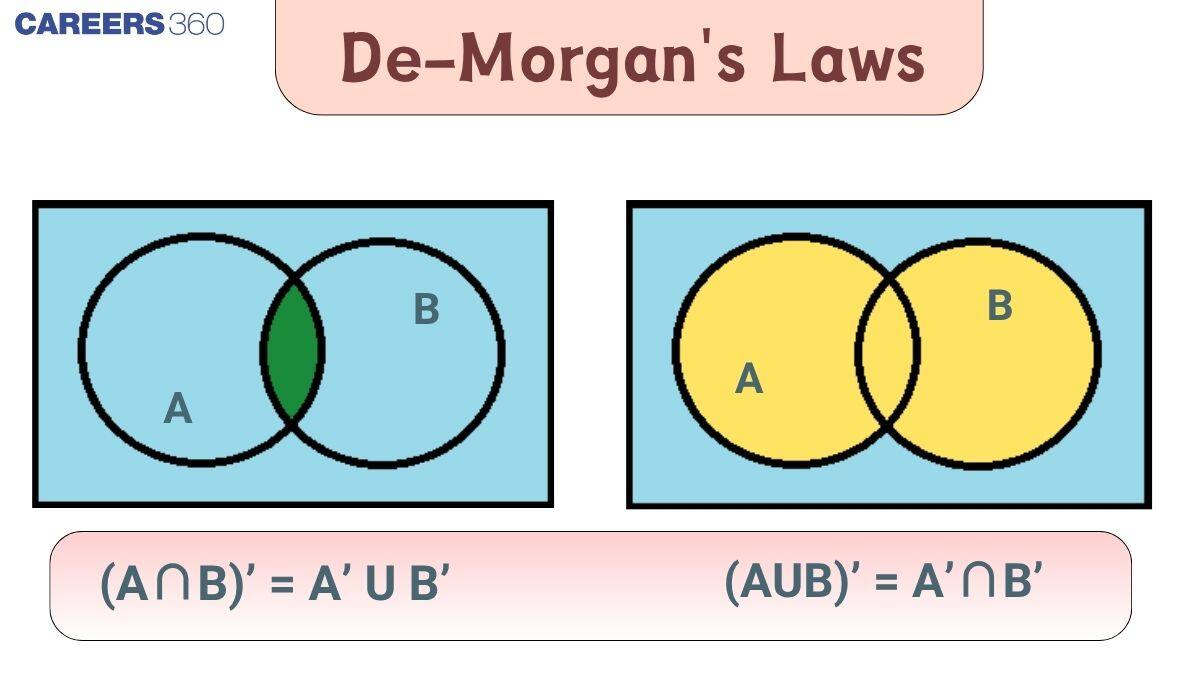
De Morgan's laws are crucial for simplifying negations. They tell you how to distribute a negation ~ over a conjunction ∧ or a disjunction ∨.
The two laws are:
~(p ∧ q) ≡ ~p ∨ ~q(The negation of an "and" is an "or" of the negations)~(p ∨ q) ≡ ~p ∧ ~q(The negation of an "or" is an "and" of the negations)
A simple way to remember this is: "Break the line, change the sign." You distribute the ~ to p and q, and you flip the connective (∧ becomes ∨, and ∨ becomes ∧).
This principle has a direct parallel in set theory, which can help you visualize it.
Applying the Laws: Simplification and Negation
Now, let's see how to use these laws in practice. The goal is to take a complicated expression and, step by step, apply the laws to make it simpler.
Example 1: Simplifying an Expression
Let's prove the equivalence (p ∨ q) ∧ (~p ∧ ~q) ≡ F (a contradiction) without a truth table.
(p ∨ q) ∧ (~p ∧ ~q)(Starting expression)≡ (p ∨ q) ∧ ~(p ∨ q)(Applying De Morgan's Law to the second part)- Let
S = (p ∨ q). The expression is nowS ∧ ~S. ≡ F(Applying the Complement/Inverse Law, which statesS ∧ ~Sis always a contradiction)
This is much faster than constructing an 8-row truth table.
The following resource walks through several examples of proving logical equivalences step-by-step.
[PDF] Maharashtra Board Solutions Class 12 Maths Chapter 1 - Vedantu
This PDF from Vedantu shows how to construct proofs of equivalence using the algebra of statements.
Focus on "Exercise 1.4", question 3, titled "Without using truth table prove that". Study the four worked-out solutions. For each step, identify which law (Distributive, Conditional, Complement, etc.) is being used. This will build your fluency in applying the rules.
Example 2: Negating Compound Statements
A very common MHT-CET question type asks for the negation of a given compound statement. This is a direct application of the laws we've learned, especially De Morgan's and the negation rules for conditionals.
Key Negation Rules to remember:
~(p ∧ q) ≡ ~p ∨ ~q~(p ∨ q) ≡ ~p ∧ ~q~(p → q) ≡ p ∧ ~q(This one is crucial!)~(p ↔ q) ≡ (p ∧ ~q) ∨ (q ∧ ~p)
Let's watch how to solve a typical MHT-CET problem involving negation.
MHT-CET 2026 | Mathematical Logic Previous Year Questions (2004–2020) | Part-1
This video from Modx4Maths specifically tackles MHT-CET previous year questions, demonstrating the exact techniques you need.
Watch these two key examples: First, watch the segment on negating a conditional statement. The instructor clearly explains the rule ~(A → B) ≡ A ∧ ~B and applies it to a complex problem. Next, see how laws are used for simplification in the example from simplifying with distributive property. This shows how to recognize patterns and apply laws like Distributive and Commutative to quickly arrive at the answer.
Practice Problem
Now it's your turn. Use the algebra of statements to simplify the following expression, which was question 26 in the LINK resource.
Problem: The Boolean Expression (p ∧ ~q) ∨ q ∨ (~p ∧ q) is equivalent to:
(A) p ∧ q
(B) p ∨ q
(C) p ∨ ~q
(D) ~p ∧ q
Try to solve it step-by-step, stating the law you use at each stage.
Click here to see the solution
Let's simplify the expression (p ∧ ~q) ∨ q ∨ (~p ∧ q).
Step 1: We can reorder the terms using the Associative and Commutative Laws. Let's group the terms with q together.≡ (p ∧ ~q) ∨ (q ∨ (~p ∧ q))
Step 2: Let's focus on the part in the parenthesis: q ∨ (~p ∧ q). We can use the Commutative law on ~p ∧ q to make it q ∧ ~p.≡ q ∨ (q ∧ ~p)
Step 3: This now fits the pattern of the Absorption Law: A ∨ (A ∧ B) ≡ A. Here, A is q and B is ~p.
So, q ∨ (q ∧ ~p) ≡ q.
Step 4: Substitute this simplified result back into the main expression.
The original expression becomes (p ∧ ~q) ∨ q.
Step 5: Now we apply the Distributive Law: (A ∧ B) ∨ C ≡ (A ∨ C) ∧ (B ∨ C).≡ (p ∨ q) ∧ (~q ∨ q)
Step 6: Look at the second bracket, (~q ∨ q). This is the Complement/Inverse Law. A statement OR its negation is always true (a tautology, T).≡ (p ∨ q) ∧ T
Step 7: Finally, apply the Identity Law: A ∧ T ≡ A.≡ p ∨ q
Conclusion: The expression simplifies to p ∨ q. Therefore, the correct option is (B).
Conclusion
In this lesson, you've moved beyond the manual labor of truth tables and into the more elegant and efficient world of logical algebra. You learned what it means for statements to be logically equivalent and how to use the fundamental laws—Commutative, Associative, Distributive, Identity, and especially De Morgan's Laws—to simplify complex statements and find their negations. This skill is not just a theoretical exercise; it's a practical tool that will save you valuable time and help you solve MHT-CET problems with confidence and accuracy.
We have now covered the core concepts of Mathematical Logic. In the next lesson, we will shift gears to the second topic in this module: Matrices and Determinants. We will begin by learning how to evaluate determinants, a foundational skill for solving systems of linear equations and understanding matrix properties.