Welcome back! In our previous session, we established the fundamental equations for lines and planes in 3D space. We saw that a line is defined by a point and a parallel direction vector , while a plane is defined by a point and a perpendicular normal vector . These vectors are the key to understanding the orientation of lines and planes.
Today, we will build directly on that knowledge. Your learning objective is to calculate the angle between two lines, two planes, or a line and a plane. We will see how the dot product, a familiar tool from vector algebra, allows us to use these defining vectors ( and ) to find the angles between these geometric figures. This skill is a cornerstone of 3D geometry and frequently tested in exams like the MHT-CET.
1. Angle Between Two Lines
The most straightforward case is finding the angle between two intersecting lines. The angle between the lines is simply the acute angle between their respective direction vectors.
Let's consider two lines with vector equations:
- Line 1:
- Line 2:
Here, and are the direction vectors. If is the angle between the lines, it is also the angle between and . From the definition of the dot product, we know:
Rearranging this gives us the formula for the angle:
In Cartesian form, if the direction ratios of the lines are and , the formula becomes:
Two important conditions arise from this:
- Perpendicular Lines: If the lines are perpendicular, , so . This implies , or .
- Parallel Lines: If the lines are parallel, their direction vectors are proportional, meaning for some scalar . This means .
For a formal summary of these formulas, you can review the following text.
"Three Dimensional Geometry – Notes, Topics, Formulas, Equations ...
This section from the Careers360 guide provides a clear and concise presentation of the formulas for the angle between two lines in both vector and Cartesian forms.
Focus on the subsections titled Vector Form and Cartesian Form. Pay attention to how the direction vectors/ratios are extracted from the standard line equations to be used in the dot product formula.
2. Angle Between Two Planes
As you learned in the last lesson, the normal vector defines a plane's orientation. Logically, the angle between two planes is defined as the angle between their normal vectors.
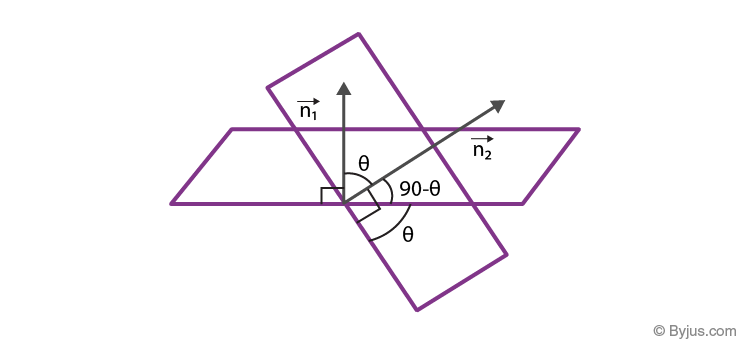
Given two planes:
- Plane 1: or
- Plane 2: or
The normal vectors are and . The formula for the angle between the planes is identical in structure to the one for lines, but uses the normal vectors:
We use the absolute value (modulus) because the angle between planes is conventionally taken as the acute angle.
The video below provides an excellent, step-by-step walkthrough of a typical problem.
How To Find The Angle Between Two Planes
This video from The Organic Chemistry Tutor demonstrates how to calculate the angle between two planes starting from their Cartesian equations.
Watch the video from the beginning. Follow the process: Identify the normal vectors from the plane equations. Calculate the dot product of the normal vectors. Calculate the magnitude of each normal vector. Substitute these values into the cos θ formula. Find the angle using arccos. The instructor also clearly explains why there are two angles (an acute and an obtuse one) and how they relate.
3. Angle Between a Line and a Plane
This case is slightly different and requires careful thought. The angle between a line and a plane, denoted by , is the angle between the line and its projection onto the plane. It is not the angle between the line's direction vector and the plane's normal vector.
Instead, we first find the angle between the line's direction vector and the plane's normal vector . Let's call this angle .
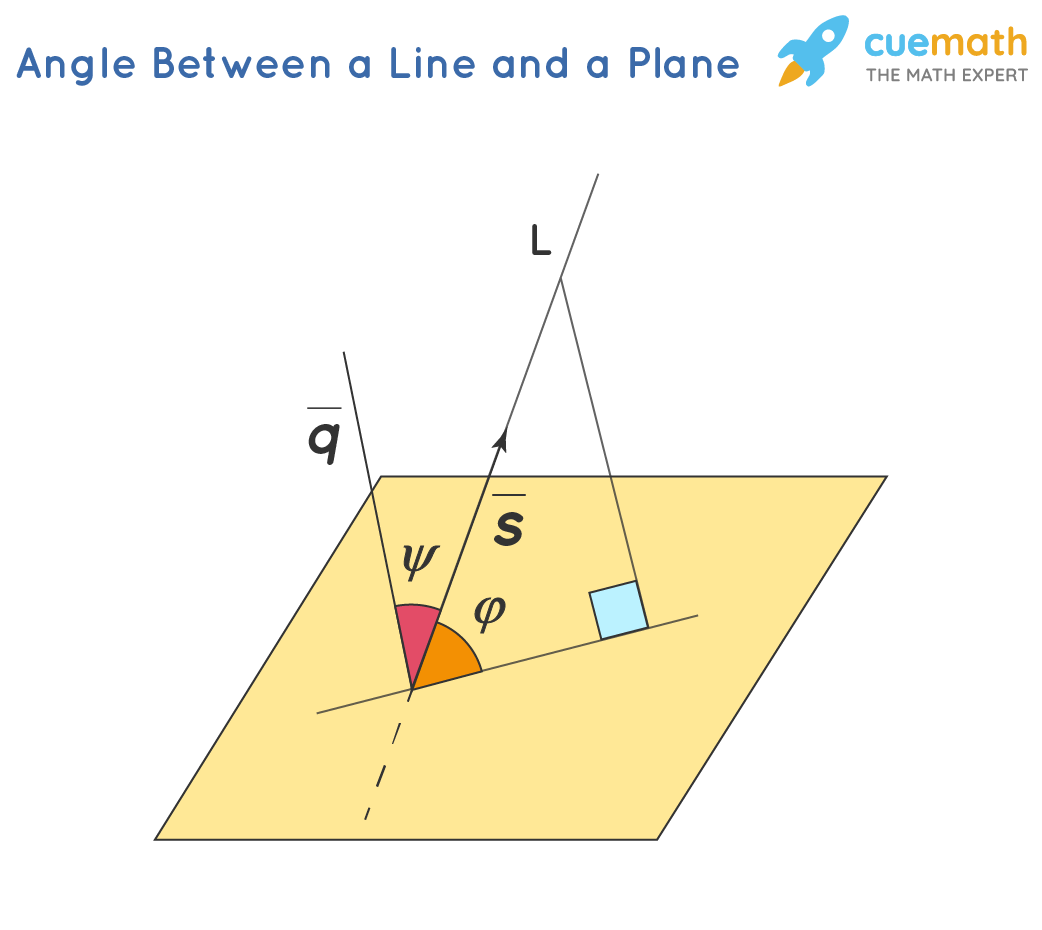
From the geometry, the angle we want () and the angle we can easily calculate () are complementary:
We know how to find using the dot product:
Using trigonometry, since , we have . This gives us the final formula:
In Cartesian form, for a line with direction ratios and a plane , this is:
Notice the key difference: for the angle between a line and a plane, we use sine, not cosine.
The following resource clearly defines this relationship.
11.6 Lines and Planes in Three Dimensions
This PDF from Contemporary Calculus provides a concise explanation of how angles involving planes are calculated.
Read the short section titled Angles of Intersection. It explicitly states that the angle between a line and a plane is \pi/2 minus the angle between the line and the normal vector.
Conclusion
In this lesson, you've learned to leverage the direction and normal vectors to measure the relationships between lines and planes. The dot product remains your primary computational tool throughout.
Here are the key takeaways:
- Angle between two lines: Use the cosine of the angle between their direction vectors and .
- Angle between two planes: Use the cosine of the angle between their normal vectors and .
- Angle between a line and a plane: Use the sine of the angle, calculated from the dot product of the line's direction vector and the plane's normal vector .
Mastering which vectors to use ( or ) and which trigonometric function to apply (cos or sin) is essential.
In our next lesson, we will continue exploring the geometry of lines by tackling another classic problem: calculating the shortest distance between two skew lines.