In our previous lesson, we explored how to determine the angle between lines and planes using their direction and normal vectors, with the dot product as our main tool. We will now extend our study of the relationships between lines in 3D space by addressing a scenario unique to three dimensions.
Today's objective is to compute the shortest distance between two skew lines. Skew lines are pairs of lines that are not parallel but also never intersect. Imagine two planes, one above the other, and draw a line on each; unless these lines are parallel, they are skew. We will develop the formulas to find the length of the unique line segment that is perpendicular to both skew lines, representing the shortest possible distance between them. This involves combining the cross product and dot product into a powerful tool called the scalar triple product.
1. Understanding Skew Lines
Before we can calculate distances, we must first be able to visualize and define skew lines. Intersecting lines and parallel lines are both coplanar, meaning they can lie on the same flat surface. Skew lines are non-coplanar.
This introductory section from your NCERT textbook formally defines skew lines and provides a helpful visual analogy using the diagonals of a room.
Read the initial paragraphs of section 11.5, titled Shortest Distance between Two Lines. Focus on the distinction between parallel, intersecting, and skew lines.
The Khan Academy video below offers another excellent way to visualize this concept.
Distance between skew lines (intuition) | 3D Geometry | Grade 12 | Math | Khan Academy
This video from Khan Academy provides an intuitive explanation of what skew lines are and what the 'shortest distance' between them represents.
Watch the first part of the video from the beginning. The presenter uses a simple analogy of a line on a screen and another line passing through it to help you visualize non-coplanar lines and the unique perpendicular segment that connects them.
2. The Shortest Distance Formula (Vector Form)
The shortest distance between two skew lines is the length of the line segment that is perpendicular to both. Let's find a formula for this distance.
Consider two skew lines given by the vector equations:
- Line :
- Line :
Here, and are position vectors of points on the lines, and and are their direction vectors.
The logic proceeds in two steps:
- Find a common perpendicular direction: A vector that is perpendicular to both lines (and thus to their direction vectors and ) is given by their cross product, . The line of shortest distance is parallel to this vector .
- Project a connecting vector: Take a vector connecting any point on to any point on . The simplest one to use is . The shortest distance is the length of the projection of this connecting vector onto the common perpendicular direction .
The projection of a vector onto a vector is given by . Applying this, the shortest distance is:
The numerator is the absolute value of the scalar triple product of , , and .
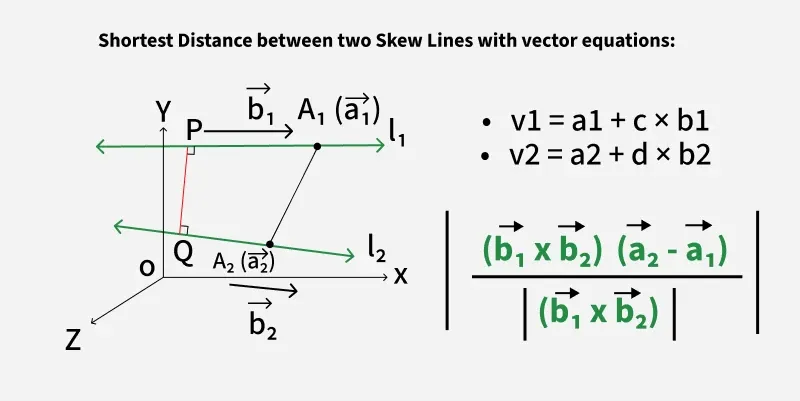
The following reading formally derives this result.
This section of the NCERT text walks through the derivation using the concept of vector projection and also provides a summary of the final formula.
In section 11.5.1, read the part titled Distance between two skew lines to see the formal derivation. Then, look at the "Summary" section at the end of the chapter to review the final formula.
3. The Shortest Distance Formula (Cartesian Form)
If the lines are given in Cartesian form:
- Line :
- Line :
The vector formula can be translated. The scalar triple product is equivalent to the determinant:
The magnitude of the cross product is:
Combining these gives the rather large, but systematic, Cartesian formula for the shortest distance .
Worked Example: Applying the Formulas
Let's apply these formulas to a typical problem. Consider finding the shortest distance between the lines:
- :
- :
The following resource provides a meticulous, step-by-step solution using both the Cartesian and Vector methods. This is an excellent way to see the formulas in action.
Find shortest distance between lines - 3D Geometry (Vector, Cartesian)
This guide from Teachoo.com solves the exact problem stated above, clearly demonstrating how to extract the required points and direction ratios/vectors and substitute them into the formulas.
First, follow the steps under Cartesian method. Observe how the values for x_1, y_1, z_1, a_1, b_1, c_1 etc., are identified and used to calculate the determinant and the denominator. Next, review the Vector method. See how the same Cartesian equations are converted to vector form to find \vec{a}_1, \vec{a}_2, \vec{b}_1, \vec{b}_2 and then used in the vector formula. Notice that both methods yield the same result: 2\sqrt{29}.
4. An Alternative Method: Finding the Points of Closest Approach
Sometimes, a problem may ask not just for the distance, but also for the coordinates of the points on each line that are closest to each other, or for the equation of the line of shortest distance itself. The direct formula method doesn't give us this information.
A more versatile (though longer) method involves finding these points directly using the perpendicularity condition. The video below explains this process clearly.
How to find Shortest Distance, Equation of Line of Shortest Distance, Coordinates of the point.
This video by 'dy by dx' demonstrates a powerful method to find not just the shortest distance, but also the points and the line of shortest distance.
Watch the video, paying close attention to the following key steps applied to a new example problem: General Points: Watch how general coordinates for points on each line are written using parameters \lambda and \mu. (Watch this step) Direction Ratios: See how the direction ratios of the line segment connecting these two general points are calculated. (Watch this step) Perpendicularity Condition: This is the crucial part. The line of shortest distance is perpendicular to BOTH original lines. The dot product of their direction ratios is therefore zero. This creates a system of two linear equations in \lambda and \mu. (Watch this step) Finding Coordinates & Distance: Once \lambda and \mu are solved, they are substituted back to find the exact coordinates of the endpoints of the shortest distance segment. The distance can then be found using the standard distance formula. (Watch this step) You can also see how to find the equation of the line of shortest distance itself. While this method is more involved, it is extremely powerful and can solve a wider range of problems you might encounter in the MHT-CET.
Conclusion
In this lesson, we focused on one of the most classic problems in 3D geometry: the shortest distance between skew lines. You now have two effective methods to tackle this.
Key Takeaways:
- Skew lines are non-coplanar lines that are neither parallel nor intersecting.
- The shortest distance is the length of the segment that is mutually perpendicular to both lines.
- Formula Method (Vector): . This is fast if you only need the distance.
- Formula Method (Cartesian): This involves calculating a 3x3 determinant for the numerator and the magnitude of the cross product for the denominator.
- General Point Method: This involves parameterizing points on both lines and using the perpendicularity condition (dot product = 0) to solve for the parameters. This method is more versatile as it can also find the coordinates of the endpoints and the equation of the shortest distance line.
In our next lesson, we will round out our study of distances in 3D space by learning how to calculate the distance of a point from a plane and the distance between two parallel planes.