Hello! In our last lesson, we focused on defining lines in 3D space using a point and a parallel direction vector. This gave us powerful tools like the vector equation and the Cartesian form. Today, we shift our focus from one-dimensional lines to two-dimensional planes.
Your learning goal for this session is to find the vector and Cartesian equations of a plane in various forms (normal, one-point, three-point). A plane is a flat, infinite surface, and understanding its equations is fundamental to 3D geometry. While a line is defined by a vector parallel to it, we'll discover that a plane is best described by a vector that is perpendicular to it. This "normal vector" is the key to everything we'll do today.
1. The Normal Vector: The Essence of a Plane
The single most important concept for defining a plane is the normal vector. This is a vector that is perpendicular (at a 90° angle) to every line or vector lying within the plane.
Imagine a flagpole standing perfectly upright on a flat courtyard. The courtyard is the plane, and the flagpole is the normal vector.

This diagram illustrates a plane in a 3D coordinate system. The vector is the normal vector, perpendicular to the plane. Any vector formed by connecting two points within the plane, like , will be orthogonal to .
This orthogonality is the key. Since the dot product of two perpendicular vectors is zero, if we take any two points P and Q on the plane, the vector lies in the plane, and its dot product with the normal vector must be zero.
This simple equation is the foundation for all forms of a plane's equation.
For a great intuitive explanation of the normal vector (which the instructor calls a "झंडा" or flag) and its central role, watch this short introductory clip.
PLANE in 3D Geometry 🔥 | Most Scoring Topic | LIVE Today 7:30 PM | MHT-CET & JEE
This video from EquationX, tailored for MHT-CET, introduces the concept of a plane and its normal vector with a helpful analogy.
Watch from the beginning of the plane discussion. Focus on how the normal vector \vec{n} defines the plane's orientation and is represented in both the vector equation \vec{r} \cdot \vec{n} = p and the Cartesian equation ax + by + cz + d = 0.
2. Form 1: The Point-Normal Form
This is the most fundamental way to write the equation of a plane. We need two ingredients:
- A specific point that lies on the plane.
- A normal vector perpendicular to the plane.
Vector Equation
Let be the position vector of the known point A, and be the position vector of any general point P on the plane. The vector connecting A to P is . Since this vector lies in the plane, it must be perpendicular to the normal vector .
Therefore, their dot product is zero:
This is the vector equation of the plane in point-normal form. It can also be written as .
Cartesian Equation
We can convert the vector form to Cartesian coordinates.
Let , , and the normal vector's direction ratios be , so .
Substituting into the vector equation:
This is the Cartesian equation in point-normal form. Notice that the coefficients of in the general equation are simply the direction ratios of the normal vector.
The following resource provides a clear walkthrough of these derivations.
"Three Dimensional Geometry – Notes, Topics, Formulas, Equations ...
This article from Careers360 clearly outlines the equations of a plane.
Please read the two sections titled Vector Form and Cartesian form. This will reinforce the derivations we just discussed.
3. Form 2: The Normal Form (and Intercept Form)
This form is special because it directly involves the perpendicular distance of the plane from the origin.
Normal Form
- Vector Equation:
Here, is the unit normal vector, and is the perpendicular distance from the origin to the plane. - Cartesian Equation:
Here, are the direction cosines of the normal vector.
To convert a general equation to normal form, you divide the entire equation by .
Intercept Form
This is a simple and useful special case of the Cartesian equation. If a plane makes intercepts of length , , and on the x, y, and z axes respectively, its equation is:
This form is very handy for quickly sketching a plane or finding where it crosses the axes.
4. Form 3: The Three-Point Form
What if you are not given a normal vector, but instead three points that lie on the plane? As long as the points are non-collinear (i.e., they don't all lie on the same straight line), they uniquely define a plane.
Let the three points be , , and .
- Find two vectors in the plane: We can create two vectors from these points, for example, and .
- Find the normal vector: Your knowledge of the cross product is crucial here. The cross product of and will produce a vector perpendicular to both, which is exactly the normal vector we need.
- Use the Point-Normal Form: Now you have a normal vector and a point on the plane (you can use A, B, or C). You can plug these into the point-normal form from Section 2.
Cartesian (Determinant) Form
This entire process can be condensed into a single formula using the scalar triple product, which is most efficiently calculated with a determinant. For any point on the plane, the vectors , , and must be coplanar. This means their scalar triple product is zero.
This determinant form is extremely useful and is a very common question type in exams like the MHT-CET.
This video demonstrates exactly how to apply this method, emphasizing its importance for your exam.
PLANE in 3D Geometry 🔥 | 2025 pyqs| LIVE Today 7:30 PM | MHT-CET & JEE
In this video, the same instructor from EquationX explains how to find the equation of a plane passing through three points using the determinant method.
Watch the segment from this explanation. The instructor sets up the determinant and solves an example step-by-step. He correctly points out that this is a "sure shot question" type and that direct calculation is the most reliable method.
5. Summary of Plane Equations
The image below provides an excellent visual summary of the main forms of the equation of a plane.
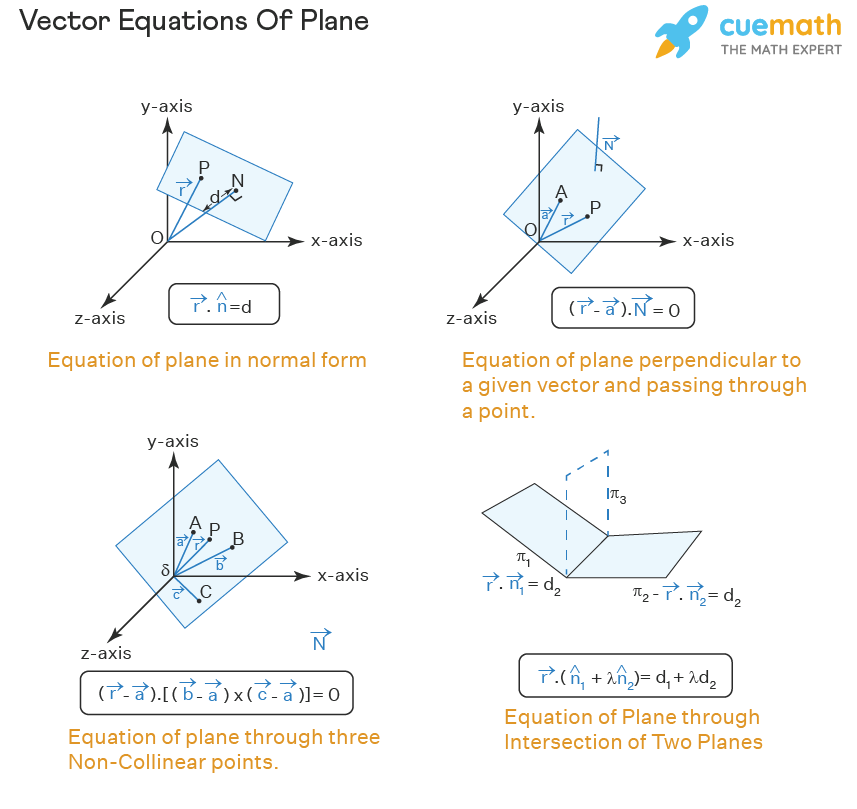
*This image displays four key scenarios for finding the equation of a plane:
- Normal Form: , defined by the unit normal and distance from origin.
- Point-Normal Form: , defined by a point and a normal vector.
- Three-Point Form: , using the scalar triple product.
- Intersection of Two Planes: This is a topic we will cover later.*
Conclusion
Today we've moved from lines to planes, and you've learned how to describe these 2D surfaces in 3D space using both vector and Cartesian equations. The underlying logic is consistent and builds upon your prior knowledge of vector operations.
Here are the key takeaways:
- The normal vector is the most crucial element in defining a plane's orientation.
- Point-Normal Form: The most fundamental form, requiring a point and a normal , is .
- Three-Point Form: Given three points, you can find the normal vector using the cross product of two vectors formed by the points, then use the point-normal form. The determinant method is the most direct way to solve this.
- The coefficients in the Cartesian equation are the direction ratios of the normal vector.
In our next lesson, we will use these equations to solve more complex geometric problems. We will learn how to calculate the angle between two lines, two planes, or a line and a plane, which directly applies the concepts of direction and normal vectors we've mastered.