Welcome to your next lesson in the Vectors & 3D Geometry module. In our previous session, we mastered the scalar triple product, using it to calculate volumes and check for the coplanarity of vectors. This showed how vector operations can describe complex spatial relationships. Today, we will apply our vector knowledge to a more fundamental geometric object: the straight line in three-dimensional space.
Your goal for this lesson is to learn how to find the vector and Cartesian equations of a line in 3D. This is a cornerstone of 3D geometry and a frequently tested topic in the MHT-CET. We will break down how to derive these equations from first principles and then apply them to the types of problems you'll encounter in your exam, ensuring you can navigate them confidently.
1. The Ingredients of a 3D Line
Just like in 2D coordinate geometry, a line in 3D space is uniquely determined by two pieces of information:
- A fixed point that the line passes through.
- The direction of the line.
In 3D, we specify the direction using a vector that is parallel to the line. The components of this parallel vector are called Direction Ratios (DRs). If we are given two points on the line, say and , the direction ratios of the line are simply the components of the vector , which are .
For a quick and exam-oriented refresher on Direction Ratios and their cousins, Direction Cosines (DCs), the following video is excellent.
LINE in 3D Geometry 🔥 | Most Scoring Topic | LIVE Today 7:30 PM | MHT-CET & JEE
This video from EquationX, tailored for MHT-CET and JEE, begins by explaining exactly how to find Direction Ratios (DRs) and Direction Cosines (DCs) from two points.
Watch the initial segment from the beginning. Focus on how to calculate the DRs (a, b, c) by subtracting coordinates, and the process of finding the DCs (l, m, n) by dividing the DRs by the magnitude \sqrt{a^2+b^2+c^2}.
2. The Vector Equation of a Line
The vector equation is an elegant way to describe a line using position vectors. Imagine a line in space that passes through a point P and is parallel to a direction vector .
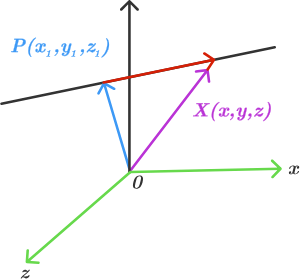
Let the position vector of the known point P be . Now, let's take any other arbitrary point X on the line, with position vector . The vector connecting P to X, which is , must lie along the line. Since the line is parallel to the direction vector , the vector must be a scalar multiple of .
We can write this relationship as:
where is a scalar parameter.
From the triangle law of vector addition on , we have . Substituting our known vectors:
This gives us the standard vector equation of a line:
Here, is the position vector of a point on the line, and is the direction vector.
To see this derived and applied to an example, the following video provides a very clear, step-by-step explanation.
How To Find The Vector Equation of a Line and Symmetric & Parametric Equations
This video from The Organic Chemistry Tutor clearly explains the derivation of the vector equation of a line.
Watch the segment from the introduction. Pay attention to how the vector sum \vec{r} = \vec{r_0} + t\vec{v} (using t instead of \lambda and \vec{v} instead of \vec{b}) is constructed and then applied to a problem.
3. The Cartesian Equation of a Line
The Cartesian equation expresses the same relationship using the x, y, and z coordinates. It can be derived directly from the vector equation.
Let the known point be , so its position vector is .
Let the direction ratios of the line be , so the direction vector is .
Let the general point on the line be , so its position vector is .
Substituting these into the vector equation :
By comparing the coefficients of , , and , we get the parametric equations:
If we solve each of these for the parameter , we get:
Since is the same in all three, we can set them equal to each other to get the Cartesian (or symmetric) equation of the line:

4. The Two Fundamental Cases
All problems on finding the equation of a line boil down to one of two scenarios. The GeeksForGeeks article below is a good reference for both, presented in a clear, structured way.
This article from GeeksForGeeks systematically covers the main forms and cases for the equation of a line in 3D.
Focus on the two main scenarios: Given a Point and a Parallel Vector: Read the sections on this case for both the Cartesian form and the Vector form. Given Two Points: Read the sections for this case for both the Cartesian form and the Vector form. Note how finding the direction vector (x_2 - x_1, y_2 - y_1, z_2 - z_1) is the key first step.
5. Exam Focus: Conversions and Non-Standard Forms
For competitive exams like the MHT-CET, a common task is to convert between Cartesian and vector forms. More importantly, questions often present the Cartesian equation in a "non-pure" form, with coefficients on x, y, or z, or with terms rearranged. You must first convert it to the standard symmetric form before you can correctly identify the point and the direction ratios.
The following video is essential viewing as it specifically addresses these exam-oriented tricks.
LINE in 3D Geometry 🔥 | Most Scoring Topic | LIVE Today 7:30 PM | MHT-CET & JEE
Let's return to the EquationX video. The instructor now moves into the core topic, explaining conversions with a focus on MHT-CET question patterns.
This is a critical segment. First, watch the explanation of the standard forms and the conversion process from this point. Next, pay very close attention to how to handle non-standard equations from this section. The instructor shows how to manipulate an equation like 2x + 1 / 3 = 1 - y / 2 = z / 1 into its "purest form" by dividing by coefficients and adjusting signs. Finally, see this skill applied directly to a past MHT-CET question from this example. This will solidify your understanding of what to expect.
Mastering this manipulation is key. Always ensure the coefficients of x, y, and z are +1 before reading the direction ratios from the denominators.
Conclusion
In this lesson, we have built a solid foundation for describing lines in three dimensions. You now have the tools to define a line and switch between its different mathematical representations.
Here are your key takeaways:
- A line in 3D is defined by a point on the line and a parallel direction vector.
- The vector equation is , where is the position vector of the point and is the direction vector.
- The Cartesian equation is , where is the point and are the direction ratios.
- For exams, always convert non-standard Cartesian equations to the pure symmetric form before extracting the point or direction ratios.
In our next lesson, we will expand our study of 3D geometry by moving from one-dimensional lines to two-dimensional surfaces: planes. We will discover that they, too, have distinct vector and Cartesian equations.